
Between Augustine and Anselm lies six hundred years often dismissed as a philosophical wasteland — yet one thinker built, from scratch, one of the most ambitious systems in Western thought. Who was John Scotus Eriugena, and why did the Church order his book burned?
Key Takeaways
- John Scotus Eriugena (c. 810–877) is the only original philosopher in the six-hundred-year gap between Augustine and Anselm — the sole green tree in an intellectual desert. In this entire period, Boethius translated texts; Isidore of Seville compiled encyclopedias; neither produced genuinely new philosophy. Eriugena alone built something original: a complete, systematic account of all reality — God, creation, knowledge, and the soul’s return — constructed through rigorous reasoning rather than commentary or compilation. His attempt to create a coherent, systematic Christian Neoplatonism was the most ambitious philosophical project undertaken between the fall of Rome and the thirteenth century.
- His starting claim was the boldest statement any medieval philosopher had made: ‘True religion is true philosophy, and true philosophy is true religion.’ Faith and reason are not opposed; they are two equal paths to the same truth. Where the entire tradition after Augustine had held that faith is the supreme authority and reason merely its servant, Eriugena insisted that if reason and faith appear to conflict, at least one of them — possibly the traditional interpretation of faith — contains an error. This single claim was the philosophical foundation from which his entire system was built, and it was already enough to mark him as a danger to the institutional Church.
- Reality — which Eriugena calls ‘nature’ — divides into ‘things that are’ and ‘things that are not’; but ‘things that are not’ does not mean nothingness. There is no nothingness in his system. The phrase has four precise meanings: sinful persons (whose integral human nature is absent); changing physical objects (which are always in flux, never stably being); potential beings (which exist only as unactualized capacity); and God (who surpasses being from infinite excess, not from deficiency). Only stable, intelligible reality — the Primordial Causes in God’s mind — constitutes full ‘being.’
- Because God is beyond all categories, ordinary language fails completely when applied to God — and Eriugena’s three-step solution is one of the most philosophically precise responses to theological language ever formulated. Affirmation alone is misleading (calling God ‘good’ in the same sense that humans, animals, or even spinach are good). Negation alone is equally misleading (sounding as if God is evil or absent). Together, affirmation and negation point beyond themselves toward a super-predicate: God is super-good, super-being, superessential — a reality that our language can only circle around without directly naming. This is not evasion; it is the most precise thing that can be said.
- The world is God’s theophany — his deliberate self-manifestation — but this is more complex than it first appears. God does not appear through the world in the way a hidden object appears through a window. Rather, God actively shows himself through the world as the medium of his self-expression — and we, our minds and reason included, are part of that theophany. We are not external observers looking at God through creation; we are inside the self-expression. Furthermore, knowledge of any created thing is therefore, at a deeper level, knowledge of God — not God as he is in his superessential nature, but God as he has chosen to make himself accessible to rational creatures.
- Eriugena’s system, for all its philosophical brilliance, proved to be a dead end for Christian theology — and this failure was historically necessary and productive. By following Neoplatonic logic faithfully and rigorously, Eriugena demonstrated with precision exactly where and why Neoplatonism and Christianity are incompatible: God and world become inseparable (pantheism); the creator-creature distinction dissolves; personal survival after death is denied; evil becomes unreal; theological authority collapses into private mysticism. His work demonstrated definitively that ‘the attempt to construct a Christian metaphysics on a Platonic basis was a blind alley’ — clearing the ground for Thomas Aquinas’s Aristotelian approach a century later.
Table of Contents
Introduction — A Philosopher in a Desert
Most histories of medieval philosophy move from Augustine (d. 430) directly to Anselm (b. 1033) as if the six centuries between them were philosophically empty. In one sense they were. The Dark Ages saw the collapse of the Roman educational infrastructure, the near-disappearance of Greek literacy in the West, and the loss of almost the entire inheritance of classical philosophy. Boethius translated Aristotle’s logic before being executed; Isidore of Seville compiled encyclopedias; neither produced genuinely new philosophical ideas.
Eriugena is the exception. In that entire six-hundred-year intellectual silence, he alone built something original — a comprehensive, systematic philosophical account of all reality. He did not comment on existing texts; he constructed. He did not compile what others had said; he thought for himself, using the materials available to him (Neoplatonism, Christian doctrine, Greek theology he could read in the original) to build a complete picture of the universe.
The desert and the tree: Picture a vast desert — no blade of grass, no water, nothing alive in any direction for hundreds of miles. And then, in the exact centre of that desert: a single magnificent tree, green and alive. That tree is Eriugena. He stands alone in the most intellectually sparse period of Western history as the one genuinely original thinker — not because the others were unintelligent, but because the tools had been lost, the books were gone, and the infrastructure for original thought had collapsed.
His importance is twofold. First, in his own right: he produced a philosophical system of genuine power and originality. Second, historically: by following Neoplatonic premises to their logical conclusions with maximum rigour, he demonstrated exactly why Neoplatonism cannot serve as the foundation for Christian theology. This negative demonstration was as philosophically valuable as any positive achievement — it cleared the ground for the Aristotelian synthesis that Thomas Aquinas would later build.
His name carries its own history. ‘John’ was his given name. ‘Scotus’ comes from the Latin for Irish — in the ninth century, Ireland was called Scotia Maior, and its inhabitants were Scoti. ‘Erigena’ derives from the Irish ‘Eire’ and means ‘Irish-born.’ His full name therefore means: John the Irishman, born in Ireland. He had learned Greek at an Irish monastery at a time when Greek literacy had virtually disappeared from Western Europe — a skill that would prove decisive for everything he did.
1. Life — From the Palace School to Condemned Books
Around 847, Eriugena moved from Ireland to France and established himself at the Palace School in Paris — the prestigious centre of learning that Charlemagne had founded. He came under the patronage of King Charles the Bald, who found in him an intellectual companion of unusual quality. This royal protection would prove crucial, because Eriugena’s career was immediately marked by controversy.
Controversy One — Predestination
The ninth century was exercised by a dangerous theological position: double predestination, advocated by a monk named Gottschalk. If God has predestined every soul either to heaven or to hell before they are born — and nothing they do in this life can change their destination — then prayer, the sacraments, the Church, and all moral effort are rendered meaningless.
Archbishop Hincmar of Rheims and Bishop Pardulus of Laon commissioned Eriugena to write a refutation. He did so in On Divine Predestination. His argument was philosophically sophisticated: God’s perfect goodness cannot be the source of damnation; God exists outside time and therefore cannot ‘fore’-know or ‘pre’-destine (these are temporal words that cannot apply to a timeless being); and human nature, created rational, was created free.
The irony: by defending human freedom against Gottschalk’s extreme determinism, Eriugena was accused of going too far in the opposite direction — of Pelagianism, the heresy of claiming humans can achieve salvation through their own unaided effort. His treatise was condemned in 855 by the Council of Valence, which dismissed it with the phrase ‘Irish porridge’ (pultes Scottorum). Despite this condemnation, Charles the Bald continued to protect him — the king valued his scholar too much to surrender him to ecclesiastical politics.
Controversy Two — The Eucharist
Eriugena became embroiled in a dispute about the Eucharist — the central ritual of Christianity in which bread and wine are consecrated and, according to Catholic teaching, genuinely become the body and blood of Christ. Eriugena argued that the Eucharist is symbolic and commemorative, not a literal transformation.
The Church ordered his book on the subject to be burned. The order was carried out so effectively that not a single copy survives today. Eriugena had committed the double offence of being philosophically correct enough to identify real problems with Catholic doctrine and insufficiently cautious about saying so publicly.
The Turn to Translation — and Philosophy
Perhaps as a result of these controversies, Eriugena turned to what seemed like safer ground: translating Greek philosophical texts that scholars in Paris had acquired but could not read. Among the texts he translated were the works attributed to Dionysius the Areopagite — allegedly Paul’s convert at Athens, therefore a figure of near-apostolic authority.
After this translation work, Eriugena turned to the philosophical project for which he is chiefly remembered: On the Division of Nature (Periphyseon), written as a dialogue between a Teacher (Nutritor) and a Student (Alumnus). It is the most ambitious philosophical work produced in Western Europe between Augustine and Aquinas.
2. The Founding Claim — True Religion Is True Philosophy
Before entering his metaphysics, Eriugena states a claim that sets everything else in motion. It is worth pausing on it because it is both philosophically significant and extraordinarily bold for its era:
‘True religion is true philosophy, and true philosophy is true religion.’ — Eriugena. Reason and faith are not opposed, not in competition, and not hierarchically ordered with faith above. They are two equally valid paths to the same truth. A conflict between them signals an error in at least one of them — and the error might be in a traditional interpretation of faith, not only in reason.
The standard medieval position was that faith is the ultimate authority and reason is its subordinate servant. If reason appeared to contradict faith, reason was wrong — always. Eriugena’s position was different: both paths are equal, and both are capable of error. This meant that when he followed a philosophical argument to a conclusion that appeared to conflict with Church teaching, he was not simply deferring — he was genuinely reasoning.
This is the philosophical foundation of the entire On the Division of Nature. It is also the source of every problem that follows. An age committed to institutional Christianity as the supreme authority was not ready for a thinker who genuinely meant what he said about reason and faith being equal.
3. The Nature of Reality — Things That Are and Things That Are Not
Eriugena begins with the most fundamental question: what is reality? His answer starts with a division. Everything that exists — the totality of reality, which he calls ‘nature’ (natura) — divides into two categories: things that are (ea quae sunt) and things that are not (ea quae non sunt). These two together make up all of reality.
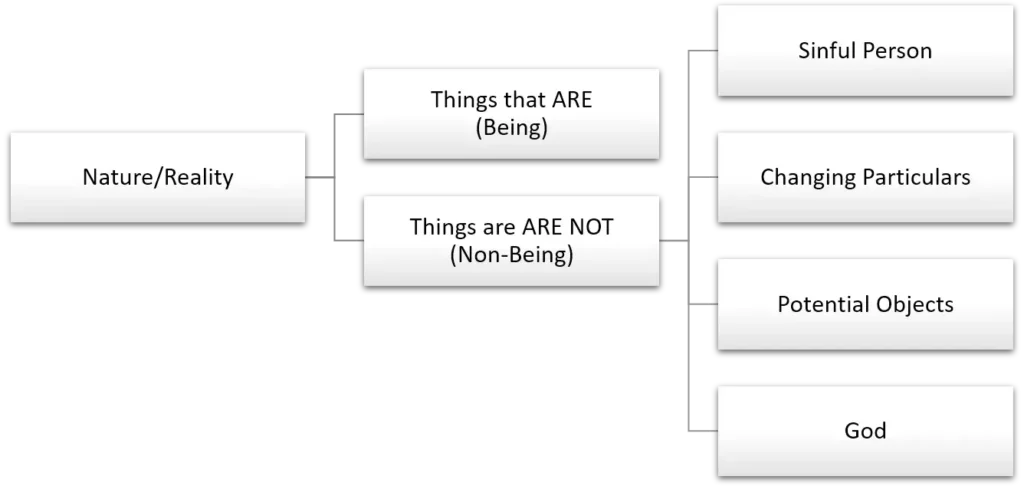
This raises an immediate puzzle. How can things that are not be part of reality? If they are not, they are nothing — and nothing cannot be part of something. Eriugena’s response is crucial: ‘things that are not’ does not mean nothingness. There is no pure nothingness in his system. The phrase has four distinct and specific meanings, each capturing a different mode of incomplete, unstable, or transcendent existence.
| Mode of Non-Being | What It Means | Illustration |
|---|---|---|
| Sinful persons | The human being exists physically — walks, speaks, thinks. But their integral nature — what makes them a complete, genuine human being (rationality, love of God, expression of the divine image) — has been compromised or destroyed by sin. The physical shell exists; the true nature is absent. | Like a guitar that has been physically shattered. It exists — you can see it, touch it. But its integral nature — the capacity to make music — is gone. It exists in some sense; it does not exist in the sense that matters. We intuitively sense this when we say ‘no human being could do that’ — pointing to an absence of integral humanity, not physical non-existence. |
| Changing physical objects | Physical things are always in flux — continuously changing, never stable. A flower is blooming right now. But it was different yesterday, and will be different tomorrow. It ‘is’ but also ‘is not’ — it is always in the process of becoming, never simply and stably being. Heraclitus: you cannot step into the same river twice. | The flower in full bloom: beautiful now, but already fading. If you try to describe exactly what it is, you find it has already changed. It participates in both being and non-being simultaneously — that is precisely what it means to be a changing physical object. This is the class Plato was most concerned with when he said the physical world falls short of genuine knowledge and genuine being. |
| Potential beings | Something that exists only as potential — a genuine capacity not yet made actual. Potential is real (a seed genuinely has the capacity to become a tree), but the actualized thing does not yet exist. It is neither nothing nor full being. | A seed in the ground: the great oak tree is somehow present in it, as potential. But the oak does not yet exist. You cannot sit under it for shade; you cannot carve it into timber. The potential is real; the actuality is not-yet. Aristotle introduced this distinction (potential vs actual), and Eriugena uses it to carve out a third mode of non-being. |
| God — beyond being | God surpasses all our categories, all our concepts, all our language — not because God lacks something (unlike the three above), but because God infinitely exceeds everything our finite minds can reach. God is not less than being; God is more than being. This is the most important mode of non-being. | Saying God “is good” is as misleading as saying Bernini’s Apollo and Daphne is “a nice statue.” The statement is technically true—Apollo and Daphne is a statue, and God is good. But it is so inadequate that it becomes misleading. If that is what “good” means, then God is not good in that sense. God is not good the way humans are good, the way a kind action is good, or even the way spinach is good. God belongs to a completely different order of reality. |
The Scale of Reality
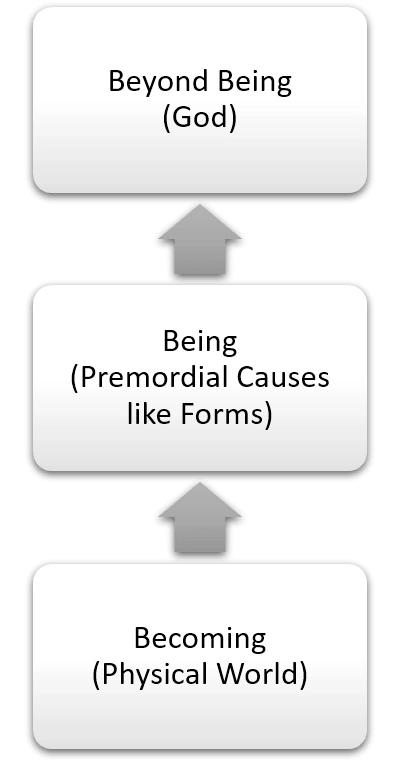
With these four modes in hand, Eriugena’s picture of reality arranges itself as a scale:
- Nothingness: Cancelled entirely. It has no place in the system.
- Becoming (lower non-being): Sinful persons (lacking integral nature), changing physical objects (lacking stability), potential beings (lacking actualization). Real but incomplete.
- Being: The stable intelligible reality — the Primordial Causes or divine archetypes. The only things that ‘truly are, which are comprehended by the intellect alone’ (Eriugena’s own formulation).
- Beyond Being: God — not absent, not deficient, but infinitely exceeding all our categories. God is ‘beyond being’ the way the ocean is beyond a cup: not because the ocean is less, but because it is immeasurably more.
Note that God appears in both ‘things that are not’ (because God exceeds being) and ‘things that are’ (as the ground and source of all being). This is not inconsistency — it reflects two different perspectives on the same God: seen from our cognitive standpoint, God surpasses all our concepts; seen from the metaphysical standpoint of all reality, God is the origin and sustainer of everything.
4. God Beyond Being — The Language Problem
Once we accept that God is beyond being and beyond all our categories, we face a problem that Eriugena sees very clearly: how can we say anything meaningful about God at all? Every word we possess is drawn from our finite human experience. Every concept gets its meaning from its opposite. ‘Good’ is meaningful only in contrast to ‘bad’; ‘being’ only in contrast to ‘non-being’; ‘eternal’ only in contrast to ‘temporal.’ But God has no opposite. Nothing stands in relation to God the way ‘bad’ stands in relation to ‘good.’
This is a genuine philosophical problem — not a rhetorical question. If we apply our ordinary language to God, we inevitably make God sound like a very excellent version of ordinary things: a very good being, a very powerful being, a very knowledgeable being. But this is precisely wrong. God is not merely a superlative version of the ordinary. God is in a completely different order.
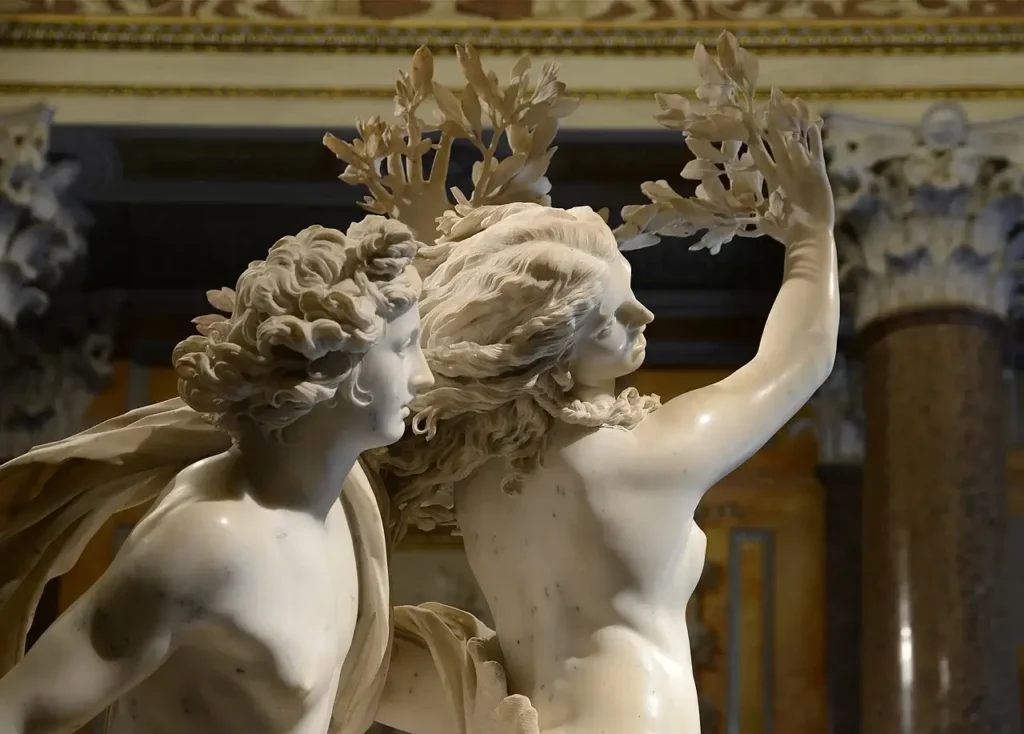
The Bernini analogy: Imagine someone standing before Bernini’s Apollo and Daphne—one of the greatest sculptures ever created—and saying, “That’s quite a nice statue.” Another person replies, “A nice statue, indeed! That barely begins to describe it.” The second person is pointing out that the vocabulary we use for ordinary statues—”nice,” “well-made,” “beautiful”—is simply inadequate for Bernini’s masterpiece. If an ordinary garden statue is a statue, then in one sense Apollo and Daphne is also a statue. Yet Bernini’s work transcends the category so completely that calling it merely “a nice statue” is technically true but profoundly misleading. The same logic applies to God. “God is good” is technically true—God is more like goodness than like evil. But saying God is good in the same sense that kind people are good, that a pleasant day is good, or even that spinach is good, is as misleading as describing Apollo and Daphne as merely “a nice statue.” The statement is true, but so inadequate that it distorts the reality it is trying to describe.
Eriugena’s solution is a three-step process — the most sophisticated theological language system produced in the early medieval period:
| Step | What You Do – and Why | The Problem It Solves and the Problem It Raises |
|---|---|---|
| Affirmation (Cataphatic) | State positive things about God: ‘God is good,’ ‘God is being,’ ‘God is truth.’ These statements are not false — they point in the right direction. God is more like goodness than like evil; more like being than like nothingness. They are useful as starting points. | But every word we use gets its meaning from its opposite. ‘Good’ is meaningful only in contrast to ‘bad.’ ‘Being’ is meaningful only in contrast to ‘non-being.’ But God has no opposite. Applying our ordinary words to God without qualification makes God sound like just a very excellent member of the ordinary world. Like calling the Last Judgment ‘a pretty picture.’ |
| Negation (Apophatic) | Correct the positive: ‘God is not good (not good in the ordinary sense),’ ‘God is not being (not being as created things are being).’ These negations prevent the dangerous literalism of taking positive statements at face value. | But negation alone is equally misleading in the opposite direction. It sounds as if God is evil or non-existent. We do not mean God is not good because God is bad; we mean God is not good because God is beyond the ordinary meaning of goodness. Negation without affirmation destroys instead of clarifying. |
| Super-predicate (The Resolution) | Hold affirmation and negation together, and they point beyond themselves toward a third level: God is super-good, super-being, super-essential, more than true, more than eternal. These super-predicates acknowledge what is true in both the affirmation and negation while transcending both. | ‘God is called essence, but properly he is not essence, to whom nothing is opposed; therefore he is superessential. Likewise he is called goodness, but properly he is not goodness; for evil is opposed to goodness; therefore he is supergood.’ (Eriugena, On the Division of Nature). The super-predicate names the reality that ordinary language can only circle around. |
The result: God is superessential, supergood, more than true, more than eternal. These super-predicates are not more words that fail in the same way as ordinary words. They are explicit acknowledgments of failure — statements that name the reality our language can only point toward without grasping. This is philosophically important beyond theology: it is an early and serious engagement with the limits of language itself — a problem that would become central in modern philosophy through Wittgenstein, Frege, and Derrida.
5. The Creation Paradox — How Can an Unchanging God Create?
Having established that God is beyond being and beyond ordinary language, Eriugena confronts a problem that sits at the heart of any theistic metaphysics. If God is absolutely unchanging — immutable, simple, timeless — how can God create a world? Creating seems to require acting, deciding, initiating a new state of affairs. But an unchanging God cannot begin anything. The very concept of ‘beginning to create’ implies change.
The dialogue in On the Division of Nature sets up this problem with remarkable precision. The Student says: ‘I cannot grant motion to God, who alone is immutable… but I cannot deny making of him, when he is the maker of all things.’ And when the Teacher asks whether the student can separate motion from making, the Student replies: ‘Not that indeed, inasmuch as I see that they are inseparable from each other.’ The problem is formally identified: if making requires motion, and God cannot move, how does God make anything?
Essential versus Accidental Qualities
The resolution begins with a classical philosophical distinction: the difference between essential and accidental qualities.
An essential quality is what a thing must have to be what it is. A triangle must have three sides — remove this and it is no longer a triangle. A human being must be a rational animal — remove this and you no longer have a human being. Essential qualities define identity.
An accidental quality is what a thing can have or lack without ceasing to be what it is. A triangle can be red or blue; large or small — these vary without making it stop being a triangle. A person can be awake or asleep, standing or sitting — these change without changing their identity.
Now apply this to God’s act of creating. If God created the world ‘at a moment’ — if there was a time when God existed without creating and then began to create — then creating would be an accidental quality of God. Something that came to God at a point in time. But accidents imply: something came from outside God (impossible — nothing is outside God), or God underwent change (impossible — God is immutable), or God is composite (essence + accident, which contradicts God’s absolute simplicity). Any of these consequences destroys the concept of God as traditionally understood.
Therefore, Eriugena argues, creating cannot be an accidental quality. It must be God’s essential nature. God does not occasionally, contingently, or at a specific moment create — God essentially, necessarily, always creates. ‘In God there is not one thing which is being and another making, but for him being itself is also making.’
Co-Eternal and Co-Essential
From this follows the most striking conclusion of Eriugena’s metaphysics: God and creation are co-eternal and co-essential. There was never a moment when God was without creation, because time itself is part of creation. ‘Before creation’ is a phrase that presupposes time — and time did not exist before creation. The question ‘What was God doing before creation?’ is grammatically coherent but metaphysically empty: there was no ‘before.’
The sun and its light: The sun and its light are inseparable. The sun does not first exist, and then decide to produce light. Producing light is what a sun is and does — they are co-essential and co-eternal. You cannot have a sun that does not produce light; you cannot have this light without this sun. They always exist together because each is the essential expression of the other. God and creation are related in exactly this way: God without creation would not be God; creation without God would not exist for an instant.
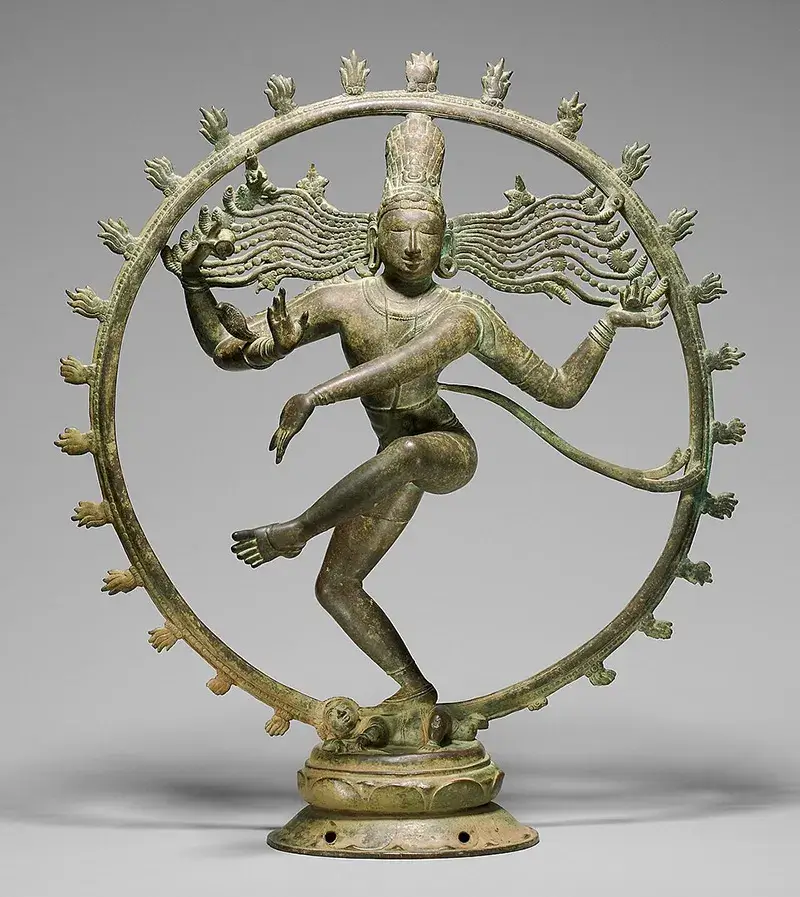
The dancer and the dance: The dance cannot be separated from the dancer. Where there is a dancer in motion, there is dance; where there is dance, there is a dancer. Neither precedes the other. Neither outlasts the other. They are identical as an event. God IS the creative act — not a being who occasionally performs creation, but a being whose very being is the act of creating. ‘When we hear that God made everything, we ought to understand nothing other than that God is in all things, that is, subsists as the essence of all things.’
The practical upshot: God does not make the world and then withdraw from it, like a carpenter who builds a table and walks away leaving the table to exist independently. God is the world’s living, continuous, essential ground. Every thing that exists depends on God at every moment for its being. ‘Only he himself truly is per se, and only he himself is everything which is truly said to be in those things which are.’
6. Theophany — The World as God’s Self-Manifestation
Given that God and creation are co-essential and co-eternal, what exactly is the world in relation to God? Eriugena gives this a precise name: theophany. The word combines theos (God) and phainein (to appear). The world is God’s appearance — the way God shows himself to rational creatures.
But ‘appearance’ can mean two completely different things, and the distinction matters enormously.
- Illusory appearance: Something appears to be what it is not. A rope lying on the road appears, in dim light, to be a snake. The snake is not really there — the appearance is a mistake. No one would call this a ‘revelation’ of anything.
- Deliberate, creative appearance: A teacher appears before students and displays their knowledge — reveals it, makes it visible. An actor appears on stage and embodies a character. The appearance is intentional, genuine, and reveals something real about the one who appears.
God’s theophany is entirely of the second kind. It is God’s deliberate, creative self-disclosure. The world is not a mistake we make about God, not an illusion to be seen through. It is ‘the way God chooses to reveal Himself’: ‘God is not only said to be divine essence, but also that mode by which he shows himself in a certain manner to the intellectual and rational creature.’
The Active Voice — A Crucial Distinction
The critical point: Notice the active voice: God shows himself. Not: ‘the world shows God to those who look.’ The agency is God’s. God is not passively available to be discovered through creation; God actively discloses himself through it. This makes theophany an act of divine generosity — a condescension of divine wisdom to human nature, not a human achievement of discovery.
The Mountain Views — The Limits of All Experience of God
One of the most philosophically rich passages in Eriugena’s discussion of theophany concerns the fundamental limitation of all knowledge of God — including, remarkably, God’s own self-knowledge in a certain sense.
Driving past a mountain: Imagine driving along a highway, getting a succession of views of a distant mountain. You stop at different points; the mountain looks different from each position. Which view is ‘correct’? The answer is: all of them and none of them. All: each is a genuine view of the actual mountain. None: none is more than a view. Now you ask: would the totality of all possible views of the mountain — every perspective from every angle — give you an adequate experience of the mountain? No, for two reasons: (1) You could never actually experience all possible views; (2) even if you could, they would still be a plurality of views, whereas the mountain itself is a single, unified, undivided thing. You would have a collection of experiences; you would not have the mountain.
Perhaps, then, the mountain’s own experience of itself would be completely adequate? Here Eriugena makes a striking philosophical observation: even this would not fully resolve the problem. The difficulty is not with the observer — it is with the nature of experience itself. Experience is inevitably experience of something. It is the nature of intellect — any intellect, including the mountain’s own intellect if it had one — to be ‘at a distance,’ to be ‘of things’ rather than simply being things. The intellect always divides, classifies, pluralizes. Experience is inherently perspectival.
Therefore: there is a genuine contrast between any experience of the mountain (from any position, including the mountain’s own) and the mountain itself — complete, unified, undivided. Apply this to God: there is a contrast between any experience of God — ours or indeed God’s own — and God Himself, in his superessential, complete, unitary nature. This is why the progression of nature must begin: only by creating his own mind (Division II) does God become conscious and begin to know himself.
The Mirrors — Many Mansions in One House
A room of mirrors: Imagine a room hung with many mirrors. These mirrors reflect one another — each mirror reflects the reflections of all the other mirrors, creating the impression of an endless vista of apartments. The house is one and the same, yet it appears multiple and divided to those who dwell in it. Eriugena says this is precisely what Jesus meant when he said: ‘In my Father’s house are many mansions.’ The house — God, the superessential unity — is single. But to the rational creatures dwelling in it (who, by their nature, divide and classify), it appears as a vast multiplicity of distinct things.
The mirrors analogy captures something important about why the theophany cannot be simply set aside. If you grant that mirrors exist, you must accept their reflections as genuine — it is the nature of mirrors to reflect. Similarly: if you grant the existence of rational human minds, you must accept that those minds divide and classify the superessential unity into distinct substances in various relations. It is the nature of rational creatures to divide, distinguish, and categorize. The multiplicity of the world is not a mistake or an illusion — it is what the divine unity looks like from the inside, to a mind that can only know things by distinguishing them.
We Are Part of the Theophany
This leads to a philosophically important implication. If the entire world is God’s theophany — his self-expression — then we, and our minds, are also part of that theophany. We are not observers standing outside the self-expression, looking at God through it. We are inside it. Our reason, our logic, our categories — these are themselves part of what God is expressing.
We cannot step outside the theophany to observe it from a neutral position. There is no neutral position. And this means that our knowledge of any created thing is, at a deeper level, knowledge of God — not God in his superessential nature, but God as he has externalized himself in creation. Knowledge is therefore, fundamentally, divine illumination.
7. Knowledge as Divine Illumination
From the theophany, a further principle follows with philosophical necessity: all genuine knowledge is illumination. Since everything that exists is an aspect of God’s nature reflected from some perspective or other, then in knowing the things around us we know God — not God as he is in his superessential nature, but God insofar as he has externalized himself.
The sun and the air: The sun can be seen only through the medium of air. Yet we do not see the air — we see the light that pervades it. We see by virtue of the combination of sun and air, though the roles of each are different: the air is the passive medium; the sun is the active source. Knowledge works the same way. Created things (including our own minds) are the medium; God is the active source. When we know any created thing, we know it because God illumines our minds through the medium of his self-expression. What we call ‘our knowledge’ is, at the deepest level, God making himself known through the things he has created and through the minds he has given us to perceive them.
There is a deeper philosophical principle at work here: the cognitive status of an object reflects its metaphysical status. If a thing is metaphysically independent — if it exists in its own right, depending on nothing — then it can be known completely without reference to anything else. But if a thing is metaphysically dependent — if it exists only through participation in something beyond itself — then it can be fully understood only through what it depends on.
Fido — the dog: Consider a particular dog, Fido. Can Fido be known completely by studying him in isolation? Clearly not. To understand him fully, you must know the principles of mammalian biology, the nature of dogs as a species, and the conditions that make his existence possible. Fido is not truly himself per se—he does not exist or make sense entirely by himself. Christianity agrees with this much: Fido’s being depends completely on God. But Eriugena goes a step further. If Fido is an appendage to God—dependent on and included within God—then we cannot know God completely without knowing Fido, just as we cannot know Fido completely without knowing God. Dependence, according to Eriugena, cannot be one-way.
This is why knowledge is illumination: in knowing created things, we are knowing something about God — who they depend on, whose nature they reflect, whose self-expression they are.
8. God Does Not Know Himself at Division I
One of the most philosophically striking claims in Eriugena’s entire system concerns the question of divine self-knowledge. We might naturally assume that an omniscient God knows himself perfectly above all things. Eriugena says otherwise — at the most fundamental level, God does not know himself. This is not a statement about limitation; it is a statement about transcendence.
The argument turns on what knowledge requires. All knowledge involves a structure: a knowing subject and a known object. When I know something, there is a knower (me) and a thing known (whatever I am attending to). This subject-object duality is constitutive of what knowledge is. Remove it and there is no knowledge — just identity.
God at Division I — God as the ultimate source, before the progression into the Primordial Causes — is absolutely simple: no parts, no divisions, no internal structures of any kind. Imposing a subject-object duality on this absolute simplicity would be to introduce a division that contradicts the very premise. ‘In Himself, God is not conscious; He does not know Himself.’ The progression of nature begins only when God creates His own mind — when He becomes conscious and thinks the archetypes at Division II. Self-knowledge enters at the second level, not the first.
This does not mean God is ignorant at Division I. It means God transcends the subject-object structure that knowledge requires. This is consistent with the three-step language: we say God knows (affirmation), God does not know (negation, correcting any anthropomorphic reading), God super-knows (super-predicate, pointing toward a reality that exceeds both). At the level of Division II — through the Primordial Causes — God is conscious, self-knowing, and fully articulated. But the deepest level, Division I, is beyond even that.
9. The Four Divisions of Nature — The Complete System
Having established these foundations, Eriugena presents his comprehensive framework. He divides nature — all of reality — into four divisions based on the logical possibilities of ‘creates’ and ‘is created.’ These four divisions together describe the complete arc of reality from its source to its destination.
| # | Definition | What It Is | Critical Philosophical Point |
|---|---|---|---|
| I | CREATES but is NOT CREATED | God as the ultimate, unfathomable source. At this level, God is beyond being, beyond all categories — and, crucially, not yet conscious or self-knowing. God does not know Himself at this level: the very structure of knowledge (a knower distinct from the known) requires a duality that God’s absolute unity makes impossible. The progression of nature begins only when God creates His own mind — when He becomes conscious and thinks the archetypes. | This is the most philosophically radical point in the entire system: at the deepest level, God does not know Himself. Not because of ignorance, but because knowledge requires a subject-object distinction that contradicts God’s absolute simplicity. God transcends even self-knowledge here. |
| II | IS CREATED and CREATES | The Primordial Causes — God’s own ideas or archetypes — the level at which God becomes conscious and self-knowing. These are: goodness, being, life, wisdom, truth, intelligence, reason, virtue, justice, health, greatness, omnipotence, eternity, and peace. They are ‘created’ in the sense that they arise through God’s thinking; they in turn ‘create’ by giving structure and essence to physical things. | Unlike Plato’s Forms (which existed independently and even limited the Demiurge), these Primordial Causes are entirely within God’s mind — they are the divine mind. They are not independent existents. A healthy college student who is also good and virtuous participates in the archetypes of health, goodness, and virtue — these characteristics have been produced in him by the action of the Primordial Causes. |
| III | IS CREATED but does NOT CREATE | The physical world — the realm of time, space, and multiplicity that we experience. This world has its being through participation in the Primordial Causes, just as the Primordial Causes have their being through God’s thinking of them. Crucially, this world longs to return to its source — it is oriented from within toward God, the goal from which it came. | The physical world is real but dependent. It is not an illusion or a mistake — it is the way God has chosen to reveal Himself to rational creatures. But it is not self-sufficient; it exists only through participation. The unity of the archetype is scattered into the plurality of sense particulars the way the unity of a room is scattered into countless mirror-reflections. |
| IV | NEITHER CREATES nor IS CREATED | God as the final goal and resting place of all creation — the same God as Division I, but seen now as destination rather than source. Everything that has proceeded from God longs to return. The circle completes. | ‘God is the beginning, because all things which participate in essence are from him; but the middle, because they subsist and are moved in him and through him; the end, because they are moved to him seeking the quiet of their motion and the stability of their perfection.’ God at Division IV is the fulfilment toward which Augustine’s ‘our heart is restless until it rests in Thee’ points. |
The Primordial Causes — God’s Own Ideas
Division II — the Primordial Causes — deserves particular attention. These are the divine archetypes, and Eriugena gives us a precise list: goodness, being, life, wisdom, truth, intelligence, reason, virtue, justice, health, greatness, omnipotence, eternity, and peace. These are not independent Forms (as in Plato, where the Forms existed separately from the Demiurge and even limited his creativity). They are entirely within God’s mind — they are the divine mind. They exist only because God thinks them.
Their role is twofold. Upward: since they are God’s own ideas, when we attribute qualities to God (calling him good, wise, just), we are using these archetypal qualities — and we are, therefore, characterising God truly (though always inadequately). Downward: since they are the causes of everything in the physical world, they are the source of whatever goodness, wisdom, and justice we encounter in ordinary experience.
The college student: A healthy college student who is also good and virtuous participates, to a finite degree, in the archetypes of health, goodness, and virtue. These characteristics have been produced in him by the action of the Primordial Causes. They are not intrinsic to him — he does not possess them in himself — but he genuinely reflects them, the way a mirror genuinely reflects an image without the image being the mirror’s own. The unity of the archetype (say, virtue itself) gets broken up into the countless particular virtuous acts and virtuous persons in the world, the way the unity of a well-lit room gets broken up into countless reflections in a room of mirrors.
Reality as a Circle
The four divisions together describe a complete movement: procession from God (exitus) and return to God (reditus). This is not a static hierarchy but a dynamic, living circulation. God at Division I proceeds into Primordial Causes (Division II), which in turn give rise to the physical world (Division III), which longs to return to its source and eventually does (Division IV).
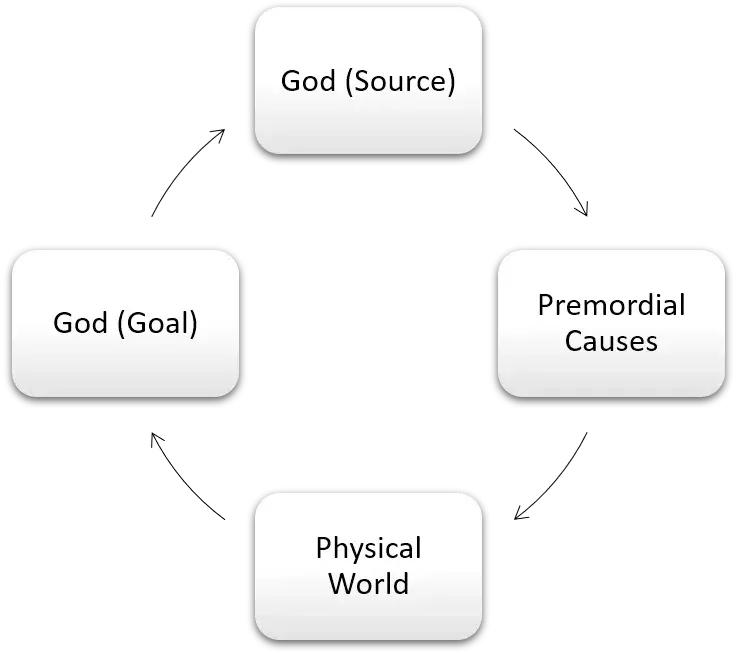
God appears at both ends of this circle: as source (Division I) and as goal (Division IV). This is not redundancy but essential to the picture. God is simultaneously the origin and the destination — and through the Primordial Causes, God is also the sustaining middle. As Eriugena writes: ‘God is the beginning, because all things which participate in essence are from him; but the middle, because they subsist and are moved in him and through him; the end, because they are moved to him seeking the quiet of their motion and the stability of their perfection.’
This maps onto three central Christian doctrines: God as creator (Division I and II), God as sustainer (the ongoing participation of all things in the Primordial Causes), and God as saviour and final destination (Division IV). Augustine’s most famous sentence finds its metaphysical ground here: ‘Our heart is restless, until it rests in Thee.’ The restlessness is not merely psychological; it is built into the metaphysical structure of all created reality. Everything in Division III has a constitutive longing for Division IV.
10. Partial Knowledge — We Cannot See the Whole
Since we are rational creatures inside the theophany — not observers outside it — our knowledge of ultimate reality is always partial, always perspectival, always limited by the position from which we see.
The mountain revisited: The mountain analogy is not just an illustration of God’s transcendence — it is a point about the nature of experience itself. Even if you could somehow gather every possible view of the mountain from every conceivable angle, those views would still be plural where the mountain is singular. They would still be ‘of’ the mountain rather than being the mountain. Experience is inevitably ‘of’ — it is the nature of intellect to stand at a distance, to classify, to distinguish, to pluralize. The very structure of knowing prevents it from coinciding with the known. This applies to our knowledge of any created thing, and with even greater force to our knowledge of God.
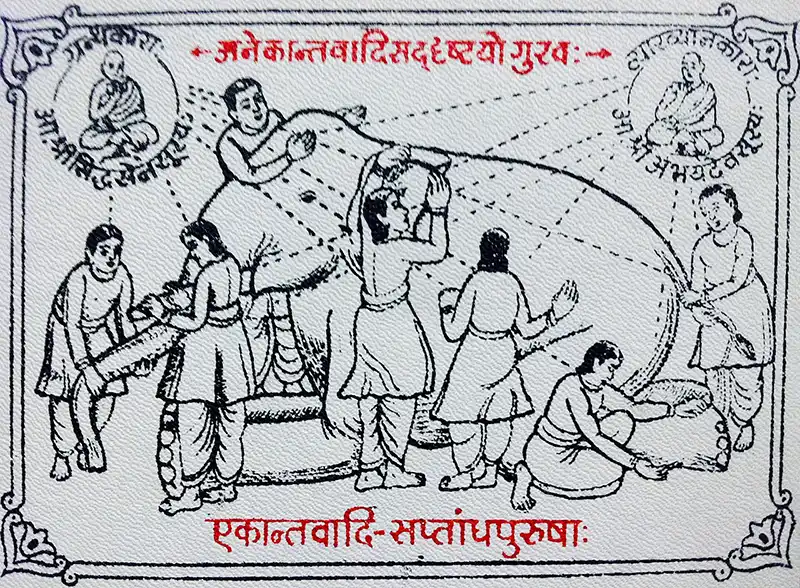
The blind men and the elephant: Several blind men encounter an elephant. One touches the leg: ‘An elephant is like a pillar.’ One touches the trunk: ‘Like a thick rope.’ One touches the ear: ‘Like a large fan.’ Each statement is true from the position of the speaker. None captures the elephant. The combination of all their statements, taken together, still does not give you the elephant — it gives you a collection of partial truths. Our knowledge of God works like this: each piece of genuine theological or philosophical insight is real and accurate from the perspective of the knower. But none of it, and no sum of it, constitutes the whole. The whole exceeds every possible perspective on it.
This epistemological humility is not scepticism — Eriugena is not saying that knowledge of God is impossible. He is saying that all knowledge of God, like all knowledge of any sufficiently complex reality, is perspectival and partial. This has practical philosophical implications: no single theological tradition, no single philosophical system, no single religious insight can claim to have exhausted the truth about God. The super-predicates — God is super-good, superessential — are themselves acknowledgments of this limit, reaching toward what exceeds them.
11. Problems with the System — Where Christian Neoplatonism Breaks Down
Eriugena’s system is philosophically remarkable: comprehensive, internally consistent, and rigorously argued. But when it is tested against the specific requirements of Christian theology, it generates problems that are not merely technical difficulties but fundamental incompatibilities. These are not bugs in the system — they are the logical consequences of following Neoplatonic premises faithfully.
| Problem | What Christianity requires | What Eriugena’s system produces — and why it is fatal |
|---|---|---|
| Subjectivism — collapse of objective theology | If God is beyond all categories and all our knowledge of God is partial and perspectival, no objective theological claim is possible for anyone. | Church authority to define doctrine, condemn heresy, interpret scripture — all of this depends on the possibility of objective theological knowledge. If all knowledge of God is ‘a private affair between the soul and its God,’ the Church as an institution becomes philosophically unjustifiable. Religious individualism replaces institutional Christianity. |
| Transcendence vs Dependence — the core impossibility | Christianity requires both: (a) God is entirely separate from the world (transcendence); and (b) the world depends completely on God (dependence). Eriugena’s analysis shows these two are logically incompatible. | The Fido argument: If Fido (a dog) depends entirely on God for his being, then Fido is an “appendage” to God. But if Fido is an appendage to God, we cannot know God completely without knowing Fido—dependence runs both ways. Transcendence implies distinctness → independence → knowing God without Fido. Dependence implies inclusiveness → knowing God requires knowing Fido. These cannot both be true. Eriugena chooses dependence; the Church insists on transcendence as well. |
| Dissolution of the Creator-Creature distinction | Christianity depends on an absolute, qualitative difference between God (infinite, perfect, necessary) and creatures (finite, sinful, contingent). This gap grounds sin, redemption, prayer, the moral relationship with God. | If God and creation are co-eternal and co-essential — if creating is God’s essential nature — the difference between God and world collapses into one of degree, not kind. The creature is ‘lower God’; God is ‘higher creature.’ The basis for humility, the awareness of finitude, the awe before the infinite — all presuppose a sharp metaphysical gap that Eriugena’s system dissolves. |
| Personal survival after death denied | Christianity promises the resurrection of specific persons — individual souls retaining their identity eternally after death. This is central to the meaning of salvation. | In Eriugena’s system, at Division IV all creation returns to God and is absorbed. Individual identity dissolves into the divine unity. The result is closer to Plotinus’s absorption of the soul into the One than to the Christian resurrection. As the reference text says directly: ‘immortality is achieved only at the cost of abandoning personal survival; man seems finally to disappear into, to merge with, God. This, clearly, is blasphemy as well as heresy.’ |
| Evil becomes unreal | If the world is God’s own essence made external, and God is perfectly good, then all that exists is good. Evil cannot genuinely exist in such a system. | Eriugena’s position: the world is like a beautiful and harmonious picture on a vast scale. Any part that appears dark or ugly is actually shadow that the divine artist placed there to heighten the overall aesthetic effect. If we could see the whole composition, every dark part would be beautiful. And when creation returns to its source, sin and evil — even hell — must disappear. For orthodox Christianity, which insists evil is real and requires genuine redemption, this is unacceptable. |
| The Genesis problem | Genesis explicitly states that God created the world ‘out of nothing’ (ex nihilo). Eriugena says God created it out of himself. These appear to contradict. | Eriugena’s response: Genesis was written for simple people; it cannot be expected to be technically precise. But more cleverly: it IS true in a sense that God created from nothing — because God’s own nature is ‘beyond being,’ and ‘beyond being’ in his technical language is ‘nothing.’ So ‘out of nothing’ = out of the super-being divine nature. A clever defence — but it requires so loose an interpretation of scripture that it undermines biblical authority. |
The Root Cause — Two Incompatible Frameworks
All six of these problems trace to a single source. Neoplatonism and Christianity share a vocabulary (God, creation, soul, salvation) and even some structural similarities — but their core metaphysical commitments are deeply antagonistic:
- God’s nature: Neoplatonism — the One is absolutely impersonal, beyond all relation, beyond love. Christianity — God is a personal Father who loves, hears prayer, and enters into genuine relationship with each soul.
- The nature of creation: Neoplatonism — the world flows from God necessarily, as light necessarily flows from the sun. There is no choice; love plays no role. Christianity — God creates freely, as an act of will and love. Creation is a gift.
- Evil: Neoplatonism — evil is not genuinely real; it is merely the absence of good at the far end of the emanation from the One. Christianity — evil is real, powerful, and requires genuine redemption, not merely a return to fuller participation in being.
- The soul’s destiny: Neoplatonism — the soul is ultimately absorbed back into the One, losing individual identity. Christianity — the soul retains personal identity after death; the resurrection is of specific persons, not of soul-stuff dissolved into the divine.
Eriugena did not see these incompatibilities as clearly as we now do — in part because the Pseudo-Dionysian texts he had translated gave him reason to believe Neoplatonism had already been successfully integrated into Christian thought. But by following the logic faithfully, he made the incompatibilities impossible to ignore.
12. The Pseudo-Dionysius Problem
The historical situation that made Eriugena’s attempt both possible and particularly ironic was the status of the Pseudo-Dionysian texts. When Eriugena translated these Greek texts into Latin, he was doing so because scholars in Paris had obtained them but could not read them. These texts were attributed to Dionysius the Areopagite — the person mentioned in the Book of Acts as Paul’s first convert at Athens.
If genuinely written by Paul’s convert, these texts would carry near-apostolic authority. They had been present in the Christian tradition since at least the fifth century, accepted as genuinely apostolic. Eriugena’s use of them was therefore not heterodox adventurism — it was working with what appeared to be the mainstream of authoritative Christian thought.
The historical truth: the Pseudo-Dionysian texts were not written by Paul’s convert. They were written by an anonymous Neoplatonist — probably in the late fifth or early sixth century — deeply influenced by the philosopher Proclus. They are saturated with Neoplatonism. The forgery was not definitively exposed until the Renaissance, centuries after Eriugena. Throughout the medieval period, these texts were treated as authoritative Christian sources.
This created what can only be called a philosophical time-bomb at the heart of medieval Christian thought. The texts of Augustine (undeniably authoritative) were deeply influenced by Neoplatonism. The texts of Pseudo-Dionysius (believed apostolically authoritative) were even more thoroughly Neoplatonic. Medieval thinkers therefore had strong reasons to believe that Neoplatonism and Christianity were compatible — that these two frameworks could be synthesised. Eriugena’s work, by following that synthesis to its logical conclusions, demonstrated that this belief was false.
The Church saw plainly enough that Eriugena’s use of Neoplatonism and the Pseudo-Dionysius was heretical. But it did not immediately know how to deal with the resulting embarrassment. It could not simply throw Neoplatonism overboard — too many revered Christian authorities had used it. And yet Eriugena’s conclusions showed exactly where following Neoplatonism leads: to pantheism, the dissolution of personal identity, the unreality of evil, and the collapse of institutional theology.
13. The Historical Lesson — A Necessary Failure
The most important thing to understand about Eriugena is not where he went wrong, but what his going wrong achieved. His system was the most rigorous and systematic attempt to build a Christian philosophy on Neoplatonic foundations — and it failed. Not through carelessness or heterodox intent, but through faithful, rigorous philosophical reasoning.
‘John’s work demonstrated that the attempt to construct a Christian metaphysics on a Platonic basis was a blind alley.’ This is the historical verdict. Not that Eriugena failed as a philosopher — he succeeded as a philosopher. He showed exactly where and why this particular synthesis cannot work.
This negative demonstration was historically necessary. Before Eriugena, it was possible to believe that a careful, orthodox Christian thinker could build a comprehensive system on Platonic-Neoplatonic foundations. After Eriugena, this belief was no longer philosophically tenable — though it took the Church and subsequent thinkers time to draw the right conclusion from his failure.
The right conclusion was that Christian philosophy needed a different philosophical foundation entirely. Plato’s metaphysics — with its emphasis on the world’s ultimate unreality, its identification of the highest with the abstract and impersonal, and its picture of the soul dissolving back into unity — was simply incompatible with Christianity’s insistence on the reality of creation, the personal nature of God, and the individual destiny of souls.
Aristotle, by contrast, takes this world seriously on its own terms. His metaphysics gives created things their own genuine existence, their own natural purposes, and their own proper dignity — without reducing them to mere aspects of a higher unity. The creator-creature distinction can be maintained within an Aristotelian framework in a way that Neoplatonism makes impossible. When Aristotle’s texts were rediscovered through the Islamic world and returned to Europe in the twelfth century, they provided exactly what was needed. Thomas Aquinas’s great synthesis — reason and faith, Aristotle and Christianity — became possible because Eriugena had first shown what synthesis was not possible.
14. A Parallel from Indian Philosophy
The philosophical framework that Eriugena developed — independently, without any knowledge of Indian thought — bears remarkable structural similarities to the Advaita Vedanta tradition. The parallels are worth noting not as historical influence (no such influence existed) but as evidence that a certain way of thinking about ultimate reality tends to produce similar insights when followed seriously across different traditions.
- God as beyond being — corresponds to Nirguna Brahman: Brahman without qualities, beyond all predication, all categories, all description. The attempt to describe Nirguna Brahman using ordinary language fails for exactly the reasons Eriugena identifies.
- The three-step theological language (affirmation + negation + super-predicate) — corresponds to neti neti (‘not this, not this’): the Upanishadic method of approaching Brahman by progressively negating all finite descriptions, each negation pointing toward what exceeds it.
- Theophany — God manifests the world through himself — corresponds to the relationship between Brahman and the world in Advaita: the world is real as Brahman’s self-expression, but not independently real. Maya does not mean illusion in a dismissive sense; it means the world’s dependence on Brahman, as Eriugena’s theophany means the world’s dependence on God.
- Reality as a circle: procession from God and return to God (exitus and reditus) — corresponds to srishti and pralay: the great cosmic processes of creation and dissolution, emergence and absorption.
These parallels are structural and intellectual, not historical. There is no transmission route between Eriugena and Vedanta philosophy in the ninth century. The resemblance demonstrates that a particular style of thinking about infinite reality — following its internal logic with rigour — tends to arrive at similar philosophical destinations from different cultural starting points. This convergence is itself philosophically interesting.
Conclusion — What Eriugena’s Work Achieved
John Scotus Eriugena built something that had not existed in Western philosophy for six centuries and would not exist again with comparable ambition for several centuries after: a complete, original, systematic account of all reality, constructed through rigorous philosophical reasoning rather than pious commentary or mere compilation.
His system has three great strengths. It is comprehensive: covering God, the Primordial Causes, the physical world, knowledge, language, and the soul’s destiny within a single unified framework. It is internally consistent: each element follows from what precedes it, and the connections are genuinely philosophical rather than rhetorical. And it is honest: Eriugena follows the argument where it leads, even when it takes him into conflict with Church authority.
And it has one decisive weakness: it does not work as Christian philosophy. The Neoplatonic framework, followed faithfully, produces conclusions that contradict Christian doctrine on multiple fronts. Eriugena showed this not through carelessness but through philosophical precision. He took the tradition he inherited — the Augustinian Christianity interpreted through Neoplatonic categories, reinforced by the authority of the Pseudo-Dionysian texts — and followed it to its logical end.
The logical end is pantheism; the dissolution of personal identity; the unreality of evil; the collapse of institutional theology into private mysticism. The Church was right to see these conclusions as dangerous. But the way to deal with them was not simply to condemn Eriugena — it was to build a different philosophical foundation. That foundation would come, three centuries later, when Aristotle returned to Europe through the Islamic world and Thomas Aquinas recognised in him the philosophical instrument that Christianity actually needed.
Eriugena did not solve the problem of building a Christian philosophy. He demonstrated, with a clarity that could not be ignored, exactly why a particular approach to that problem was doomed. That demonstration was the most philosophically valuable thing he could have done — and it is enough to make him, for all his obscurity in subsequent centuries, one of the genuinely essential figures in the history of Western thought.
Frequently Asked Questions
Who was Eriugena and why does he matter despite being so rarely discussed?
John Scotus Eriugena (c. 810–877) was an Irish scholar working at the Carolingian court in Paris — the only original philosopher in the six-hundred-year period between Augustine (d. 430) and Anselm (b. 1033). He matters for two distinct reasons. First, positively: he produced a philosophical system of genuine power and originality in the most intellectually sparse period of Western history. Where everyone else compiled, translated, or commented, he built — a complete, systematic account of God, creation, knowledge, and the soul’s destiny, constructed through rigorous reasoning. Second, and equally important, negatively: his system demonstrated with precision exactly where and why Neoplatonism and Christianity are fundamentally incompatible. By following Neoplatonic premises faithfully to their logical conclusions, he proved that ‘the attempt to construct a Christian metaphysics on a Platonic basis was a blind alley.’ This negative demonstration was historically necessary — it cleared the philosophical ground for the Aristotelian synthesis that Thomas Aquinas would later achieve. You cannot understand why medieval philosophy needed Aristotle without understanding why Eriugena’s Platonic approach failed.
What are the four modes of ‘things that are not,’ and why is this distinction important?
Eriugena divides all reality into ‘things that are’ and ‘things that are not’ — but crucially, ‘things that are not’ does not mean nothingness. There is no pure nothingness in his system. The distinction has four specific modes. First: sinful persons, whose integral human nature (what makes them complete, genuine human beings) has been compromised or destroyed by sin — they exist physically but metaphysically lack what they should be. Second: changing physical objects, which are always in flux, always becoming rather than stably being — they ‘are and are not’ simultaneously, like Heraclitus’s river. Third: potential beings, which exist only as unrealised capacity — real as potential, not-yet-real as actual. Fourth, and most importantly: God, who transcends being entirely — not because God lacks something (like the first three modes), but because God infinitely exceeds all our categories. God is ‘beyond being’ the way Bernini’s Apollo and Daphne is beyond being “a nice statue”: the ordinary concept applies, but so inadequately that it misleads. The importance of this distinction: it gives Eriugena a framework for understanding reality as a hierarchy — from mere becoming (changing objects) through stable being (the Primordial Causes) to beyond-being (God) — without introducing nothingness as a genuine category, which would raise unanswerable questions about where it came from.
What is Eriugena’s three-step theological language, and why is it philosophically necessary?
Eriugena identifies a fundamental problem with all theological language: every word we possess derives its meaning from its opposite. ‘Good’ is meaningful only in contrast to ‘bad.’ ‘Being’ only in contrast to ‘non-being.’ ‘Truth’ only in contrast to ‘falsehood.’ But God has no opposite — nothing stands in relation to God the way ‘bad’ stands in relation to ‘good.’ Applying ordinary language to God therefore inevitably makes God sound like a superlative version of ordinary things: the best being, the most knowing, the most powerful. But God is not a superlative version of ordinary things; God is in a different order entirely. Eriugena’s three-step solution: (1) Affirmation: ‘God is good’ — true, but misleading by itself. (2) Negation: ‘God is not good (in the ordinary sense)’ — corrects the literalism, but misleading alone because it sounds like God is evil. (3) Super-predicate: hold affirmation and negation together and they point beyond themselves — ‘God is super-good,’ ‘God is superessential,’ ‘God is more than true.’ The super-predicate does not describe God directly — no language can — but it names the fact that reality exceeds our language, which is the most precise thing we can say. This is philosophically important beyond theology: it is a rigorous engagement with the limits of language itself, anticipating concerns that would not become central to philosophy until Wittgenstein, Frege, and the analytic tradition twelve centuries later.
What are the four divisions of nature, and what does the circle mean?
Eriugena divides nature — all of reality — into four divisions based on the logical possibilities of ‘creates’ and ‘is created.’ Division I: That which creates but is not created — God as the ultimate source. At this level, God is beyond all categories, and crucially, not yet conscious or self-knowing. The absolute simplicity of Division I excludes the subject-object structure that knowledge requires. Division II: That which is created and creates — the Primordial Causes, God’s own ideas (goodness, being, life, wisdom, truth, intelligence, reason, virtue, justice, health, greatness, omnipotence, eternity, peace). At this level, God becomes conscious, thinks his archetypes, and knows himself through them. They in turn give structure and essence to physical things. Division III: That which is created but does not create — the physical world, which has its being through participation in the Primordial Causes and which has a built-in longing to return to its source. Division IV: That which neither creates nor is created — God as the final goal and resting place of all creation. The same God as Division I, seen now as destination rather than source. Together, the four divisions describe a circle: God proceeds into the world (Divisions I→II→III) and the world returns to God (Division IV). God is ‘the beginning, middle and end’ — creator, sustainer, and final destination. The circle maps onto three Christian doctrines (creation, sustenance, salvation) and grounds Augustine’s ‘our heart is restless until it rests in Thee’ in a metaphysical account of what all created things fundamentally are: oriented toward their source.
Why does Eriugena’s system fail as Christian philosophy — and why does that failure matter?
Eriugena’s system generates six major conflicts with Christian theology when followed to its logical conclusions. First: subjectivism — if God is beyond all categories and knowledge of God is always perspectival and partial, no objective theological claims are possible, collapsing the Church’s authority to define doctrine. Second: the transcendence-dependence contradiction (the most fundamental) — Christianity requires both that God is completely separate from the world (transcendence) and that the world depends completely on God (dependence). Eriugena demonstrates these are logically incompatible: if the world depends entirely on God it cannot be separate from God; if God is separate he cannot be the world’s complete ground. He chooses dependence — which produces pantheism. Third: the creator-creature distinction dissolves — if God and creation are co-eternal and co-essential, the qualitative difference between creator and creature (on which sin, redemption, prayer, and moral relationship all depend) disappears. Fourth: personal survival after death is denied — all returns to God and is absorbed, eliminating the personal resurrection Christianity promises. Fifth: evil becomes unreal — if the world is God’s own essence externalized, all that is, is good; evil cannot genuinely exist. Sixth: the Genesis contradiction — ‘creation out of nothing’ appears to conflict with creation from God’s own nature, and Eriugena’s resolution requires interpreting scripture very loosely. The failure matters because it was historically productive: it demonstrated definitively that Neoplatonism cannot serve as the philosophical foundation for Christian theology. This cleared the ground for Thomas Aquinas, who would use Aristotle instead — a philosophy that takes creation seriously in its own right and maintains the creator-creature distinction that Neoplatonism dissolves.

Leave a Reply