
What do you do in your final months, sentenced to death on a false charge, stripped of everything you built? Boethius answered by writing one of philosophy’s most enduring books — a conversation with Lady Philosophy herself about fortune, happiness, and the freedom no prison can take away.
Key Takeaways
- Boethius (c. 476–524 AD) wrote The Consolation of Philosophy while in prison awaiting a painful death — and it became one of the most widely read books of the entire medieval period. He had been the most powerful administrator in Italy under the Ostrogothic king Theodoric — equivalent to chief administrative officer of the entire government. Falsely accused of treason (through a combination of court politics and religious difference), imprisoned in the Tower of Pavia, and eventually killed with extraordinary brutality, he spent his final months producing not a personal lament but a sustained philosophical work of lasting importance. The contrast between the circumstances and the achievement is itself philosophically instructive.
- The Consolation is structured as a dialogue between Boethius and Lady Philosophy — a wise woman he imagines visiting him in prison — and moves through five books in alternating poetry and prose. The poetry gives emotional expression to suffering; the prose applies reason to that suffering. Lady Philosophy’s first act is to dismiss poetry: not because emotion is worthless, but because emotional wallowing is not medicine. The real cure for suffering is rational understanding — seeing reality clearly, not feeling it more intensely. This is the book’s central claim, and it shapes every argument that follows.
- Book II introduces Fortune’s Wheel — the insight that external goods (wealth, power, fame) are Fortune’s loans, not gifts, and can be reclaimed at any moment. On the cosmic scale, Earth is tiny, and human pride in position is like a mouse boasting to another mouse. But the deeper point is about bad fortune: it is actually more valuable than good fortune, because it reveals your real friends, strips away illusion, and shows you who you truly are. Real happiness — Book III’s subject — cannot be in any of these temporary, partial goods. It must be found in something complete, perfect, and stable: God, the source of all perfect goodness.
- Book IV addresses one of the most persistent questions in moral philosophy: why do the wicked prosper while the good suffer? Boethius’s answer (through Lady Philosophy, drawing on Plato) reframes the question entirely. The wicked are not truly successful — they are becoming more morally corrupted with every unjust act, losing their human nature and regressing toward the animal. Not being punished is actually the worst outcome: without correction, the error compounds indefinitely. And the right question is not ‘who is winning?’ but ‘who is becoming a better person?’ By that standard, the good are advancing and the wicked are declining.
- Book V contains Boethius’s most philosophically original contribution: the distinction between certainty and necessity, and the principle that knowledge depends on the knower. His argument is that God’s certain knowledge of future events does not make those events necessary or fixed — because certainty (a property of knowledge) and necessity (a property of events) are different things. And whether any event is known certainly depends not on the event but on the knower. Since God exists outside time, what is future for us is eternally present for God. Human free will and divine knowledge are compatible — they operate from different temporal positions.
- The philosophical methods Boethius uses in Book V introduce modal thinking — the analysis of reality in terms of necessity, contingency, possibility, and counterfactuals — which became foundational for medieval and modern logic, science, and philosophy. Even if his specific solution to the free will problem is contested, the conceptual tools he deploys permanently enriched philosophical reasoning. His translation of Aristotle’s logical works further ensured that formal reasoning would survive the Dark Ages. And his recognition that logic, ethics, and aesthetics — corresponding to truth, goodness, and beauty — are the three fundamental disciplines of philosophy connects him to a cross-cultural insight found in Plato, Indian philosophy, and Islamic thought alike.
Table of Contents
Introduction — Philosophy in a Death Cell
Imagine a person in prison. Everything has been taken from them: their wealth, their political power, their freedom, and soon their life. Death is only weeks or months away. In this situation, most people would sink into grief or rage. Boethius turned to philosophy.
In the Tower of Pavia, he sat down and wrote The Consolation of Philosophy — one of the most widely read books of the entire medieval period, translated into every major European language, and cited by Dante, Chaucer, Boccaccio, and countless others as an inspiration. He discussed the deepest questions of human existence: why good people suffer and wicked people prosper; what genuine happiness is and where it can be found; whether human free will is possible in a universe governed by divine foreknowledge.
The circumstances of his imprisonment and death make the achievement even more striking. Historical accounts of his execution — tying a rope or wire around his head, tightening it until his eyes were displaced, and then beating him to death — describe an act of deliberate brutality. The exact duration of his imprisonment is not recorded. What is recorded is what he chose to do with those months: not weep, but think.
Boethius (c. 476–524 AD) — historical position: The last major philosopher to write in the classical Latin tradition, and the first great philosopher of the medieval scholastic tradition. He is often called ‘the last of the Romans and the first of the medieval scholastics.’ His writings were the primary channel through which ancient Greek philosophy flowed into the Middle Ages. Without him, medieval thought would have had almost no access to Aristotelian logic.
1. Life, Politics, and the Charges
Boethius was born around 476 AD — the same year the Western Roman Empire formally ended — into one of Rome’s most distinguished and wealthy families. His father died when he was young, and he was raised by a politically prominent relative who gave him an exceptional education.
He learned Greek at a time when Greek literacy was becoming extremely rare in the Latin-speaking West. The collapse of Roman education had made Latin readers scarce; Greek readers were rarer still. Boethius’s mastery of Greek — and through it his deep knowledge of Plato’s and Aristotle’s actual texts — gave him access to philosophical resources that were effectively unavailable to almost everyone else in Western Europe.
His political career was equally exceptional. Under the Ostrogothic king Theodoric, who ruled Italy after Rome’s fall, Boethius rose to the post of magister officiorum — in modern terms, the chief administrative officer of the entire government. He managed all government departments and all state communications, internal and external. Only the king himself held more power.
The Charges — Court Politics and Religious Difference
He was accused of treason: specifically, of conspiring with Justin, the Eastern Roman Emperor, to overthrow Theodoric. The charge was never proven. A more likely explanation involves two overlapping factors.
First: court politics. Boethius worked with unusual honesty and directness, which made him effective but also made him enemies. Anyone in a position of real power accumulates rivals who would prefer to see them gone. Second: religious difference. Boethius was a Catholic Christian; Theodoric was an Arian Christian — a different branch of Christianity with different theological commitments and different political allegiances. This religious gap created a background of mutual suspicion that was easily exploited.
He was imprisoned in the Tower of Pavia and kept there for some months. During that time, he wrote The Consolation of Philosophy. Then he was killed.
2. The Consolation of Philosophy — Structure and Lady Philosophy
The Consolation opens with Boethius in prison, composing sad poems. A woman appears to him — tall, ancient, radiantly clear. She is Philosophy personified: Lady Philosophy.
Lady Philosophy’s appearance: She seems sometimes to be of ordinary human height, and at other moments her head reaches the heavens. This is not inconsistency — it is philosophical precision. Philosophy addresses the ordinary problems of daily life (practical concerns, human height) and simultaneously reaches to the highest truths that transcend all experience (heavenly height). On her dress is embroidered a ladder: at the bottom, the letter P (for practical); at the top, TH (for theoretical). Philosophy is the ladder that carries us from the practical problems of everyday life to the highest theoretical truths. Nothing else in human experience performs this function.
Lady Philosophy’s first act is to dismiss the Muses of poetry who have been surrounding Boethius — and this dismissal is philosophically important. She is not dismissing emotion. She is insisting that emotional expression, however genuine, is not the medicine. Poetry that expresses sadness can deepen sadness; it cannot dissolve it. Real understanding — rational clarity about what is actually true — is what heals. The book therefore proceeds through alternating poetry and prose: the poetry voices the feelings, and the prose does the work of reason.
The book is divided into five sections, each called a ‘book’ in the terminology of the period. Each addresses a progressively deeper philosophical question.
3. The Five Books — A Complete Summary
| # | Theme | The Problem and Argument | The Key Insight |
|---|---|---|---|
| I | The Philosopher’s Fate | Boethius defends himself: he entered politics because Plato said philosophers must guide kings. Lady Philosophy responds that this has always been the philosopher’s fate in a corrupt world — Socrates was killed in Athens, Seneca in Rome. In a corrupt society, the just person always suffers. | The solution is not emotional protest but rational understanding. Lady Philosophy insists: control your emotions, use reason, understand reality as it is. A Stoic poem closes this section: genuine peace comes when the mind is stable and governed by reason rather than driven by feeling. |
| II | Fortune and the Wheel | Fortune gives wealth, power, and fame — but these can all be taken away. The universe is vast; human ‘greatness’ is as meaningless as a mouse boasting to another mouse. Real happiness is not in external things but in character, wisdom, and virtue — things that no one can take from you. | Bad fortune is actually MORE useful than good fortune: it shows you who your real friends are, who you truly are, and strips away the illusion. And if you accepted Fortune’s good gifts, you cannot now complain when Fortune reclaims them. Fortune’s nature was always to give and take. |
| III | What Is True Happiness? | Happiness is the state where no desire remains — where nothing is lacking. Boethius analyses each apparent good: wealth generates more desire; power brings fear and enemies; fame is temporary; physical pleasure fades. Each gives only a fragment of happiness. | We make the mistake of seeking happiness in separate pieces. Real happiness must unite ALL these qualities in a single, complete, and perfect thing. That thing is God — the source of all perfect goodness. A person who achieves true happiness becomes, in that sense, divine: complete in themselves. |
| IV | Why Do the Wicked Prosper? | The apparent injustice: wicked people seem successful while good people struggle. Lady Philosophy (drawing on Plato) argues this is a surface reading. Wicked people are not truly successful — they are becoming MORE morally damaged and MORE corrupted with every unjust act. | Not being punished is actually the WORST outcome for the wicked: they never see their error, never correct it, and keep regressing. Punishment is correction, like a teacher marking a spelling mistake. The right question is not ‘who is winning?’ but ‘who is becoming a better person?’ |
| V | Free Will and Divine Foreknowledge | If God knows with certainty everything that will happen, does this make our future fixed and free will an illusion? Lady Philosophy’s answer in two moves: (1) Certainty in knowledge is NOT the same as necessity in events. (2) Whether something is certain or uncertain depends on the KNOWER, not just on the event itself. | God exists outside time — what is ‘future’ for us is eternally PRESENT for God. ‘Eternal’ does not mean ‘lasts forever’ — it means OUTSIDE time. So God does not ‘foreknow’ our future in the temporal sense at all; he eternally knows all moments as present. Human freedom remains intact. |
4. Book I — The Philosopher’s Fate in a Corrupt World
Boethius begins by defending himself. He entered politics, he says, not from ambition but from philosophical duty. Plato had argued that philosophers must enter political life — not because they want power, but because society needs wise guidance from people who understand justice and truth. Boethius followed this Platonic principle. And he paid for it with his life.
Lady Philosophy’s response is not sympathy but perspective: this is nothing new. Socrates was condemned to death by the democratic citizens of Athens. Seneca, the Roman Stoic philosopher, was ordered to commit suicide by the emperor Nero. In a corrupt society, a just person will always be in danger. The corruption does not come from outside — it comes from within the society itself. This is simply what happens when power is divorced from wisdom.
But her deeper point is about the appropriate response. Emotional indignation does not solve anything. Boethius cannot reverse his situation by feeling it more intensely. What he can do is understand it correctly — see clearly what Fortune is, what happiness really means, and what kind of freedom is actually worth having. That understanding is the only genuine consolation available to him, and it is the project of the remaining four books.
5. Book II — Fortune, the Wheel, and the Wisdom of Bad Times
Lady Philosophy introduces the concept that organises much of the book: Fortune — the ancient personification of luck, chance, and the contingent rise and fall of worldly goods.
Fortune’s defining characteristic is instability. Wealth, political power, social status, fame — these are Fortune’s domain. And Fortune’s nature is to give and to take. The person who enjoys Fortune’s gifts must understand the terms of the arrangement: what Fortune gives, Fortune can reclaim. The gift was always a loan.
Today’s examples make this viscerally clear: a company’s collapse destroys a career built over decades; a social media presence that attracted millions becomes irrelevant in months as platforms shift and tastes change; a political party that seemed invincible loses every seat in a single election. None of this is exceptional or unfair — it is exactly how external goods operate. They come; they go.
The Cosmic Scale
The mouse boasting to another mouse: Lady Philosophy reminds Boethius of the scale of things. The universe is incomprehensibly vast. Earth is a tiny speck within it. And within that tiny speck, human beings — with their political positions, their wealth, their fame — strut and compete as if these things were cosmically significant. To boast of power or wealth on this scale is like a mouse turning to another mouse and demanding respect for the size of its burrow. The cosmic perspective does not demean human beings; it demeans the specific pretension that external goods make us important.
From this, Lady Philosophy draws the crucial philosophical point: genuine happiness cannot be located in external goods at all. Character, wisdom, virtue, genuine understanding — these reside inside a person, not in their bank account or their title. And inside a person is exactly where Fortune cannot reach.
Why Bad Fortune Is More Valuable Than Good
Lady Philosophy makes a point that initially sounds paradoxical but becomes clear on reflection: bad fortune is actually more useful to us than good fortune.
Good fortune presents a pleasant surface that conceals reality. When things are going well, you cannot know who your real friends are — you have no way of distinguishing those who value you from those who value your position. You cannot know how resilient you are, because your resilience has not been tested. And you cannot know what you truly value, because the easy availability of external goods means you have never had to choose between them and anything more fundamental.
Bad fortune strips away exactly these layers of comfortable illusion. Who stays when the position is gone? Who leaves? What are you when the title is removed? These are the most important questions about a person, and bad fortune — painful as it is — provides the only reliable answers. Lady Philosophy also notes that if Boethius accepted Fortune’s gifts when they were flowing freely, he cannot now justifiably protest when Fortune reclaims them. He was always operating on Fortune’s terms.
6. Book III — The Analysis of True Happiness
With Book III, the Consolation reaches its philosophical centre: what is true happiness, and where is it actually found?
Boethius’s definition of happiness: Happiness is the state in which no desire remains — where nothing is lacking, where the person is complete. A state of genuine sufficiency, not mere pleasure or contentment. The moment you still want something, you have not yet reached happiness.
With this definition in hand, Lady Philosophy subjects each candidate for happiness to examination.
- Wealth: Does more money bring happiness? It does not — it brings more desire. The more wealth a person accumulates, the larger their appetite for wealth becomes. Greed grows with its object. And wealth is always at risk: it can be lost, stolen, destroyed. A person who builds their sense of wellbeing on wealth is building on sand.
- Power: Power brings fear along with it. Those who hold power are constantly aware that others want to take it. They must watch their backs, manage their rivals, defend their position. Even the most powerful rulers can be overthrown. The person with power is often less secure than the person without it.
- Fame: Fame depends entirely on what others think of you. It is therefore completely outside your control. And most fame is local and temporary — it reaches only a small region of the world and fades with the passage of time.
- Physical pleasure: Pleasure is real in the moment but leaves no trace. It cannot be accumulated or stored. The memory of pleasure is not the same as pleasure. And pleasure sought as a life’s goal quickly becomes compulsive — a pursuit that traps rather than satisfies.
The pattern across all four is the same: each offers a fragment of what happiness would include if it were real, but none provides the whole. And the reason we keep chasing them is that we have an idea — however dim — of what complete happiness would look like. We keep buying pieces of a puzzle because we sense what the full picture would show, even if we cannot yet see it.
The insight: We seek happiness in separate parts — wealth, power, fame, pleasure — but real happiness would have ALL of these qualities unified in a single, complete, and permanent thing. No fragment will ever add up to the whole. The parts point toward the whole, but they cannot substitute for it.
That complete thing — the source of all goodness, truth, and permanence — is God. God is not simply the greatest good among many goods; God is the source from which all genuine goodness derives. A person who truly achieves this — who genuinely reorients their fundamental desire toward God — becomes, in a meaningful sense, divine: complete in themselves, needing nothing external.
7. Book IV — Who Is Truly Powerful?
The surface reading of the world suggests a troubling injustice: powerful people frequently act wickedly and seem to prosper for it; people of integrity frequently struggle. This is visible everywhere — in politics, in business, on social media where the most shallow content often reaches the largest audience.
Lady Philosophy’s response is structured and precise, drawing on Platonic moral philosophy. She does not deny that the surface reading is accurate as far as it goes. She says it does not go far enough.
The Wicked Are Not Truly Successful
Every time someone acts corruptly, dishonestly, or cruelly, they damage themselves — not just their reputation but their actual moral constitution. The person who lies habitually loses the capacity for honest perception; the person who treats others ruthlessly loses the capacity for genuine relationship; the person who always seeks advantage degrades into someone who cannot value anything that is not advantageous. They become less of what a human being should be with every act of corruption.
And crucially: a person who is never held accountable — who escapes all consequences for their wrongdoing — is in the worst possible situation. Without feedback, the error is never seen. Without correction, it compounds indefinitely.
Punishment as correction: When a student makes a spelling mistake and the teacher corrects them, the correction serves the student. Without it, the mistake persists and becomes a fixed habit. Punishment — when it genuinely works — is this kind of correction applied to moral error: it creates the awareness of wrongdoing without which the wrongdoing cannot stop. A wicked person who prospers without punishment is therefore in the worst state: they are getting worse, they cannot see it, and there is nothing to interrupt the process.
Changing the Question
Lady Philosophy reframes the whole discussion by proposing a different question. Instead of asking ‘who is winning?’ she proposes asking: ‘who is becoming a better person?’
By the standard of external success, the wicked may well be winning. But by the standard of genuine human development, they are regressing. Their moral nature is deteriorating with every act. They are moving away from what a fully developed human being should be.
The animals metaphor: Lady Philosophy describes the wicked in symbolic terms: the greedy become like wolves — predatory, acquisitive, always hunting. The angry become like lions — driven purely by aggression. In each case, they are losing their distinctively human character. Aristotle defined the human being as a rational animal: an animal, but one elevated by reason. The human stands between the purely animal (driven only by physical appetite) and the divine (pure reason and goodness). The more a person follows physical desire without rational governance, the more they move toward the animal end. The more they cultivate reason and virtue, the more they approach the divine. Both trajectories are available to every person; the choice is genuinely theirs.
8. Book V — Free Will and Divine Foreknowledge
Book V addresses the deepest philosophical problem in the Consolation — a problem that had already been raised by Cicero, addressed by Augustine, and would continue to be debated for centuries after Boethius. It is the problem of free will and divine foreknowledge, and Boethius’s treatment of it introduced philosophical distinctions that permanently changed the conversation.
The Problem Stated Precisely
God is omniscient — God knows everything, and God’s knowledge cannot be wrong. God knows, at this moment, everything that every human being will ever do in the future. Since God’s knowledge is certain and infallible, what God knows must happen. And if it must happen, it is fixed in advance. If the future is fixed in advance, the person making the ‘choice’ had no genuine alternative. If they had no genuine alternative, they had no real freedom.
Stated formally: God’s certain foreknowledge → future events are necessary → no genuine alternatives → no free will. The argument is logically tight, and Boethius acknowledges it. His response does not ignore the difficulty; it attacks it at two distinct points.
| # | What It Says | How It Works |
|---|---|---|
| The problem | God knows with certainty everything that will happen. God’s knowledge cannot be wrong. If God is certainly right that X will happen, then X must happen — it is fixed. If X is fixed, we had no genuine alternative. If we had no alternative, we had no real freedom. | This argument equates two different things: the CERTAINTY of God’s knowledge and the NECESSITY of events. Boethius separates them. |
| Move 1 — Certainty ≠ Necessity | CERTAINTY means knowledge is infallible — it cannot be wrong. NECESSITY means an event is fixed — it could not have been otherwise. These are two different properties in two different domains. | You are watching a horse race. You CERTAINLY know who is leading — you can see it directly. But your certain knowledge does not CONTROL the race. The race runs on its own terms. Your knowing doesn’t force the outcome. Similarly: ‘I certainly know it is raining outside’ does not CAUSE the rain or make rain inevitable in any metaphysical sense. |
| Move 2 — Knowledge depends on the knower | Whether an event is certain or uncertain to someone does not depend on the event itself — it depends on the KNOWER: their position, their nature, their perspective. | You are driving a car. You cannot see around the bend — what comes next is uncertain for you. But God, like someone watching from a mountain top, sees the entire road at once. Same road; same events; different knowers → different knowledge. A magician’s audience cannot see which coloured ball comes next (uncertain); the person backstage sees the arrangement clearly (certain). Same balls; same sequence; different position. |
| God and time — the resolution | We exist INSIDE time — past, present, future are distinct for us. God exists OUTSIDE time. ‘Eternal’ does not mean ‘lasts forever’: it means outside the temporal order entirely. | Because God is outside time, what is ‘future’ for us is already present for God. God does not ‘fore-know’ our future the way a person might predict tomorrow’s weather. He eternally sees all moments simultaneously. Our freedom is real (from inside time, alternatives exist). God’s knowledge is certain (from outside time, all is present). There is no contradiction. |
Move One — Certainty Is Not Necessity: The Horse Race
The horse race: You are sitting in a stadium watching a horse race taking place directly in front of you. At any given moment, you know with absolute certainty which horse is leading — you can see it clearly and directly. Your knowledge is infallible. Now: does your certain knowledge of who is leading control the race? Does it force that horse to be leading? Obviously not. The race runs on its own terms, driven by the horses’ speed, the conditions of the track, the jockeys’ choices. Your observation is perfectly accurate and perfectly certain — and completely irrelevant to the causal structure of the race.
The same structure applies to rain. Right now, I know with complete certainty that it is raining outside — I can see it, hear it, feel it. My knowledge is certain. But my certain knowledge did not cause the rain, does not maintain the rain, and would not stop the rain if I changed my mind about it. Certainty is a property of my knowing; the rain is a property of the weather. They are different categories.
Boethius’s point: God’s knowledge is certainly correct. But this tells us something about the quality of God’s knowledge — not about the metaphysical status of the events known. Certain knowledge of a free, contingent event is perfectly possible. It is exactly what you have when you watch a horse race.
Move Two — Knowledge Depends on the Knower: The Mountain Viewpoint
The car on the road: You are driving a car. You come to a bend in the road. You cannot see what lies beyond the bend — there might be a traffic jam, an accident, road works, or nothing at all. The next stretch of road is genuinely uncertain from where you are. Now imagine someone watching from a mountain top overlooking the entire road. They can see your car, the bend, and everything beyond it simultaneously. What is uncertain and unknown for you is fully present and known for them. Same road; same events; radically different epistemic positions.
The magician’s coloured balls: A magician is producing coloured balls from a container. For the audience in front, each ball’s colour is unknown before it appears — there is no way to see what is coming. For the person working backstage, the arrangement is perfectly visible: red first, then green, then blue. Same balls, same sequence — but completely uncertain from one position and completely certain from another. Knowledge is not just a function of what exists; it is a function of where the knower stands.
Applied to God: we exist inside time. For us, time is divided into past (gone), present (now), and future (not yet). The future is genuinely not yet fixed from our temporal position — that is why we experience decision, deliberation, and genuine choice. But God does not exist inside time. God is eternal — and ‘eternal’ does not mean ‘lasts forever.’ It means outside the temporal order entirely. From God’s eternal vantage, all moments are simultaneously present. What we will do next year is not in God’s future — it is in God’s eternal now.
God therefore does not ‘foreknow’ our future the way a weather forecaster might predict tomorrow’s rain. The forecaster is also inside time and is making a probabilistic guess about what will happen later. God is outside time and eternally perceives what, from our temporal position, is still to come. The freedom is real (from inside time, alternatives are genuinely open); God’s knowledge is certain (from outside time, all is present). There is no contradiction, because the two claims are made from radically different temporal positions.
This solution closely echoes and extends Augustine’s treatment of the same problem — Boethius had studied Augustine deeply — but it adds the precise epistemological move (knowledge depends on the knower) that Augustine had not fully articulated.
9. Philosophical Contributions — Modal Thinking
Whether or not Boethius’s solution to the free will problem is ultimately satisfying (philosophers continue to debate it), the conceptual tools he deployed in reaching that solution are among the most important gifts he gave to Western philosophy.
Before Boethius, there was a tendency — natural but philosophically confused — to treat knowledge and reality as aligned in the following way: if something is certainly known, it must be the case; if it must be the case, it is necessary. Boethius broke this alignment by introducing a precise distinction between CERTAINTY (how firmly something is known) and NECESSITY (whether it could have been otherwise). These belong to different domains: certainty is epistemological (about knowledge); necessity is metaphysical (about reality). Conflating them produces the false conclusion that God’s certain knowledge makes events necessary.
Once this distinction is made, a new space opens up for analysing reality: the space of modality — the analysis of reality in terms not just of what is, but of what must be, what could be, what cannot be, and what would have been under different conditions.
| Concept | Definition | Example |
|---|---|---|
| NECESSITY | A truth that cannot be otherwise. Its opposite is impossible. It is true in every possible situation. | 2 + 2 = 4 — this is necessarily true; it cannot be otherwise in any conceivable world. A triangle necessarily has three sides. These are not contingent facts — they hold regardless of any circumstances. |
| CONTINGENCY | A truth that is real and actual, but could have been otherwise. Its opposite was possible. | It is raining right now — a contingent fact. It is true, but it did not have to be true. Under different atmospheric conditions, it might not be raining. The world as it actually is does not exhaust the world as it could have been. |
| POSSIBILITY | Something that is NOT currently the case but COULD be. Logically possible even if not actual. | Life on another planet: not confirmed, not actual for us — but logically possible. The fact that something has not happened does not mean it cannot happen. Possibilities are real features of reality, not just fictions. |
| COUNTERFACTUALS | Reasoning about what WOULD HAVE happened if circumstances had been different — even though those circumstances did not occur. | ‘If I had not been late, I would have caught the train.’ In reality, I was late and missed it. But I can reason about the alternative path. Scientists use this constantly: What if gravity were absent? What if Earth’s rotation stopped for one second? What if the dinosaurs had not gone extinct? |
These four modal concepts — necessity, contingency, possibility, and counterfactuals — are now foundational in logic, metaphysics, philosophy of science, ethics, and legal reasoning. Every controlled scientific experiment implicitly asks a counterfactual question: what would happen to the outcome if we changed this one variable? Every legal argument about what a ‘reasonable person’ would have done under the circumstances is a counterfactual claim. Every statistical model works with contingency — with facts that are real but could have been otherwise. Boethius’s philosophical move is the origin of this entire mode of thinking in the Western tradition.
His second contribution — knowledge depends on the knower — anticipates the most important developments in epistemology for the next millennium. Thomas Aquinas, working in the thirteenth century, systematically distinguished between different types of knowledge (sensory knowledge, intellectual knowledge, divine knowledge) and showed that what can be known at each level differs qualitatively. Immanuel Kant, in the eighteenth century, made the knower-dependence of knowledge the cornerstone of his entire philosophical project: the mind does not passively receive reality but actively structures experience. Both developments have Boethian roots.
The important lesson here — one that Boethius himself makes explicit — is that the value of a philosopher’s work is not always in whether they solved a problem. It is in whether the methods they use, the distinctions they draw, and the concepts they introduce provide tools that others can use to go further. Boethius may not have dissolved the free will problem. He equipped everyone who came after him to think about it more precisely.
10. The Logic Legacy — Preserving Aristotle
Beyond the Consolation and the philosophical innovations it contains, Boethius’s most historically important contribution was his project of translating all of Aristotle’s and Plato’s available works from Greek into Latin. He recognised — with unusual historical clarity — that Greek literacy was dying in the Latin West. If the classical philosophical inheritance was not translated soon, it would be lost to Western European thought for generations.
He did not complete the project. His execution intervened. But he succeeded in translating Aristotle’s logical works — the Categories, On Interpretation, the Prior Analytics, the Topics, the Sophistical Refutations, and possibly the Posterior Analytics — as well as Porphyry’s Introduction to the Categories. He also wrote extensive commentaries on several of these texts and produced original logical treatises of his own, including an important work on hypothetical syllogisms.
Of these translations, only On Interpretation and the Categories survived the Dark Ages. But these two texts, along with his translation of Porphyry’s Introduction, constituted the entire logical curriculum of Western Europe for the next six centuries. Without Boethius, medieval philosophy would have had almost no logical tools. The discipline of formal reasoning that eventually underpinned Scholasticism — Anselm, Aquinas, and the entire tradition of systematic theology — was made possible by what Boethius preserved.
The philosophical culture of Alexandria — the greatest centre of learning in late antiquity — had made logic the foundational subject of all philosophical study. You studied logic first, before anything else, because logic is the discipline that distinguishes truth from opinion, valid inference from mere plausibility, genuine understanding from sophisticated-sounding confusion. Boethius transmitted this priority — and the Aristotelian tools for carrying it out — into the medieval world.
Logic as foundation — a cross-cultural note: The same priority appears in the Indian philosophical tradition. The gurukul system identified two foundational subjects that every student studied before anything else: Vyakarana and Nyaya. Vyakarana is not merely grammar; it is linguistic analysis — the discipline of breaking language down into its components and examining how meaning is produced. Nyaya combines what we would now call logic and epistemology: the analysis of valid inference and the theory of knowledge. Vyakarana analyses language; Nyaya analyses thought. Together they formed the analytical basis for all further study. The convergence with Alexandria is independent but philosophically significant: both traditions recognised that the tools of clear thinking must be established before any philosophical enquiry can be trusted.
A point worth making: Logic is now optional in many university philosophy curricula. A student can complete a philosophy degree without studying logic. Boethius — and the entire Alexandrian and Indian traditions — would regard this as indefensible. Logic is to philosophy what mathematics is to physics: not one tool among many but the foundational discipline without which the field cannot be practised rigorously.
11. The Three Transcendentals — Truth, Goodness, and Beauty
Boethius’s legacy connects to a philosophical insight that transcends any single tradition. Plato identified three fundamental properties of ultimate reality — the Form of the Good, at the summit, is simultaneously the source of truth, of goodness, and of beauty. These three together describe what is most real and most valuable.
| Tradition | Truth | Goodness | Beauty | Significance |
|---|---|---|---|---|
| Plato (Greek) | The Ultimate Truth | The Highest Good | The Most Beautiful | The highest Form — the Form of the Good — is simultaneously the source of truth, goodness, and beauty. These three together define ultimate reality. |
| Indian Philosophy | Satyam (सत्यम्) | Shivam (शिवम्) | Sundaram (सुन्दरम्) | The famous Vedic/Upanishadic formula describes ultimate reality as the Absolute Truth, the Highest Good/Auspiciousness, and the Most Beautiful. |
| Thomas Aquinas / Bible | Truth (Veritas) | Goodness (Bonitas) | Beauty (Pulchritudo) | Aquinas argues that God possesses these three as his essential transcendental properties. Creation reflects these three attributes because it proceeds from God. |
| Islam / Quran | Al-Haqq (الحق) — The Absolute Truth | Al-Khayr — The Good, source of all goodness | Al-Jameel (الجميل) — The Most Beautiful | Among the 99 names of Allah: Al-Haqq, Al-Khayr, and Al-Jameel. Allah is described as the source of all truth, goodness, and beauty. |
The convergence is philosophically striking. These traditions developed independently, across different cultures and centuries, and arrived at the same three properties as the fundamental characteristics of ultimate reality. It suggests that the triad — truth, goodness, and beauty — is not a culturally contingent invention but tracks something genuinely fundamental about how the human mind understands value at its highest level.
Each of these three corresponds to a major philosophical discipline:
- Truth is the subject of logic, epistemology, metaphysics, and science. How do we know what is true? What is the structure of reality? These are questions about truth.
- Goodness is the subject of ethics. How should we live? What constitutes right action? What is genuine human flourishing? These are questions about goodness.
- Beauty is the subject of aesthetics — what the Indian tradition calls Saundarya Shastra and the Arabic tradition calls Ilm al-Jamaal. What is beautiful? Why does beauty move us? How does beauty relate to truth? These are questions about beauty.
Logic (truth) and ethics (goodness) are taught in philosophy departments everywhere. But aesthetics — the systematic study of beauty — has been marginalised. Like logic, it is now frequently optional. This is a loss that goes beyond curriculum design.
12. Beauty — A Neglected Discipline
Plato’s account of beauty in the Symposium is not an aesthetic theory in the narrow modern sense. It is a philosophical ladder. You begin with particular beautiful things: beautiful objects, beautiful bodies, beautiful faces. Staying with them, attending carefully to what makes them beautiful, you begin to perceive the structure of beauty itself — the harmonies, proportions, and forms that make these things beautiful rather than ugly. From there, you ascend to the beauty of souls — the beauty of a mind that is just, curious, or generous. And from there, finally, to Beauty itself: the absolute form from which all particular beautiful things derive whatever beauty they have.
Beauty, on this account, is a ladder to truth. The aesthetic experience is not merely a pleasure or a luxury; it is a form of perception — a way of recognising structure and harmony that ultimately leads to the deepest understanding of what is real.
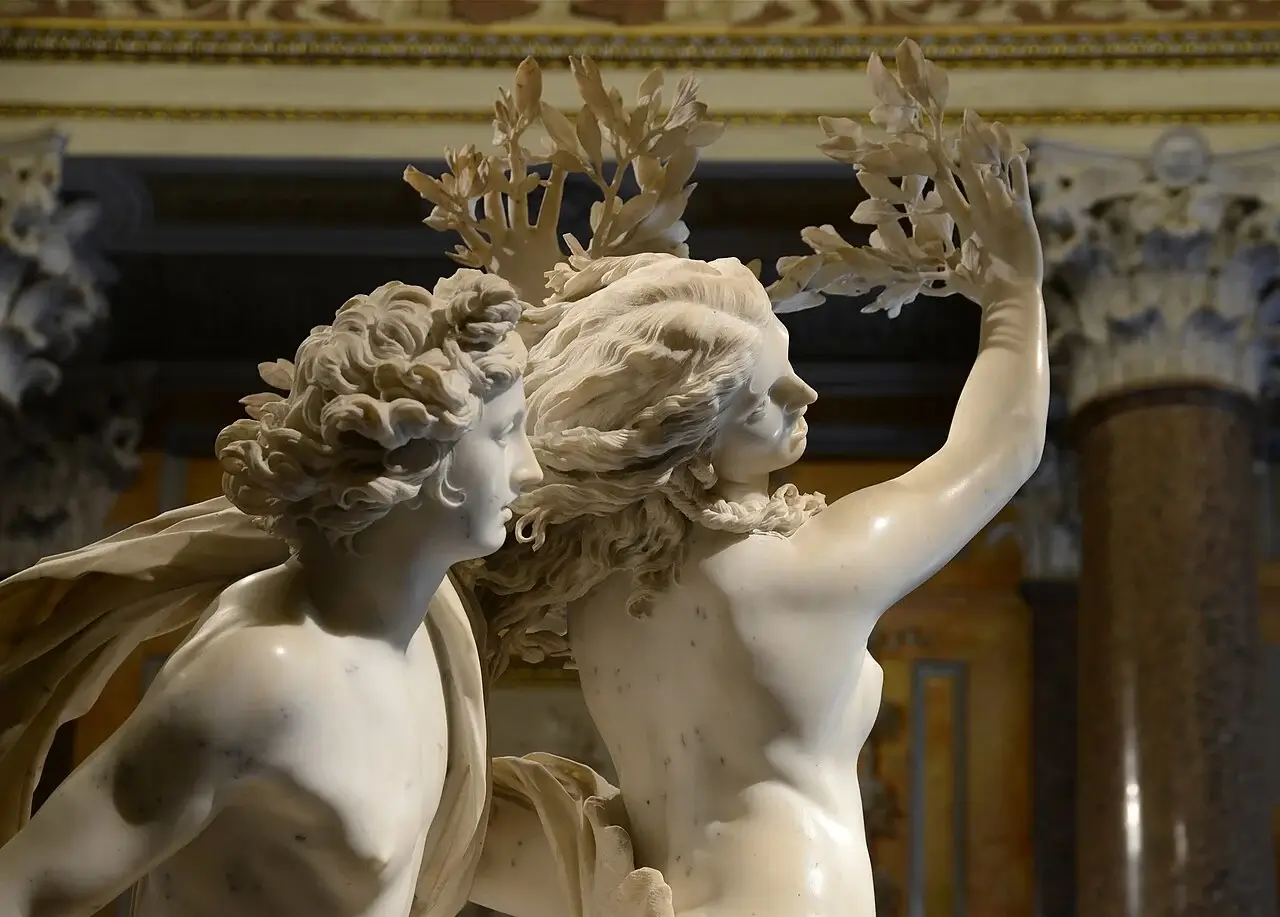
Bernini’s Apollo and Daphne: In this marble sculpture, the god Apollo reaches to grasp the nymph Daphne as she transforms into a laurel tree to escape him. What Bernini achieves — in solid marble — is the impossible: explosive motion and perfect stillness captured in the same object, at the same moment. Her fingers are becoming branches; her feet are taking root; his forward movement is arrested by what he touches. How can stone hold this? The sculpture forces the viewer to confront the paradox of motion frozen in stillness, and in doing so reveals something about time, transformation, and the impossibility of holding what is always fleeing. This is what genuine aesthetic experience does: it uses the particular to point toward something that transcends the particular.
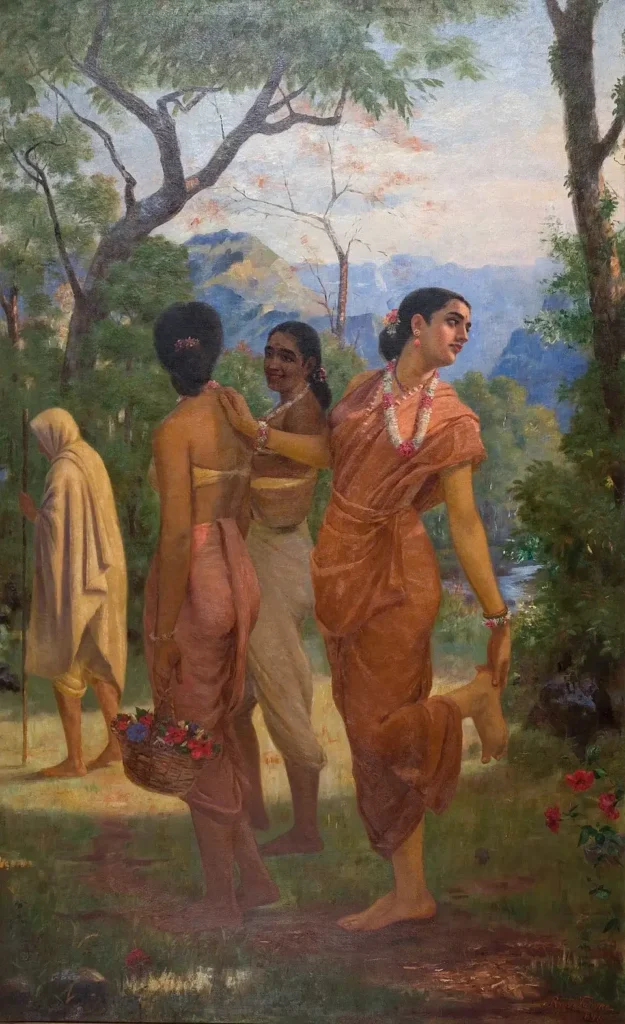
Raja Ravi Varma’s Shakuntala: In this painting, Shakuntala is walking with her companions and pretends to remove a thorn from her foot — a pretext to turn back and look at King Dushyant who is watching her. Ravi Varma extracts from a continuous movement — a journey, a glance, a love beginning — a single still moment that holds the whole meaning of that movement. The continuous becomes the still; the temporal becomes the timeless. The painting does not record; it distils.
The capacity to experience beauty at this level — not just to recognise it superficially but to feel the structure and meaning it carries — is something that separates human experience at its highest from animal experience and even from most ordinary human experience. Aristotle said that what distinguishes the human from the animal is reason. This is true, but perhaps insufficient. Machines can reason, at least in the narrow computational sense. But the experience of beauty — the recognition of harmony and form that opens onto truth — is something different from calculation. It is the mode of experience that takes the human to the highest level of what it means to be human.
Boethius understood this, even if it is not the Consolation’s primary theme. His legacy — the logic that builds foundations, the ethics that shapes action, and the aesthetics that trains perception — points toward a complete philosophical education that contemporary universities have largely dismantled by making each of these foundational disciplines optional.
Boethius stands at the most precarious moment in the history of Western intellectual culture. The Roman world that had produced Plato and Aristotle, Cicero and Seneca, was collapsing. Greek literacy was dying. Books were being lost. The infrastructure that sustained philosophical life — schools, libraries, educated readers — was disappearing. Boethius could not stop any of this. But he could translate, and he did. And he could write, and he did.
The Consolation is, among other things, a proof of what philosophy is for. It is not merely an academic exercise for comfortable scholars in peaceful institutions. It is a discipline that can be practised in a death cell, that can address the hardest questions a human being faces — why suffering, why injustice, why me — and offer not false comfort but genuine understanding. Lady Philosophy does not tell Boethius that his situation is not terrible. She helps him see what is and is not lost, what is and is not truly valuable, and how reality is structured in a way that makes his despair philosophically unwarranted even if his circumstances are genuinely terrible.
His philosophical contributions — the certainty/necessity distinction, the knower-dependence of knowledge, and the modal framework these generate — changed how philosophy was done. His translations gave the medieval world what it needed to think with. And his recognition of the three transcendentals — truth, goodness, and beauty, as disciplines corresponding to logic, ethics, and aesthetics — articulated an understanding of philosophical education that the greatest traditions of East and West had independently arrived at.
He was executed before he could finish his project. The complete works of Plato and Aristotle in Latin might have changed the course of medieval philosophy — it is impossible to know. What he did manage to preserve, and what he did manage to write, was enough to make him irreplaceable. Every medieval thinker from Anselm to Aquinas built on foundations that Boethius had laid.
Frequently Asked Questions
Why did Boethius end up in prison? Was he actually guilty of treason?
The historical evidence strongly suggests he was not guilty. The charge — that he was conspiring with Justin, the Eastern Roman Emperor, to overthrow Theodoric — was never proven. The more plausible explanation involves two overlapping factors. First, court politics: Boethius worked with unusual integrity in a deeply political environment, which made him effective but also made him powerful enemies who wanted him removed. Anyone who makes real decisions in a position of real power accumulates people who have reasons to see them gone. Second, religious difference: Boethius was a Catholic Christian and Theodoric was an Arian Christian — a branch of Christianity with different theological commitments and different political alignments, particularly toward the Eastern Empire. In a period of religious tension, this gap provided a ready basis for suspicion. The most probable account is that Boethius was caught in a combination of court intrigue and religious politics, falsely accused by enemies who saw an opportunity, and executed by a king who may have genuinely believed the charge or simply found it convenient to do so.
What does Lady Philosophy mean when she dismisses poetry at the beginning?
The dismissal of poetry is not a rejection of emotion or of art. It is a philosophical claim about what genuinely helps a person in distress — and what does not. Lady Philosophy’s point is this: poetry speaks to emotion and through emotion. A sad poem, or a sad song, can make sadness feel more expressive and more resonant. But it does not address the source of the sadness, does not clarify what is actually true about the situation, and does not dissolve the confusion that makes the sadness worse than it needs to be. If anything, artistic expression of distress can deepen the distress by intensifying the focus on it — in the way that listening to sad songs when you are unhappy often makes you more unhappy, not less. What genuinely helps is understanding: seeing clearly what has actually happened, what is truly lost and what is not, what is permanently valuable and what was always only temporarily held. That understanding is philosophy’s work. The subsequent alternation of poetry and prose in the book shows that Boethius does not reject emotional expression — he integrates it with the rational analysis that gives it proper context and direction.
Is Boethius’s solution to the free will problem convincing?
Philosophers continue to debate this, and it is not a question with a settled answer. Boethius’s two philosophical moves — distinguishing certainty from necessity, and arguing that knowledge depends on the knower — are genuine philosophical contributions that have influenced every subsequent discussion of the problem. But his solution faces continuing objections. On the certainty/necessity distinction: while it is correct that knowing something will happen does not by itself make it necessary, there is a question about whether God’s knowledge of what you will do is more than mere observation — whether divine providence involves some deeper kind of causal involvement in events that the horse race analogy does not capture. On the eternal present: while the concept of God outside time elegantly sidesteps the temporal structure of the problem, some philosophers argue that ‘timeless knowledge of free acts’ is itself incoherent — that genuine freedom requires temporal openness, and a being that timelessly knows what you will do has in some sense already ‘closed’ the future from eternity. What is beyond debate is that Boethius’s method of engaging with the problem — drawing precise conceptual distinctions rather than simply asserting compatibility — raised the level of the discussion permanently. Whether or not he solved the problem, he made it impossible to discuss it carelessly afterward.
What is modal thinking and why does it matter beyond philosophy?
Modal thinking is the analysis of reality using the concepts of necessity, contingency, possibility, and counterfactuals — not just asking ‘what is?’ but ‘what must be?’, ‘what could be?’, ‘what couldn’t be?’, and ‘what would have been if things had been different?’ These distinctions, introduced with philosophical precision by Boethius’s argument, are now foundational across multiple disciplines. In science: every controlled experiment is a counterfactual (‘what would happen to the outcome if we changed this one variable?’). In law: determining whether a defendant is responsible often requires asking counterfactual questions about what a reasonable person would have done under the same circumstances. In medicine: understanding causation (did this treatment help?) requires comparing what happened with what would have happened without the treatment. In probability theory and statistics: every probability is a claim about contingency — about events that are real but could have been otherwise. The move from ‘what is’ to ‘what must/might/could/would be’ is one of the most productive expansions in the history of human reasoning, and its philosophical articulation in the Western tradition traces directly to Boethius’s response to the free will problem.
What is the connection between the Three Transcendentals and Boethius’s philosophy?
Plato identified three fundamental properties of ultimate reality: the highest Form — the Form of the Good — is simultaneously the source of truth, goodness, and beauty. These three together are what makes the real fully real. Boethius inherited this Platonic framework and it runs through the Consolation: the analysis of false goods in Book III (testing each against the standard of complete, stable goodness) and the vision of God as the source of all genuine goodness are expressions of this Platonic inheritance. What the Consolation reveals — and what the cross-traditional survey in the lecture underlines — is that this triad (truth, goodness, beauty) appears in independent philosophical and religious traditions across cultures: Satyam Shivam Sundaram in Indian philosophy; the three transcendental properties of God in Christian scholasticism; Al-Haqq, Al-Khayr, Al-Jameel in Islamic thought. The convergence is not coincidental. Truth, goodness, and beauty correspond to the three fundamental modes of human valuation — knowledge, action, and perception — and any adequate account of what is most real and most worth pursuing will naturally converge on all three. Each corresponds to a philosophical discipline: logic/epistemology (truth), ethics (goodness), aesthetics (beauty). Boethius’s legacy touches all three: through his logical translations (truth), through the ethical argument of the Consolation (goodness), and through the vision of ultimate beauty that runs through Plato’s account of the Form of the Good.

Leave a Reply