
Is the good life about maximizing pleasure — or about wanting less in the first place? Epicurus’s garden commune quietly answered both: pursue pleasure intelligently, but discover that once fear of gods and death is removed, almost nothing is actually necessary for happiness. This lecture unpacks the philosophy most people misunderstand as indulgence, and which was actually a rigorous, almost ascetic path to peace of mind.
Key Takeaways
- Epicureanism is a philosophy of happiness understood as the intelligent pursuit of pleasure and avoidance of pain. For Epicurus, this is not a moral ideal but a description of how humans actually work: observe children, who instinctively pursue what pleases them and avoid what hurts them. Adults are no different in their fundamental motivation — they are simply more confused about what will actually deliver lasting pleasure. Philosophy’s entire purpose is to clarify this confusion.
- Philosophy is purely instrumental for Epicurus — it is a tool for happiness, not a good in itself. Aristotle held that contemplation and philosophical inquiry are intrinsically valuable; Epicurus disagrees entirely. Philosophy matters only insofar as it helps us eliminate pain and achieve genuine pleasure. Everything in philosophy that does not serve this purpose is to be set aside.
- Most human suffering is mental, not physical — and most mental suffering comes from false beliefs. Physical pain (illness, injury, old age) is unavoidable and must be endured. But mental pain — worry about the past, dread of the future — is avoidable. Its primary sources are false beliefs about the gods and false beliefs about death. Understanding atomism dissolves both: if all events are atomic processes, the gods do not interfere in human life, and death is simply the separation of atoms with no afterlife of punishment.
- True pleasure requires prudence — intelligent calculation, not blind gratification. Epicureanism is not an endorsement of unlimited indulgence. A drink gives immediate pleasure but causes lasting health damage; a bitter medicine is immediately unpleasant but produces lasting wellbeing. Prudence (vivek) is the capacity to evaluate the long-term pleasure-and-pain balance of any choice. Without prudence, the pursuit of pleasure leads directly to a life of increasing pain.
- Epicurus classifies desires into three tiers: vain (limitless, eliminate), natural but non-necessary (manageable, moderate), and natural and necessary (limited by nature, cultivate). Vain desires — for status, luxury, unlimited wealth — can never be satisfied and should be abandoned. Natural necessary desires — for food, basic shelter, friendship, and wisdom — have built-in natural limits: hunger is satisfied by simple food; a single genuine friend is enough. The Epicurean life is therefore radically simple by choice.
- Epicurus is an empiricist: all reliable knowledge comes from sensory experience. Three sources are identified: sensation (raw perceptual data — always accurate; errors arise in judgment not sensing), pre-conceptions (general concepts built up through repeated experience, which give us the starting point for inquiry — Epicurus’s answer to Plato’s paradox of learning), and feelings (pleasure and pain as the basic evaluative signal). This empiricist epistemology connects Epicurus directly to the great modern debate between innate and acquired knowledge.
Table of Contents
Introduction — Epicurus and the Garden
Epicurus was born in 341 BC on the island of Samos and became one of the most influential thinkers of the ancient world. In 306 BC he arrived in Athens and established his philosophical school in a garden outside the city — a fact that gave the school its enduring name: the Garden. He taught there until his death, probably from kidney stones, at around the age of seventy-one.
The Garden was unusual among ancient philosophical schools in an important respect. It was open to everyone without distinction: men and women, free citizens and slaves, soldiers and children. It functioned as a genuine community — a family of intellectual companions who lived together, ate together, and pursued philosophy as a shared practice rather than an academic exercise. This inclusive spirit was itself an expression of Epicurean values: friendship was central to the good life, and no conventional social category determined who was capable of living well.
Epicureanism spread rapidly. It was accessible in a way that Platonic metaphysics and Aristotelian science were not — its central claims were simple, its practical recommendations were clear, and its emotional appeal was direct. Along with Stoicism, it became one of the two dominant philosophical movements of the Hellenistic and early Roman periods. Its decline came with the rise of Christianity, and the disappearance of most of Epicurus’s prolific writings was likely accelerated by the hostility of Christian culture to a philosophy that denied divine providence and the soul’s survival of death.
1. Happiness as Pleasure — The Core Claim
Epicurus begins with a claim that is simple in statement but significant in implication: the aim of life is happiness, and happiness consists in achieving pleasure and avoiding pain. This is not an ethical prescription — a statement of what ought to be the case. It is, in Epicurus’s view, a statement of fact: an accurate description of how human motivation actually works.
The children argument: Watch small children before they have been shaped by social convention and cultural expectation. They reach toward what feels good and pull away from what hurts. Their behaviour is not guided by philosophical reasoning or moral instruction — it is the direct expression of a fundamental biological orientation. Adults operate by the same principle, but years of accumulated beliefs about what will bring pleasure complicate and often distort this basic drive.
The Greek word for pleasure is hedone, and the view that pleasure is the highest good is accordingly called hedonism. Epicurus is a hedonist, but he is very careful about what this means — and what it does not mean. It does not mean the reckless pursuit of every available gratification. It means the intelligent identification and cultivation of what genuinely produces lasting pleasure and minimises lasting pain.
Epicurus vs Aristotle — Two Views of the Good Life
Aristotle held that pleasure is good but insufficient as a life-goal. The true human good — eudaimonia — requires the activity of reason in accordance with virtue, with contemplation as the highest form of rational activity. Pleasure accompanies a well-lived life but is not its aim or its measure.
Epicurus takes a different position. He does not argue about what life should look like in principle; he claims to describe what human beings actually seek. Every person, including the philosopher, pursues pleasure and avoids pain. The contemplative life Aristotle recommends may genuinely please those temperamentally suited to it — but it is not a universal prescription. Philosophy must speak to the full range of human experience, not only to those capable of sustained intellectual inquiry.
Philosophy as Instrument, Not End
Epicurus on the purpose of philosophy: Philosophy is a tool — valuable entirely because it helps us achieve happiness. Any branch of philosophy that does not contribute to reducing pain or increasing genuine pleasure is to be set aside. This is a radical departure from both Plato and Aristotle, for whom philosophical inquiry is among the highest human activities — valuable in itself.
2. Two Types of Pain — Why Mental Pain Is the Priority
| # | Physical Pain | Mental Pain |
|---|---|---|
| Greek term | None (general bodily pain) | None (psychic pain — logismoi) |
| Source | Physical injury, illness, bodily deterioration, old age | False beliefs about reality — primarily fear of divine punishment and fear of death |
| Time range | Present only — the body can only suffer now | Past, present, and future — rumination about what happened; dread of what might come |
| Can it be avoided? | No — physical pain is an unavoidable feature of embodied life; it must be endured | Yes — with correct beliefs about reality, mental pain can be largely eliminated |
| Philosophy’s role | None — philosophy cannot prevent bodily harm | Direct — understanding atomism dissolves the false beliefs that generate mental suffering |
| Epicurus’s priority | Secondary — endure what cannot be changed | Primary — this is where philosophy has its most important work to do |
The Deer and the Human — A Study in Mental Pain
The deer analogy: A deer in the forest lives peacefully — grazing, drinking, resting — and is afraid only when a predator is physically present. The moment the predator is gone, the fear disappears completely. The deer returns immediately to its natural state of calm. Human beings are the only animals who cannot do this. Whether or not a lion is nearby, a human worries. They ruminate over past events that cannot be changed and dread future possibilities that may never occur. The mind produces suffering independently of present circumstances.
This observation points to what Epicurus sees as the central philosophical problem: most human unhappiness is self-generated, the product of false beliefs about reality rather than of genuine hardship. Physical pain requires medical treatment; mental pain requires philosophical treatment — the correction of the false beliefs that cause it.
The Two Great False Beliefs
Epicurus identifies two primary sources of false belief that generate chronic mental suffering in his culture.
- Fear of the gods: The belief that the gods watch over human affairs, intervene according to their moods, and can at any moment punish or reward individuals. People who hold this belief live in a state of permanent anxiety — attempting to appease divine beings whose intentions are unknowable and whose anger is unpredictable. Soothsayers and astrologers profit by intensifying this fear.
- Fear of death and the afterlife: Greek religious tradition contained vivid and terrifying accounts of punishment after death. These stories were not regarded as mere mythology — they were part of a living cultural framework that shaped how people understood their mortality.
The Greek Myths of Afterlife Punishment
Three myths in particular shaped the Greek cultural fear of death and what follows it.
Tantalus: Condemned to stand in a pool of water with fruit hanging above him. When he reached down to drink, the water receded; when he reached up to eat, the fruit rose beyond his grasp. An eternity of unfulfilled desire — hunger and thirst that can never be satisfied.
Tityos: Bound and spread-eagled, with vultures eternally consuming his regenerating flesh. Each time they ate, the flesh grew back. An eternity of pain without end or resolution.
Sisyphus: Condemned to roll an enormous boulder up a hill, only for it to roll back to the bottom the moment it reaches the top. An eternity of futile, exhausting repetition.
Epicurus’s response to all of this: these stories are false. Understanding the actual nature of reality — through atomism — shows that such afterlife scenarios are not merely improbable but metaphysically impossible.
3. Atomism — The Metaphysical Foundation
Epicurus adopts the atomic philosophy of Leucippus and Democritus as the metaphysical framework that supports his ethical programme. Understanding atomism is essential to understanding why Epicurus believed the fear of gods and the fear of death are groundless.
Core Atomist Claims
- Reality consists of atoms and void only — indivisible particles of matter moving through empty space. There is nothing else.
- All things — living and non-living, bodies and souls — are combinations of atoms. The soul is made of atoms too; they are simply finer and more subtle than those comprising bone or flesh.
- All change is the result of atoms combining or separating. What we experience as the birth, growth, death, and decay of things is simply the rearrangement of atomic matter.
- All atomic movement follows physical laws — cause and effect, without exception. This is mechanical determinism: in principle, every event is the necessary consequence of prior atomic configurations.
The Swerve — Creating Space for Free Will
Mechanical determinism creates a problem for any practical philosophy. If every event — including every human thought, decision, and action — is the fixed result of prior atomic states, then there is no free will. And if there is no free will, there is no point in philosophical guidance: we cannot choose how to live, because our choices are already determined.
Epicurus resolves this by modifying the atomist framework at a single critical point. He proposes that atoms occasionally deviate from their determined paths — spontaneously, without any cause. This is the swerve (clinamen in Latin). The swerve introduces genuine unpredictability into the atomic system, and with it, genuine freedom. Our choices are not entirely determined by prior atomic states; there is a gap through which voluntary action can emerge.
The swerve is philosophically controversial — Epicurus offers no explanation for why it occurs (which is precisely the point; it is causeless). But without it, or something like it, the Epicurean practical programme collapses: if all is determined, we cannot meaningfully choose to live differently.
What Atomism Does to the Fear of Gods
If every event in the world is the result of atomic motion following physical laws, then the gods — whatever they may be — have no role in natural events. Storms, eclipses, disease, crop failure, and good fortune are all consequences of atomic processes, not divine decisions. The sun and moon and planets are not divine beings watching over humanity; they are atomic formations moving according to physical principles.
Epicurus does not straightforwardly deny the existence of gods. He says that even if gods exist, they are blessed and at peace — and blessed beings have no interest in interfering in the troubled affairs of mortals. A truly happy being does not spend its time monitoring human behaviour and devising interventions. Even among humans, those who are genuinely content with their lives do not feel compelled to meddle in others’. The gods, if they are genuinely happy, are similarly disengaged.
The practical consequence is clear: stop trying to appease divine beings. Stop consulting soothsayers and astrologers about divine displeasure. The cosmos is indifferent to your choices — and this is good news, because it means there is nothing to fear from it.
4. Two Arguments Against the Fear of Death
Having shown that the fear of divine punishment is based on a false picture of reality, Epicurus addresses the second great source of mental suffering: the fear of death and what follows it. He offers two distinct and complementary philosophical arguments.
| # | Argument 1 — No Subject of Harm | Argument 2 — Symmetry |
|---|---|---|
| The argument | When we are alive, death has not yet arrived. When death arrives, we no longer exist. There is therefore no moment at which both we and death coexist — no person to experience death as something bad. | Our condition after death mirrors our condition before birth. Before birth we did not exist and suffered nothing. After death we will equally not exist and suffer nothing. We do not fear pre-birth non-existence; there is no reason to fear post-death non-existence. |
| Key premise | Good and bad are sensations — experiences of pleasure and pain. A dead person has no sensation. Therefore death cannot be experienced as something bad by the person who has died. | The two states of non-existence — before birth and after death — are structurally identical. If one does not frighten us, neither should the other. |
| Atomism connection | At death, the atoms that constitute the soul and body separate. There is no persistent self to experience anything after this separation. | The atoms that will constitute a person did not experience anything before combining; they will not experience anything after separating. |
| Famous formulation | ‘When we are, death is not; when death is, we are not.’ Death is nothing to us. | ‘Look back at the eternity before your birth — that is what death will be like.’ — A similar point made by later Epicureans. |
Together, these arguments are designed to show that death is not an evil — not because there is something good awaiting us after it, but because there is literally nothing: no subject, no experience, no suffering. The terror that the Greek myths attached to death was a product of imagination, not of reality. Reality — correctly understood through atomism — offers not comfort in the conventional religious sense but something potentially more liberating: the complete absence of any reason to be afraid.
5. Pleasure, Prudence, and the Distinction Between Pleasures
Common misconception: Epicureanism means unlimited indulgence — eating, drinking, and pursuing every available pleasure without restraint. This is not only wrong but the opposite of what Epicurus taught. Excessive pleasure-seeking reliably produces lasting pain.
The Role of Prudence
Epicurus introduces a critical concept: prudence (phronesis — vivek in Hindi). Prudence is the intellectual capacity to evaluate any choice in terms of its long-term pleasure and pain balance, not just its immediate effect.
Drinking too much: Alcohol provides immediate pleasure. But excessive consumption produces health problems — physical pain, diminished mental clarity, damaged relationships. The short-term moving pleasure is overwhelmed by the long-term static pain. A prudent person calculates this and moderates accordingly.
Bitter medicine: Medicine that tastes unpleasant creates immediate displeasure. But it restores health, which produces lasting wellbeing. The short-term moving pain is worth accepting for the long-term static pleasure. A prudent person accepts this.
Without prudence, the pursuit of pleasure is self-defeating. The person who chases every available gratification without calculation ends up in a state of chronic pain — addicted, unwell, financially ruined, or relationally isolated. Prudence is what converts hedonism from a recipe for disaster into a genuine path to happiness.
Moving vs Static Pleasure — The Higher Form
| # | Moving Pleasure (Kinetic) | Static Pleasure (Katastematic) |
|---|---|---|
| Greek term | Kinetic pleasure (kinesis = movement/process) | Katastematic pleasure (katastema = stable state) |
| What it is | The pleasure experienced while a desire is actively being satisfied — the pleasure of the process itself | The pleasure of a state in which desire has been fully satisfied and no further wanting remains |
| Example | Eating a delicious meal when hungry — the experience of eating as appetite is progressively satisfied | After the meal — full, content, at rest, no further impulse to eat even if food remains available |
| Is desire present? | Yes — desire is present and being answered; the pleasure arises from that answering | No — desire has dissolved; this is a state of complete desirelessness and tranquillity |
| Epicurus’s evaluation | Good — a genuine and natural pleasure worth experiencing | Better — the higher form of pleasure, because it is a state of peace rather than a state of active wanting |
| Connection to happiness | Contributes to happiness but requires the desire to exist first | This state of desireless contentment is what Epicurus calls ataraxia — the goal of the Epicurean life |
The highest Epicurean state is ataraxia — a Greek term meaning tranquillity or freedom from disturbance. It is the static pleasure of a life in which genuine desires are met, false desires have been abandoned, and the mind is at peace. This is not excitement or exhilaration; it is the deep, stable contentment of a person who lacks nothing they genuinely need.
6. The Classification of Desires
The most practically useful element of Epicurean ethics is its systematic classification of desires. Not all desires are equal. Understanding which desires are worth pursuing — and which should be abandoned — is the core practical skill of Epicurean living.
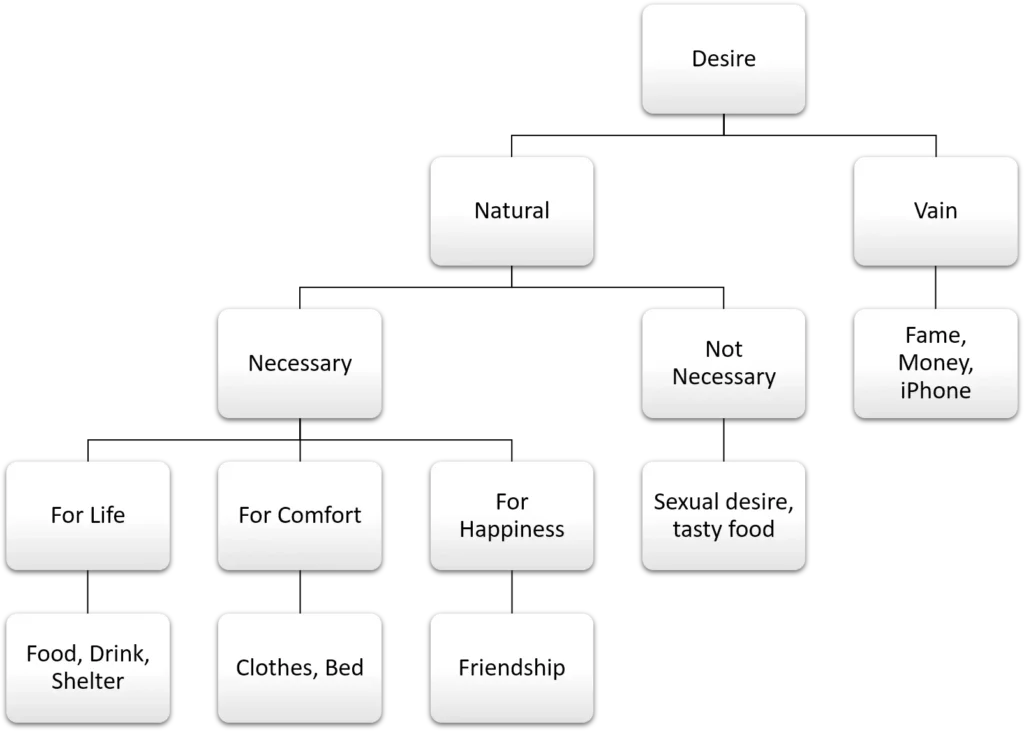
| Category | Natural? | Necessary? | Examples | Natural limit |
|---|---|---|---|---|
| VAIN / EMPTY DESIRES | Not natural | Not necessary | Designer goods, luxury items, social fame, status symbols, unlimited wealth | None — these desires expand without limit; satisfying them creates more wanting, not contentment |
| NATURAL, NOT NECESSARY | Natural | Not necessary | Sexual pleasure, exceptionally tasty food, luxury entertainment | Moderate — these can be satisfied but are not required |
| NATURAL AND NECESSARY — for life | Natural | Necessary | Food, water, warmth | Very limited — hunger is satisfied by simple food; thirst by plain water |
| NATURAL AND NECESSARY — for comfort | Natural | Necessary | Basic clothing, safe shelter from the elements | Limited — a few items of clothing; a simple, weather-proof dwelling |
| NATURAL AND NECESSARY — for happiness | Natural | Necessary | Friendship, philosophical wisdom | Limited — a single genuine friend is sufficient; wisdom deepens over time |
The Key Insight: Natural Limits
The crucial difference between necessary natural desires and all others is that necessary desires have natural limits built into them. This is what makes them the foundation of a satisfying life.
- Hunger is satisfied by simple food — not necessarily by the finest food. Once hunger is gone, no further food is needed.
- The need for warmth and shelter is met by a basic, safe dwelling. Once protected from the elements, further luxury adds nothing essential.
- Friendship is satisfied by one or two genuine companions — people with whom trust, honesty, and mutual affection are real. No quantity of acquaintances substitutes for this.
Vain desires, by contrast, have no natural limit. The person who desires social status always wants more recognition. The person who desires wealth always needs more money. The person who desires the latest product is never satisfied for long before the next version appears. These desires cannot be satisfied because satisfaction is not their nature — they are structured to perpetuate themselves.
The iPhone example: The belief that owning the newest smartphone will improve your life is not a natural desire — it is a false belief generated by advertising and social comparison. The desire itself is artificial. Even if satisfied, it produces no lasting contentment; another version quickly creates the same lack. This is the structure of all vain desires: they are designed — by social influence and false beliefs — to be permanently unsatisfied.
7. Friendship — The Highest Virtue
Among all the things that contribute to a happy life, Epicurus places friendship at the summit. The community of the Garden was itself a living demonstration of this conviction: shared meals, shared conversation, mutual affection, and intellectual companionship were the daily fabric of Epicurean life — accessible to anyone regardless of wealth, status, or education.
Friendship, in the Epicurean view, is something available to every human being. It requires no resources beyond time, honesty, and genuine care. A single true friend — someone with whom you can speak openly, who cares for your wellbeing as you care for theirs — is more valuable to happiness than any amount of wealth or status.
A noted tension in Epicurus’s account: in some passages he describes friendship as good because it produces pleasure — a purely instrumental justification. In other passages he suggests that friendship is good in itself, and that a genuine friend is worth dying for. These two positions are not easily reconciled. This inconsistency is acknowledged in the sources and remains a point of scholarly discussion.
8. Virtues, Justice, and Social Life
Virtues as Instruments
Epicurus accepts the traditional Greek virtues — moderation, courage, justice — but he refuses to grant them the intrinsic value that Aristotle and Plato ascribed to them. Virtues are good not in themselves but because they are reliable instruments for achieving happiness. A courageous person tends to live better; a moderate person avoids the pain that excess produces; a just person lives without the anxiety of wrongdoing and its consequences. The virtues work — but they are means, not ends.
Justice as Agreement
Epicurus offers a notably early version of what would later be called social contract theory. Justice, he argues, is not a metaphysical property of actions but a practical agreement between people: an understanding that neither party will harm the other. This agreement enables peaceful coexistence, which enables the pleasant, undisturbed life that is Epicurus’s goal.
This contractual account of justice anticipates the arguments of Hobbes, Locke, Hume, and later Rawls — all of whom, in different ways, ground political and moral norms in agreement and mutual benefit rather than in objective moral facts. The idea that justice is instrumentally valuable (because it enables peace) rather than intrinsically valuable (because it is objectively right) runs through a long tradition of subsequent political philosophy.
Avoid Politics
Epicurus’s social philosophy follows directly from his commitment to mental tranquillity. Political life — participation in public office, factional competition, civic debate — is a reliable source of stress, enmity, and disturbance. It creates opponents, generates conflict, and draws the mind away from the simple pleasures and friendships that actually constitute the good life. The Epicurean prescription is therefore withdrawal: live simply, cultivate friendships, follow social rules insofar as they support a peaceful existence, but do not seek power or public prominence. Follow the rules not out of duty but because doing so keeps your life undisturbed.
9. Epicurean Epistemology — All Knowledge from the Senses
Epicurus’s theory of knowledge — his epistemology — is empiricist: all reliable knowledge originates in sensory experience. This is not merely an intellectual position; it is the foundation of his entire practical philosophy. Knowledge of what produces pleasure and pain, knowledge of atomic reality, knowledge of the natural limits of desire — all of it rests on what the senses tell us about the world.
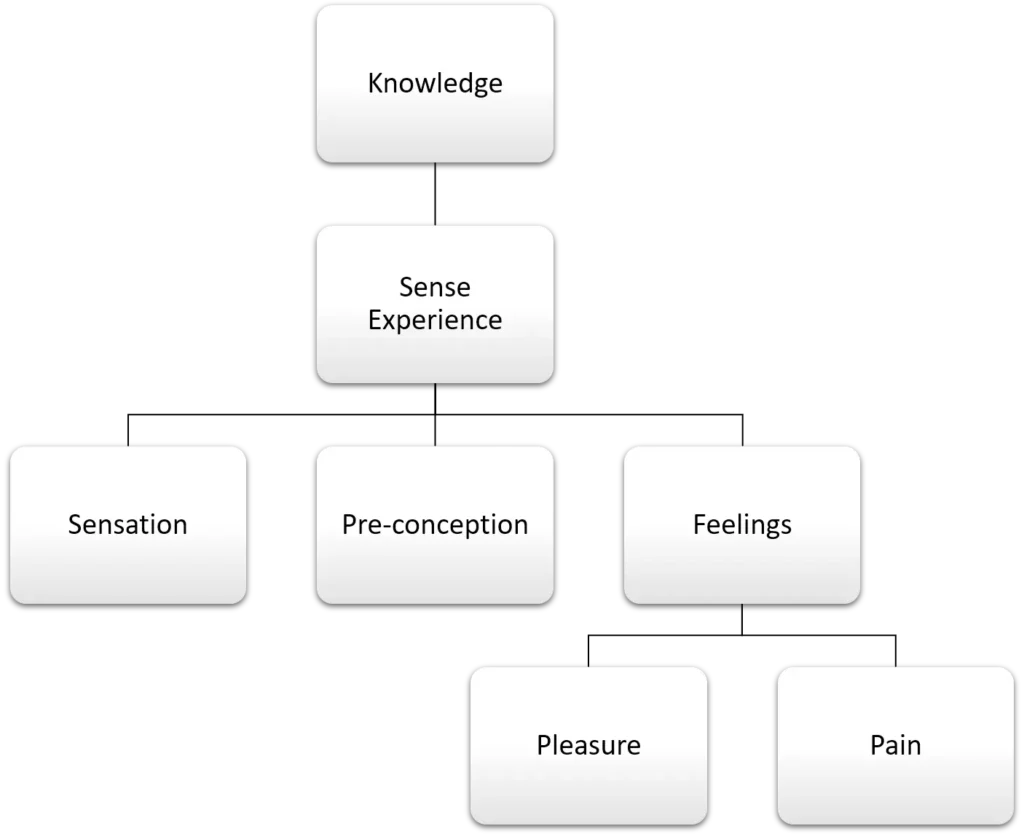
| # | 1. Sensation | 2. Pre-Conceptions | 3. Feelings (Pleasure/Pain) |
|---|---|---|---|
| What it is | Direct perceptual contact with external objects through the five sense organs | General concepts that form gradually in the mind through repeated sense experience | The basic experience of pleasure and pain arising from sense contact |
| How it arises | Automatically and mechanically — when a sense organ contacts an object, it receives an impression directly | Built up over time: a child sees many people → forms the concept ‘person’; then horse, heat, justice, good | Immediate and direct — pleasure signals what to pursue; pain signals what to avoid |
| Is it reliable? | Yes — sensation itself is always accurate; it provides raw data without distortion | Yes — these concepts are genuine generalisations from real experience | Yes — these feelings are the basic data of ethical judgment |
| Where error enters | In judgment — when we interpret sense data incorrectly (e.g. concluding a shadow is a person) | In applying concepts incorrectly or building false beliefs on top of genuine pre-conceptions | In reasoning about what will produce pleasure or pain in the longer term — this is where prudence is needed |
| Connection to Plato | N/A — Plato did not ground knowledge in sensation | Epicurus’s response to Plato’s paradox of inquiry: pre-conceptions give the starting point for learning, replacing Plato’s innate recollection from a pre-birth soul | N/A — Plato did not ground ethical knowledge in bodily sensation |
Senses Never Lie — Only Judgment Errs
One of Epicurus’s most important epistemological claims is that the senses themselves are always accurate. They provide raw, uninterpreted data about the world — and that data, as such, is never false. Error enters only when we interpret the data incorrectly.
The shadow in the dark: Walking through a dark room, you see a shape and your judgment concludes: there is a person standing there. You are frightened. You turn on the light: it is your shirt hanging on a hook. Your eyes were not wrong. They accurately reported the shape, the shadow, the visual impression. What was wrong was your judgment — the inference you drew from that accurate data. The correction is simple: move closer, turn on the light. Sense data can be verified through further sense experience.
Pre-Conceptions — Epicurus’s Answer to Plato’s Paradox
Plato posed a puzzle in the Meno known as the paradox of inquiry: if you already know something, why search for it? And if you don’t know it, how will you recognise it when you find it? Plato’s solution was the doctrine of recollection — the soul existed before birth, knew the eternal forms directly, and learning is the process of re-awakening this pre-existing knowledge.
Epicurus cannot accept this solution. He believes neither in pre-existing souls nor in eternal forms. His response is the doctrine of pre-conceptions: general concepts that develop gradually through repeated sensory experience. A child who sees many people eventually forms the concept ‘person’ — not from any innate knowledge, but from accumulated experience. These pre-conceptions then provide the conceptual framework for all further inquiry. They are the starting point — the basis from which new questions can be asked and new discoveries made.
The deeper significance: This disagreement — Plato’s innate knowledge versus Epicurus’s experientially acquired knowledge — is one of the most fundamental disputes in the history of Western philosophy. It resurfaced in full force in the seventeenth century in the debate between rationalists (Descartes, Leibniz, Spinoza — who argued for innate ideas) and empiricists (Locke, Berkeley, Hume — who argued that all knowledge derives from experience). The issue was not settled then and remains philosophically alive.
Conclusion
Epicureanism is a philosophy of liberation — but a very specific kind of liberation. It does not liberate through political action, philosophical transcendence, or spiritual transformation. It liberates through clarity: correct understanding of what reality actually is (atomism), correct understanding of what genuinely produces lasting pleasure (the classification of desires), and correct understanding of what we have been needlessly afraid of (the gods, death, and divine punishment). Remove these false burdens, and what remains is a life that is not difficult to live well: simple food, basic shelter, genuine friendship, intellectual curiosity, and the deep contentment of a mind at peace.
The Epicurean diagnosis of the human condition has lost none of its accuracy. Vain desires — for status, recognition, unlimited acquisition — still produce the same cycle of unfulfilled wanting that Epicurus described. The fear of death and the anxiety about forces beyond our control still dominate human emotional life in the ways he identified. And the remedy he prescribed — prudent management of desire, cultivation of friendship, philosophical clarity about what is and is not within our power — remains as practically sound as it was in the Garden of Athens.
What makes Epicurus significant beyond his immediate practical prescriptions is the philosophical framework he built to support them. His empiricist epistemology, his atomist metaphysics, his contractual account of justice, and his instrumental view of virtue each anticipate major subsequent developments in Western thought. He is not merely a self-help philosopher — he is a systematic thinker whose ideas reverberate across the entire subsequent history of philosophy, from the Stoics who engaged and partly adopted his positions, through the early modern empiricists who rediscovered his epistemological insights, to contemporary discussions of hedonism, desire satisfaction, and the nature of wellbeing.
Frequently Asked Questions
Is Epicureanism really just a philosophy of pleasure-seeking? How is it different from simple hedonism?
The common image of Epicureanism — as a philosophy of indulgence, luxury, and sensory gratification — is a historical distortion. Epicurus did hold that pleasure is the highest good, and in that sense he was a hedonist. But he was emphatic that the blind pursuit of every available pleasure leads reliably to lasting pain rather than lasting happiness. The key concept is prudence — the capacity to evaluate any choice in terms of its long-term pleasure-and-pain balance. A pleasure that produces greater pain later is not worth pursuing. A pain that produces greater pleasure later is worth accepting. Epicurus himself lived extremely simply — bread, water, cheese on a special occasion — not as an ascetic exercise but as a genuine expression of his position: that the simplest pleasures, properly appreciated, are sufficient for happiness, and that the pursuit of luxury creates the chronic dissatisfaction of vain desire.
What is ataraxia, and why is it the goal of Epicurean life?
Ataraxia is a Greek term meaning tranquillity, undisturbedness, or freedom from anxiety. It is the condition of a mind that has no unfulfilled genuine desires and no irrational fears — particularly no fear of the gods or of death. Epicurus identifies this as the highest form of pleasure: not the moving pleasure of desire being satisfied, but the static pleasure of a state in which there is simply nothing troubling the mind. It is not excitement or joy in the conventional sense; it is a deep, stable contentment that does not depend on any external circumstance and therefore cannot be taken away by any external circumstance. Achieving ataraxia requires doing the philosophical work of identifying and eliminating false beliefs, classifying one’s desires correctly, and cultivating the genuine goods — friendship, wisdom, simple pleasures — that satisfy natural limits.
Why does Epicurus think the senses are always reliable? Don’t we sometimes see things that aren’t there?
Epicurus’s position is that the senses themselves — the raw data provided by perceptual contact with the world — are always accurate. What goes wrong is not the sensing but the judging. When you see a shape in a dark room and conclude there is a person there, your eyes have reported the shape correctly. The error is in the inference: you have drawn a wrong conclusion from accurate data. This is an important and genuinely defensible distinction. The visual impression of the shape was real — there was something there (a shirt on a hook) producing a visual impression. The sensation accurately captured what was there; the judgment misidentified it. The correction is to gather more sense data: approach closer, turn on the light. In this way, Epicurus argues, sense experience is self-correcting. False judgments can be detected and revised through further sensory investigation.
What is the paradox of inquiry that Plato raises, and how does Epicurus respond to it?
Plato raises the paradox in the Meno: if you already know something, you don’t need to search for it; but if you don’t know it, you won’t be able to recognise it when you find it. Either way, learning seems impossible. Plato’s solution is the doctrine of recollection: the soul existed before birth and knew the eternal forms directly; learning is the process of re-remembering what was already known. Epicurus cannot accept this account. He believes there was no pre-existing soul with access to eternal forms — the soul is itself an atomic compound that did not exist before birth. His response is the doctrine of pre-conceptions: general concepts that accumulate through repeated sense experience. A child exposed to many instances of a concept — many people, many examples of justice, many experiences of heat — gradually forms a general concept from those instances. These pre-conceptions give the starting point for all further inquiry. We can search for what justice really is because we already have a rough concept of it drawn from experience; and we can recognise it when we find a better account because our concept is refined and corrected by experience. No pre-existing soul is required.
How does Epicurean ethics relate to later social contract theory?
Epicurus’s account of justice anticipates what political philosophers from Hobbes to Rawls would later develop as social contract theory. For Epicurus, justice is not a metaphysical property — an objective feature of certain actions that makes them intrinsically right. It is a practical agreement: an understanding between people that they will not harm each other. This agreement is valuable not because it is inherently obligatory but because it enables the peaceful, undisturbed life that makes happiness possible. If breaking the agreement produced better results for everyone, there would be no compelling Epicurean reason to keep it. This purely instrumental, agreement-based account of justice — grounding obligation in mutual benefit rather than in moral fact — is precisely the structure of later social contract theories. Hobbes grounded political obligation in the mutual benefit of escaping the state of nature; Locke grounded it in the protection of natural interests; Hume argued that justice is an artificial virtue whose value is entirely in its social utility. All of these echo the Epicurean starting point.

Leave a Reply