
Two thousand years before physics had microscopes or particle accelerators, four thinkers reasoned their way to atoms and void purely through logic and observation. This lecture traces how Leucippus, Democritus, Epicurus, and Lucretius built — and argued over — the ancestor of modern physics.
Key Takeaways
- Atomism holds that only two things are real: atoms (eternal, indivisible, qualitatively neutral particles that differ only in size, shape, and position) and void (empty space). Everything else — objects, qualities, souls, minds — is composed of atoms in motion.
- Three problems solved: atomism resolved the failure of quality-based approaches to explain diversity, refuted Anaxagoras’s infinite divisibility, and addressed Parmenides’s denial of motion by affirming void as a real ‘no-thing’ distinct from nothing.
- Lucretius’s five principles — nothing is created from nothing, nothing is destroyed, empty space exists, space is infinite, and atoms are infinite in number — ground atomism in observation rather than pure reason alone.
- The motion problem split the school: Democritus called atomic motion eternal and self-explanatory; Epicurus derived it from natural free fall; the unexplained ‘swerve’ Epicurus introduced to allow collisions remains the theory’s most controversial point.
- Democritus vs Epicurus on qualities: Epicurus held that sensory qualities (colour, taste) are temporary properties of atomic collections; Democritus held they are purely subjective — interactions between the object’s atoms and the perceiver’s atoms — making all sensation a form of ‘bastard knowledge’ compared to reason’s ‘trueborn knowledge’ of atoms and void.
- Free will is eliminated by strict atomism: if every event — including every thought and decision — is a necessary consequence of prior atomic motion going back infinitely, no genuine choice is ever possible. This remains one of the deepest problems in the legacy of materialism.
Table of Contents
Introduction
Atomism is the culminating answer to the question Thales first posed: what is the fundamental stuff of the world? The journey from Thales’s water through Anaximander’s Apeiron, Heraclitus’s fire, Parmenides’s changeless being, Empedocles’s four roots, and Anaxagoras’s infinite seeds ends here — with the proposal that reality consists of nothing but an infinite number of tiny, indivisible, eternal particles moving through infinite empty space. This answer is not only the conclusion of pre-Socratic philosophy; it is the direct ancestor of modern atomic and particle physics. Understanding how ancient atomism was built — and what problems it was built to solve — is essential for understanding the development of both philosophy and natural science.
1. The Four Philosophers
Leucippus (c. 480–420 BCE) — The Founder
- Almost nothing is known about Leucippus’s life. He is believed to have been active in the fifth century BCE and may have been a student of Zeno of Elea — a connection that would explain why his atomism so directly responds to Eleatic arguments.
- He founded atomism and wrote two books: The Great World System and On Mind. Both are lost. His specific contributions survive only through the writings of Democritus, his student, which makes it impossible to fully separate their ideas. For this reason, they are almost always discussed together as ‘Leucippus and Democritus.’
Democritus (c. 460–370 BCE) — The Systematiser
- Democritus was Leucippus’s student, born in Abdera (though some scholars place him in Miletus). He wrote over fifty books covering physics, mathematics, ethics, music, and language. Most are lost; only fragments survive.
- He developed atomism into a complete system, extending it to psychology, theory of knowledge, ethics, and a systematic account of the sensory world. His ethical views — focused on equanimity and moderation — are among the most practically developed in all pre-Socratic philosophy.
Epicurus (341–271 BCE) — The Refiner
- Epicurus was born approximately ninety years after Democritus and studied atomism intensively before developing his own philosophical school — Epicureanism — on its foundations.
- He was not satisfied with Democritus’s account of atomic motion, sensing it lacked explanatory rigour. His modifications — particularly the concept of free fall as the natural state of atoms and the controversial ‘swerve’ — were attempts to provide a more principled account. His extensive writings survive in significant quantities.
Lucretius (c. 99–55 BCE) — The Compiler
- Lucretius was a Roman poet who regarded Epicurus as his master, though he lived approximately two hundred years later. He wrote no original philosophy of his own.
- His poem On the Nature of Things (De Rerum Natura) is the single most complete account of ancient atomism available to us. It is largely intact and presents Epicurean-atomist philosophy in detail, with arguments, examples, and observations drawn from nature. It is the primary source for understanding the full development of ancient atomism.
2. Atomism — Core Overview
Before examining how atomism was built and justified, it is useful to have a clear picture of what the doctrine says.
Atoms
- Atoms are the ultimate constituents of matter. The word ‘atom’ comes from the Greek atomos — meaning indivisible, or uncuttable. An atom is a piece of matter so small that it cannot be divided further.
- Atoms are eternal: they were never created and can never be destroyed. They are indestructible — each atom is a Parmenidean being in miniature.
- Atoms are infinite in number: the total quantity of atoms in the universe has no limit.
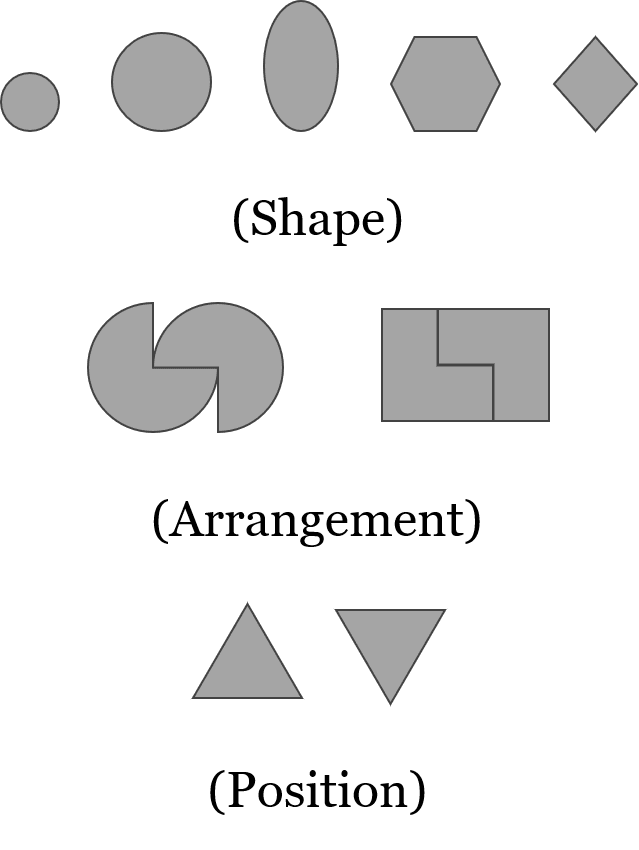
- Atoms are quantitatively different from one another: they differ in size, shape, and position. Some are large, some small; some round, some angular; some smooth, some jagged. These differences are quantitative — measurable in principle by number and geometry.
- Atoms are qualitatively neutral: they have no colour, no taste, no smell, no temperature. They are neither hot nor cold, wet nor dry. All such qualities belong to the observer’s experience, not to the atoms themselves. (Note: in the ancient world, temperature was a qualitative property — described as ‘hot’ or ‘cold’ — not yet measured numerically as it is today.)
- Atoms differ in three ways, as Aristotle summarised using an alphabet analogy: shape (as A differs from N), arrangement (as AN differs from NA), and positional orientation (as N differs from Z — the same shape turned differently).

Void
- Void is empty space — the regions where no atom is present. Without void, atoms would have no room to move, and change would be impossible.
- Void is real, but it is not a body or a thing. Democritus described it as a ‘no-thing’ — a being in which no body exists. This is carefully distinguished from ‘nothing’ (non-existence): void exists as a location, not as a material entity.
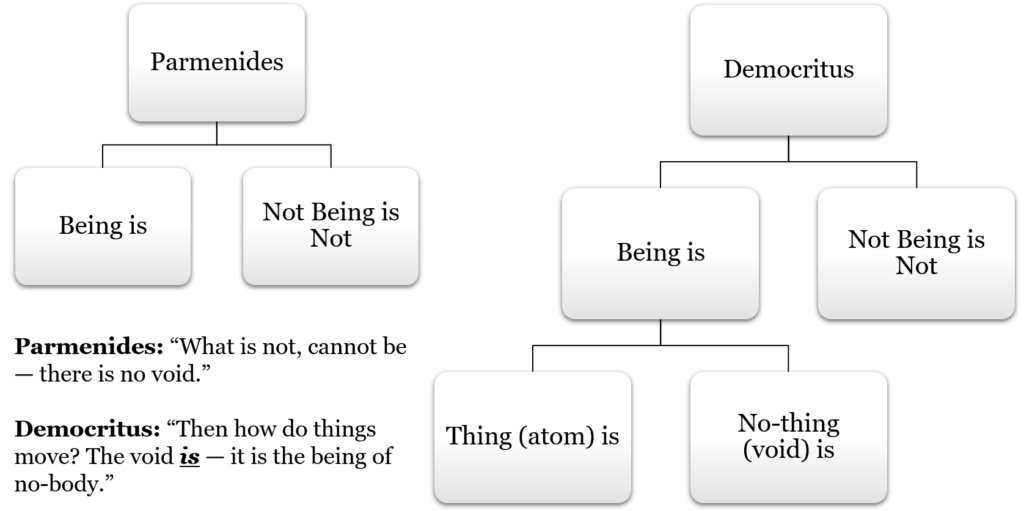
- This distinction is philosophically important: Parmenides had said ‘what is not, is not’ — non-being cannot exist. Democritus replies that void is not non-being; it is a real kind of being — the being of space without content. The ontological status of void remains one of the deepest unresolved questions in the history of metaphysics.
Change
- All change is change of place. Nothing is ever created or destroyed. What we call creation is atoms combining; what we call destruction is atoms separating. The atoms themselves remain unchanged throughout.
- Every object in the world — rocks, water, fire, plants, animals, human bodies, and even souls — is a specific combination of atoms. The differences between objects reflect differences in the size, shape, arrangement, and density of their atomic components.
- No ordering mind governs the process. Democritus explicitly denied that any god, nous, or intelligent principle directs atomic motion. Everything happens by mechanical necessity — cause and effect, all the way down.
3. Three Problems Atomism Solved
Atomism was not invented arbitrarily. It was constructed as a solution to three specific philosophical problems that had defeated every earlier approach.
Problem 1 — The Failure of Qualitative Diversity
- Every philosopher before Leucippus had tried to explain the world’s diversity by identifying fundamental substances with specific qualities: water (wet), air (cold and moist), fire (hot and dry), or Anaxagoras’s infinitely many qualitatively distinct seeds.
- This approach always failed at the same point. Either the qualities chosen were too few (Thales’s water, Empedocles’s four elements cannot account for all the qualities in the world), or there were as many fundamental elements as there are types of things — which simplifies nothing (Anaxagoras).
- Leucippus’s insight: the whole qualitative approach is the wrong strategy. No matter how many qualitatively distinct elements you propose, you cannot fully explain the world’s diversity, because diversity keeps generating new qualities that require new elements. The solution is to abandon qualities at the fundamental level entirely.
- Atoms have no qualities — only shape, size, and position (quantitative properties). The infinite variety of qualitative experience is produced by the infinite variety of atomic combinations, not by the qualities of the atoms themselves.
Aristotle’s alphabet analogy: Just as the 26 letters of the alphabet — each shapewise distinct but not coloured, flavoured, or warm — can combine to produce every word in every language, so atoms — each geometrically distinct but qualitatively neutral — can combine to produce every object and every sensory quality in the universe. The letters themselves have no meaning; meaning arises from their combinations. Atoms themselves have no sensory quality; qualities arise from their combinations.
Problem 2 — Infinite Divisibility
- Anaxagoras had claimed matter is infinitely divisible — there is no smallest part; however small a piece of matter you have, it can always be divided further.
- Leucippus turned Zeno’s own argument against this. Zeno had argued that if objects have infinitely many parts, each part either has some size (making the object infinitely large) or has no size (making it non-existent). Zeno used this to deny plurality altogether. Leucippus used the same logic differently: this absurdity shows that matter cannot be infinitely divisible. There must be a smallest part — the atom — below which division is impossible.
- Each atom is a ‘Parmenidean one’ in miniature: uncreated, indestructible, eternal, indivisible, and solid (no internal void). The difference is that Parmenides had only one such being; Leucippus has infinitely many.
- The flip: Leucippus took the arguments of Parmenides’s followers (Zeno and Melissus) — designed to defend one eternal being — and used them to prove infinitely many eternal beings. The logic of Eleatic philosophy, turned against itself, becomes the foundation of atomism.
Problem 3 — Motion and the Void
- For atomism to work, atoms must move. Combination and separation — the source of all change — require motion. Motion requires space to move through.
- Parmenides had denied void on the grounds that void is nothing, and nothing cannot exist. Empedocles and Anaxagoras had responded by showing that motion is possible without void — two substances can exchange positions simultaneously. But their solution requires that the elements be mixable with one another.
- Atoms cannot mix. Each atom is a solid, internally uniform Parmenidean being with no holes. Two atoms cannot interpenetrate or dissolve into each other. They can only collide and rebound. For atoms to move at all — to have anywhere to go — genuine empty space must exist.
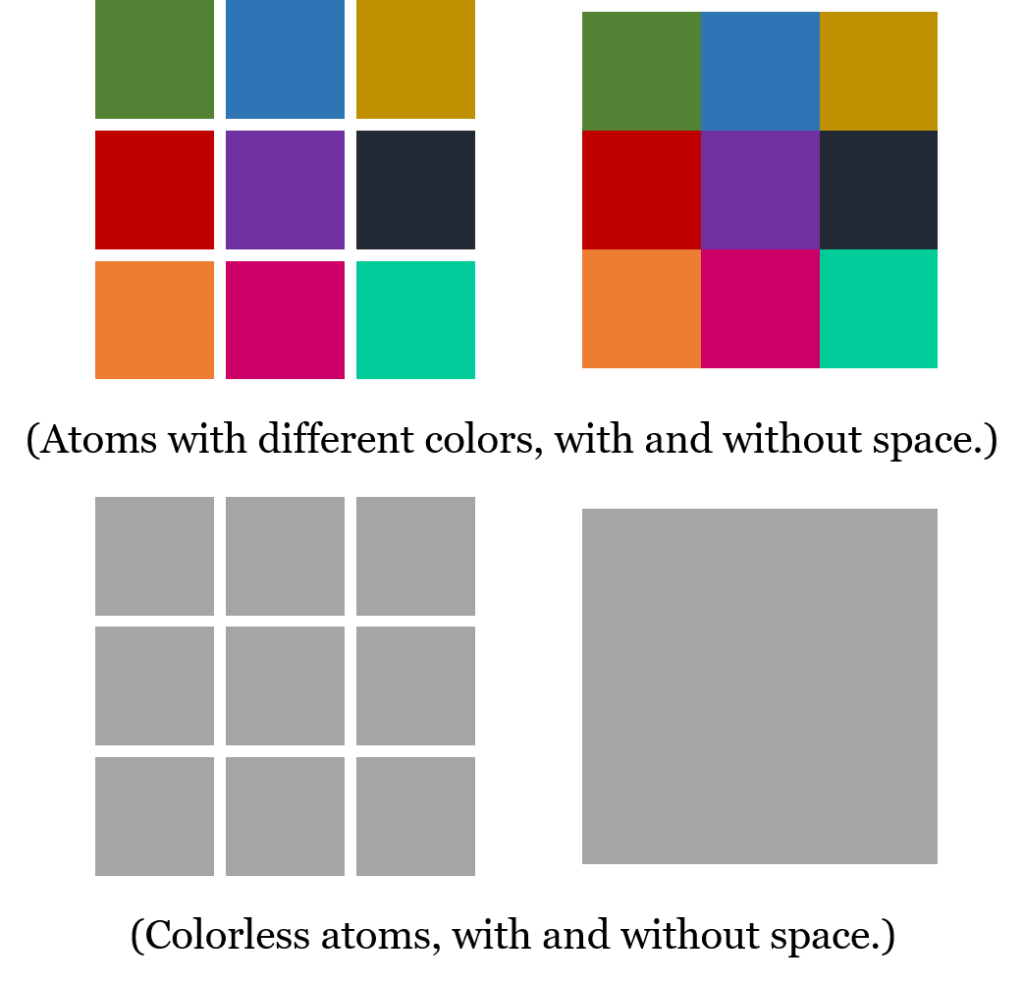
- A second reason void is necessary: atoms have no qualities. If you removed all space between quality-less atoms and pressed them together, there would be no way to distinguish one atom from the next — the result would be one undivided whole, not many atoms. It is the void between atoms that makes them countable as distinct individuals.
- Democritus’s solution: void is not nothing — it is ‘no-thing’: a real spatial being in which no body exists. Both atom and void are real. Together they are the only two realities.
4. Lucretius’s Five Principles — Atomism from Observation
While Leucippus and Democritus built atomism primarily through logical argument, Lucretius — following Epicurus — grounded the same conclusions in careful observation of the natural world. His approach is closer to empirical science: each principle is supported by examples drawn from everyday experience.
Principle 1 — Nothing Is Created from Nothing
- The claim: every existing thing has a pre-existing source. Something cannot arise from nothing.
- Lucretius’s evidence from nature: ghee is present in milk before churning; oil is present in seeds before pressing. Each thing has a fixed source — oil does not come from stone, because stone is not oil’s source. If creation from nothing were possible, anything could come from anything: a tree could bear every kind of fruit; fish could give birth to humans; an infant could age in a day.
- Nature is regular and predictable precisely because every product has a specific, pre-existing source. This regularity — not divine intervention — explains why the natural world behaves consistently.
- The theological implication: if all things come from prior things, nothing was created by gods. Gods (if they exist) play no creative role in the world’s origins or operations.
Note on method: Parmenides made the same point — being is uncreated — purely by logical deduction from axioms. Lucretius makes it through observation and induction. Both reach the same conclusion by different routes: rationalism (Parmenides) and empiricism (Lucretius).
Principle 2 — Nothing Is Destroyed into Nothing
- The claim: nothing truly ceases to exist; what looks like destruction is dispersal of atoms, not annihilation.
- Lucretius’s argument: the world has existed for infinite time (since nothing was ever created from nothing, it must always have been here). If anything could be truly destroyed — even at the slowest imaginable rate — infinite time would have been enough to reduce everything to nothing long ago. The fact that the world still exists proves that nothing is ever truly destroyed.
- Again, observation confirms reason: when a fire burns wood, the wood does not vanish — it transforms into heat, smoke, ash, and gases. The matter persists in different forms. Destruction is always transformation.
Principle 3 — Empty Space Exists
- Without void, motion is impossible: Lucretius argues that the mere fact that things move is sufficient proof that void exists.
- Sound passes through walls: if stone contained no internal void — no gaps — sound waves could not penetrate it. The fact that we hear sounds through solid walls shows that even apparently solid matter contains empty space within its atomic structure.
- Density differences at equal volume: a ball of cotton and a ball of iron of identical size differ enormously in weight. If both were completely solid, they would weigh the same. The cotton ball is lighter because it contains more void within its atomic structure; the iron ball is denser because its atoms are more tightly packed.
Principle 4 — Space Is Infinite
- The argument: space cannot have a boundary or an extreme point. Imagine travelling to the edge of the universe and throwing a spear. Either the spear flies further — proving space continues beyond the supposed boundary — or it strikes something, which must itself exist in some further space. Either way, the ‘boundary’ is not a true boundary.
- This thought experiment shows that any proposed limit to space immediately implies something beyond it. Space therefore has no limit — it is infinite.
Principle 5 — Atoms Are Infinite in Number
- If space is infinite but atoms were finite, the finite atoms would be spread infinitely thin across infinite space. Their chance of ever colliding with one another would be infinitesimally small — and without collisions, no combinations, no objects, no world.
- The existence of the world is itself the proof that atoms are infinite in number. In infinite space, only infinite atoms can guarantee the collisions and combinations necessary to produce the complex, structured universe we observe.
Carrom board analogy: Imagine a carrom board of infinite size with a finite number of discs. The chance of any two discs striking each other approaches zero as the board grows. But if the board is infinite and the discs are also infinite in number, collisions can and do happen — and the game can proceed. The existence of the game (the world) proves both the infinite board (space) and the infinite discs (atoms).
A Note on Method — Reason vs Perception
- Lucretius repeatedly states that atoms can be ‘touched’ and void cannot — language that seems to make sense perception the basis of atomic knowledge.
- But this is misleading. Atoms are far too small to be perceived directly by any sense. We cannot see, touch, or smell individual atoms. Atomic knowledge is the product of reasoning about matter — we observe ordinary objects with our senses and then reason, by mental division, to their ultimate constituents.
- Lucretius does not clearly distinguish between directly perceived bodies and inferred atomic bodies. This confusion between what is perceived and what is reasoned about becomes a source of difficulty when he tries to explain atomic motion.
5. The Motion of Atoms — Democritus, Epicurus, and the Swerve
All atomists agree that atoms move — without motion, there are no combinations, no change, no world. But what causes atomic motion? On this question, the two main schools divide sharply.
Democritus — Motion Is Eternal and Requires No Further Explanation
- Democritus’s position is simple: atoms have always been in motion. There was no original resting state from which they were set moving. Motion is simply the eternal condition of atoms — it is their nature, not something that needs a cause.
- This is philosophically honest but, as Epicurus recognised, unsatisfying as an explanation. Saying that motion has always existed is not the same as explaining what motion is or why it has the character it does.
Epicurus — Free Fall as the Natural State of Motion
- Epicurus sought a more principled account. He observed that in ordinary experience, objects exist in one of two states: rest or motion. We instinctively treat rest as the natural, default state and demand causes for motion.
- But Epicurus noticed an exception: free fall. When you lift a stone and release it, it falls downward without any further force being applied. No external agent is needed to keep it falling. Free fall is therefore a natural, uncaused motion — the stone’s default behaviour in the absence of interference.
- Epicurus proposed that free fall — downward motion through the void — is the natural and eternal state of atoms. In the infinite void, all atoms have always been falling downward. No cause for this motion needs to be given, just as no cause is needed to explain why a released stone falls.
- This elegantly unified atomic motion with a familiar observation and gave Democritus’s ‘eternal motion’ a specific, describable form: not random vibration but ordered downward fall.
The Problem with Free Fall — and the Swerve
- If all atoms fall straight downward in parallel paths, they will never collide. Parallel lines never meet. Without collisions, there is no ‘jostling’, no combination, no world.
- Various solutions were considered and rejected. If some atoms fall faster (due to greater weight), they might overtake and strike slower ones. But Lucretius correctly notes that in a true void — unlike in air or water — there is no medium to create differential resistance. All atoms would fall at the same speed regardless of weight, maintaining their parallel trajectories.
- Epicurus’s solution — the swerve (clinamen): at some point, for no stated reason, some atoms deviate very slightly from their straight downward paths. This minimal, imperceptible deflection causes atoms to collide, and the world of combinations begins.
- The swerve is philosophically devastating for a system based on strict mechanical necessity. Atomism had been built on the principle that every event has a cause — nothing happens spontaneously or without reason. The swerve is an uncaused event. It is introduced not because the theory demands it but because the theory breaks without it.
- Lucretius was clearly embarrassed by the swerve. He emphasises how slight and undetectable it is — but this makes things worse, not better. Atomism held that what cannot be observed does not exist. An unobservable, uncaused event introduced solely to rescue the theory from collapse is precisely the kind of ad hoc device that should be inadmissible.
The dilemma: Either stay with Democritus (motion is eternal, no further explanation given) or follow Epicurus (free fall is natural, but the swerve is an unexplained exception that undermines the whole system’s causal rigour). Neither option is fully satisfactory — a gap that remained open until Newton’s laws of motion and gravitation provided a genuinely quantitative account of motion in the 17th century.
6. The Sensory World — How Qualities Arise from Quality-Less Atoms
If atoms have no colour, taste, smell, or temperature, how do combinations of atoms produce a world full of colours, tastes, smells, and temperatures? This is the central problem of atomist epistemology, and Epicurus and Democritus give fundamentally different answers.
Epicurus — Properties and Accidents
- Epicurus distinguishes between two types of attributes that an atomic collection can have: properties (permanent, essential attributes) and accidents (temporary, non-essential attributes).
- A property is an attribute so essential to a thing that without it the thing could not exist. The roundness of a circle is a property: remove it and there is no circle.
- An accident is an attribute that can change without destroying the identity of the thing. The colour of a car is an accident: repaint it, and it is still the same car.
- Epicurus applies this framework to colour: the fact that an atomic collection has some colour is a property — every collection of atoms is coloured in some way. But which particular colour it has is an accident — it changes as the arrangement and composition of the collection change.
- The qualities we perceive are therefore real — they exist in the external world, in the atomic collection itself, not just in our minds. They are objective, even if temporary.
- The problem Epicurus does not solve: if atoms have no colour, and void has no colour, where exactly does the colour of an atomic collection reside? It is not in any individual atom; it is not in the void between atoms; it is not in another atomic collection. The ontological status of colour remains deeply unclear — introduced by two terminology labels (property/accident) without genuine explanation of what it is or where it exists.
Democritus — Sensations as Interactions (Bastard vs Trueborn Knowledge)
- Democritus’s view is more radical and more consistent. He holds that sensory qualities — colour, taste, smell, warmth — are not properties of external objects at all. They are produced by the interaction between the object’s atoms and the perceiver’s sense organs.
- The mechanism: the atoms of an external object (say, a rose) are in constant motion — colliding and rebounding within the object. Some atoms are ejected from the surface and travel to the observer’s sense organs. The observer’s sense organs (eyes, nose) are themselves atomic collections. When the rose’s atoms strike the observer’s atomic sense organs, they set those organ-atoms into motion, which propagates through the nervous system and produces a sensation — what we call the colour or fragrance of the rose.
- The sensation is a result of interaction, not a property of the rose alone. The rose’s atoms have size, shape, and position — but no colour. The colour is generated in the encounter between the rose’s atoms and this particular observer’s eyes.
- Consequence: sensory experience is subjective. The same rose may appear differently to different observers, because different observers’ sense organs are composed of differently arranged atoms. There is no single ‘correct’ colour that the rose has in itself — it has no colour in itself at all.
The fragrance example: If the rose’s scent were simply a property of the rose, everyone who smelled it would smell exactly the same thing — the scent would be identical for all. But if scent is produced by the interaction between the rose’s atoms and a particular person’s nose-atoms, different people may experience different scents from the same rose, because their nose-atoms differ. The scent is in the interaction, not in the rose alone.

- Democritus’s epistemological distinction: he calls knowledge obtained through sense perception bastard knowledge — indirect, subjective, unreliable. It tells us about our experience, not about reality. True knowledge — trueborn knowledge — comes through reasoning alone, applied to the atomic structure of things.
- Reality, for Democritus, contains only two things: atoms and void. Colour, warmth, taste, and sound are not real in the way atoms are real. They are effects of atomic interaction — real as experiences, but not real as features of the mind-independent world. In mind-independent reality, there is only atoms in motion through void.
Democritus vs Protagoras — Subjectivism Refuted?
- Protagoras the Sophist is famous for the claim ‘man is the measure of all things’ — meaning that each person’s experience is their own truth. If the wind feels cold to you but mild to me, both experiences are equally valid; there is no objective temperature the wind ‘really’ has.
- Epicurus’s theory refutes Protagoras. If colour is a real property of an external atomic collection — existing in the outside world — then there is an objective fact about what colour an object is. Someone who perceives the wrong colour is simply mistaken. Not all perceptions are equally valid.
- Democritus’s theory appears to support Protagoras. If colour is produced by interaction, and different people’s sense organs differ, then different people may genuinely experience different colours from the same object — and there is no external fact to appeal to as a standard. Each person’s private experience is their own.
- But there is a crucial difference. Protagoras made all experience equally valid and drew no distinction between appearance and reality. Democritus does draw that distinction sharply: appearance (bastard knowledge) is systematically unreliable, and reason (trueborn knowledge) gives the real truth — atoms and void. The subjective appearances differ between people; the atomic reality is the same for everyone. Democritus’s scepticism about the senses is a path toward deeper objective knowledge, not toward relativism.
7. Psychology — Mind, Thought, and the Problem of Free Will
Mind as Matter
- Atomism is a thorough-going materialism: everything — including the human mind, soul, and capacity for thought — is composed of atoms. The soul consists of extremely fine, smooth, spherical atoms. The mind is a physical organ, more complex than a rock or a machine, but different only in degree, not in kind.
- The difference between a mind and a machine is the complexity and organisation of their atomic structure. A human mind can experience, reason, and remember; a stone cannot — not because the mind has a non-material ingredient, but because its atoms are arranged in a vastly more intricate pattern.
Perception and Thought as Atomic Motion
- Perception: when an object’s surface atoms are ejected and travel to the observer’s sense organs, they set the sense organ’s atoms into motion. This motion propagates through the optic nerve (or other sensory pathways) to the mind’s atoms, producing the sensation. All perception is atom-to-atom physical contact, mediated by the sense organs.
- Thinking: atomists treat thinking as structurally similar to perception, but without the mediation of sense organs. When we think about an absent object, that object’s atoms (or very fine images of them) reach the mind directly — without passing through eyes or ears. Thinking is direct atomic contact between the world and the mind.
- Democritus’s distinction: sense-mediated contact gives bastard knowledge (subjective appearance); direct, unmediated atomic contact gives trueborn knowledge (objective reality). Reason accesses reality more directly than the senses do — a position that paradoxically echoes Parmenides’s rationalism, despite atomism’s materialist foundations.
The Problem of Logical Inference
- A serious difficulty arises when atomism tries to account for logical reasoning. Consider a standard syllogism: ‘All humans are mortal. Socrates is human. Therefore Socrates is mortal.’
- On the atomic account, each premise is a specific pattern of atomic motion in the mind. The logical inference — the movement from premises to conclusion — would have to be another pattern of atomic motion caused by the first two.
- But logical relations are not mechanical relations. The relationship between premises and conclusion is one of logical entailment — the conclusion follows necessarily from the meaning of the premises. This is a different kind of necessity from the physical necessity of one billiard ball striking another.
- Atomism reduces logical necessity to mechanical causality, which seems to miss what makes reasoning genuinely rational rather than merely a complicated chain of collisions. This problem — how to account for the normative, logical dimension of thought in purely physical terms — has never been fully resolved by materialist accounts of mind.
Free Will and Determinism
- Strict atomism eliminates free will entirely. If every event — including every thought and decision — is a mechanical consequence of prior atomic states, and those states are themselves consequences of still earlier states, going back infinitely, then every decision you will ever make was fixed before you were born.
- The everyday experience of choosing — weighing options, deliberating, deciding — is, on this view, simply the experience of competing atomic patterns working themselves out in the mind. The feeling of freedom is an illusion. What feels like a choice is a determined outcome of prior causes you did not choose.
The morning decision: You lie in bed at 6 a.m. debating whether to go for a walk or stay asleep. The experience of deliberation is the motion of your mind’s atoms as they interact and settle into a pattern. The eventual decision — whichever way it goes — is the necessary result of those atomic positions and motions, which were fixed by prior states, which were fixed by states before them, going back infinitely. There is no point at which ‘you’ intervened freely. The decision was always going to be what it is.
- This is called hard determinism: all events, without exception, are necessitated by prior causes. Free will — in the sense of a genuine ability to have chosen otherwise — is impossible.
- Epicurus tried to escape this by using the swerve: if some atomic motion is genuinely uncaused (the random swerve), then not everything is determined. But a random swerve does not restore freedom either — it introduces chance, not choice. An action caused by a random atomic wobble is no more ‘mine’ than one determined by prior causes. The swerve solves one problem (determinism) by creating another (randomness is not the same as rational agency).
8. Ethics — How to Live in an Atomic Universe
Democritus on Equanimity
- Democritus did not attempt to derive his ethical views from his physical theory — an intellectual honesty that is itself noteworthy. His ethical remarks are practical and aphoristic, not system-building.
- Representative fragments: ‘It is hard to fight against desire, but to overcome it is the mark of a rational man.’ / ‘The needy animal knows how much it needs, but the needy man does not.’ / ‘In cattle, excellence is shown in bodily strength; in men, it lies in strength of character.’
- One passage does connect ethics to atomic theory: ‘Equanimity comes to men through proportionate pleasure and moderation in life. Excesses and deficits are apt to cause great disturbances in the soul. Those souls that are moved over great distances have neither stability nor equanimity.’
- The atomic reading of this: all human experiences are atomic motions in the soul. A good life is one in which these motions are gentle, measured, and balanced — not violently excessive or stagnant. Just as a healthy body requires neither overexertion nor total rest, a healthy soul requires atomic motion that is moderate in amplitude and rhythm. Extremes of pleasure or pain produce chaotic, unstable atomic motion; equanimity reflects well-ordered, harmonious motion.
The Tension Between Ethics and Atomism
- If all decisions are determined, the standard ethical questions — should I do this? what are my duties? how should I treat others? — lose their conventional meaning. You cannot genuinely ‘choose’ to be honest or dishonest, virtuous or vicious. Whatever you do was always going to happen.
- Democritus wrote ethical maxims as though people can and should choose rightly. He never reconciled this with his physics. This is either an inconsistency or an implicit acknowledgement that physics and ethics operate at different levels of description — a position that later philosophers would develop more carefully.
- Epicurus’s ethics (which will be treated separately in a dedicated discussion) are more elaborate and more self-consciously integrated with his atomism — seeking pleasure and the absence of pain as the goal of life, in a world that offers no divine reward or punishment and no afterlife.
9. Evaluation and Legacy
What Atomism Achieved
- Atomism completed the pre-Socratic programme of explaining natural diversity from a small number of universal principles. It answered Thales’s original question — what is the world ultimately made of? — with the most powerful and durable answer in the history of natural philosophy.
- The redefinition of change is one of its most important contributions. For Thales and the Milesians, change meant one substance transforming into another. For atomism, change means change of place — atoms rearranging. This reduction of all change to spatial rearrangement is the conceptual foundation on which all subsequent physics is built.
- The redefinition of matter is equally significant. Earlier philosophers described matter in terms of sensory qualities — water is wet, fire is hot. Atoms are defined purely geometrically and quantitatively. This move from qualitative to quantitative description is the defining move of modern physics.
Weaknesses and Open Problems
- The motion problem remains unresolved. Neither Democritus’s ‘eternal motion’ nor Epicurus’s free fall with an ad hoc swerve constitutes a satisfactory explanation of why atoms move as they do. A genuine law of motion had to wait until Newton.
- The free will problem is acute. Strict mechanical determinism eliminates genuine agency, and the swerve replaces it with randomness — not a better alternative. This remains one of the central unresolved tensions in all materialist philosophies of mind.
- The quality problem is not fully solved. Epicurus’s property/accident distinction names the problem without resolving it; Democritus’s interactionism relocates the problem into the perceiver without eliminating qualities from the picture.
Historical Influence
- Suppression in the Middle Ages: atomism’s denial of divine creation and providence made it incompatible with medieval Christian theology. It was largely set aside in favour of Plato and Aristotle during the medieval period — a fourteen-century gap before it re-emerged.
- 17th-century revival: Gassendi, Boyle, and Newton re-engaged directly with ancient atomism. The development of modern chemistry, physics, and the laws of motion all drew on the atomist tradition. John Dalton’s atomic theory (1803) gave atoms their first quantitative chemical definition.
- 19th and 20th century: Dalton was followed by Thomson, Rutherford, Bohr, Heisenberg, and the full development of quantum mechanics — which ultimately showed that atoms are themselves divisible (into protons, neutrons, electrons) and that sub-atomic particles behave in ways that challenge the very concept of a simple, indivisible, locally-positioned particle. The ancient atomists were right that matter has ultimate constituents; they were mistaken about those constituents being indivisible, featureless, and classically mechanical.
- Philosophy of mind: the questions atomism raised about the nature of thought, the relationship between mind and matter, determinism and free will, and the reliability of the senses are the permanent agenda of philosophy of mind — questions that no subsequent theory has definitively closed.
Conclusion
Ancient atomism is the intellectual ancestor of the scientific worldview. Its core moves — reducing qualitative diversity to quantitative structure, defining fundamental particles as geometrically distinct but qualitatively neutral, insisting on void as a real spatial being, and explaining all change as rearrangement rather than transformation — are moves that modern physics has elaborated but never abandoned. The debates within atomism — about what drives atomic motion, how qualities arise from quality-less atoms, whether knowledge comes from the senses or from reason, and whether determinism leaves room for free will — are not historical curiosities. They are the precise questions that philosophy of physics, philosophy of mind, and ethics continue to wrestle with today. When Leucippus proposed that the world is atoms and void, he did not solve the problem of nature — he defined it in a form precise enough to be progressively solved.
Frequently Asked Questions
What is the basic claim of ancient atomism?
Ancient atomism holds that only two things are ultimately real: atoms and void. Atoms are eternal, indivisible, qualitatively neutral particles that differ only in size, shape, and position. Void is empty space — the region between atoms. Everything we observe — objects, qualities, living beings, minds — consists of atoms combined in different arrangements, moving through void. All change is change of place: atoms rearranging, combining, and separating. No god, mind, or ordering principle directs the process; everything happens by mechanical necessity.
How did atomism solve the three main problems of pre-Socratic philosophy?
First, the failure of qualitative approaches: all previous philosophers had tried to explain diversity using qualitatively characterised elements (wet water, hot fire). Leucippus abandoned this and proposed atoms with no qualities — only quantitative properties (size, shape, position). Diversity arises from the infinite variety of combinations, not from the qualities of the elements. Second, infinite divisibility: Anaxagoras had claimed matter is infinitely divisible. Leucippus used Zeno’s own arguments to show this leads to absurdity (objects would be infinitely large or non-existent), proving instead that division must stop at an indivisible minimum — the atom. Third, motion and void: Parmenides had denied void. Leucippus showed that solid atoms cannot mix or interpenetrate, so they require genuine empty space to move through — void is real as ‘no-thing’, a spatial being without content.
What is the difference between Epicurus’s and Democritus’s accounts of motion?
Democritus simply stated that atomic motion is eternal and always has been — it requires no further explanation. Epicurus found this unsatisfying and argued that free fall (downward motion through void) is the natural, uncaused state of atoms. This gave the ‘eternal motion’ a specific, describable form. But free fall in parallel paths means atoms never collide, so no combinations are possible. To solve this, Epicurus proposed the ‘swerve’ — a spontaneous, uncaused, unobservable minimal deflection of some atoms from their straight paths, causing collisions. The swerve is widely regarded as an ad hoc device that contradicts atomism’s own principle that every event has a cause.
How do Democritus and Epicurus differ on sensory qualities like colour and taste?
Epicurus held that sensory qualities are temporary but real properties of atomic collections — they exist in the external world, though they change as the atomic arrangement changes. Democritus took the more radical view that sensory qualities exist neither in the atoms (which have no colour, taste, or smell) nor in the void, but are produced by the interaction between an object’s atoms and the observer’s sense organs. The same object may produce different sensory experiences in different observers. For Democritus, sense perception yields only ‘bastard knowledge’ — subjective, unreliable appearances. True ‘trueborn knowledge’ is gained through reason and pertains only to the objective reality of atoms and void.
Why does atomism eliminate free will, and how did Epicurus try to restore it?
Strict atomism is deterministic: every atomic state is the necessary mechanical consequence of prior atomic states, going back infinitely. Since human thought and decision-making are also atomic processes, every decision was effectively fixed before the person existed. The experience of freely choosing is an illusion — the necessary outcome of atomic configurations we did not select. Epicurus tried to restore free will using the swerve: if some atomic motion is genuinely uncaused and spontaneous, not everything is determined. But critics (including modern philosophers) note that random, uncaused motion does not restore rational agency — it merely replaces determinism with chance. Neither determined nor random action constitutes genuine free choice. The problem remains unresolved within the atomist framework.

Leave a Reply