
He wrote nothing, founded no school, and left no doctrine — yet Socrates arguably shaped Western thought more than any other single figure. This lecture traces his life, his method of relentless questioning, and the trial and death that turned philosophy into something worth dying for.
Key Takeaways
- Socrates wrote nothing — everything we know of him comes from others, primarily Plato’s dialogues. Plato’s early dialogues (Euthyphro, Apology, Crito) reflect Socrates’s own views most closely; later dialogues increasingly express Plato’s own developing philosophy.
- The Oracle of Delphi declared Socrates the wisest person alive. Disbelieving this, Socrates spent his life questioning Athens’s leading figures — and discovered that none who claimed wisdom actually possessed it. His own wisdom lay in knowing that he did not know.
- The Socratic Method (elenchus/dialectic) proceeds in seven stages — from casual encounter to the exposure of ignorance — using three core techniques: attacking flawed definitions (circular, compositional, or shadow-example), reductio ad absurdum (accepting an opponent’s premise and showing it leads to absurdity), and counterexample.
- In epistemology, Socrates used inductive arguments to extract universal definitions from particular examples. He believed knowledge is not received from outside but is innate — already present in the soul and recoverable through careful questioning (the ‘midwife’ method).
- Socrates’s ethics centres on three linked claims: the soul is the true self and must be cared for above wealth or status; virtue is applied knowledge (ethical intellectualism — to know the good is to do the good); and eudaimonia (complete well-being) is the ultimate goal of human life, achievable only through a virtuous life.
- Socrates differed fundamentally from the Sophists in purpose, method, and belief: he sought objective truth through dialectic (not persuasion through rhetoric); he took no fees; he held that genuine knowledge exists and can be found; and he measured excellence by virtue of character, not political or financial success.
Table of Contents
Introduction
Most philosophers are remembered for their ideas — their theories, their arguments, their written works. Socrates is remembered for his character. He wrote nothing. He founded no school. He proposed no systematic doctrine. Yet no philosopher in the Western tradition has left a deeper impression on the minds of those who encountered him or studied him. His influence on Plato alone would be enough to secure his place at the centre of the philosophical tradition — but his life, his method, and above all his death have inspired thinkers across two and a half millennia. To understand Plato, Aristotle, and the entire classical tradition, one must first understand Socrates.
1. Life and Sources
Biographical Overview
- Socrates was born in Athens in 470 BCE — the first major Greek philosopher to be born in Athens itself, and the first to centre his philosophy on human life rather than on the nature of the cosmos.
- His father was a stonemason and sculptor; Socrates initially followed the same trade. His mother was a midwife — a detail that Socrates himself used as a metaphor for his own philosophical practice, as we will see.
- He served in the Athenian army on multiple occasions and was noted for extraordinary physical endurance — able to go without food, water, or warmth for extended periods, and to drink heavily without any visible effect.
- His wife Xanthippe was famously difficult-tempered; Socrates’s equanimity in the face of her anger became almost as legendary as his philosophical method. He had three sons.
- He was tried by an Athenian jury of 500 in 399 BCE on charges of impiety (failing to honour Athens’s gods) and corrupting the youth (undermining democratic institutions and spreading sceptical doubt). Found guilty by 280 votes to 220, he was sentenced to death by drinking hemlock. He was approximately seventy years old.
The Problem of Sources
- Socrates left no writings. Everything we know of him comes from others — primarily Plato, but also the playwright Aristophanes, the soldier-writer Xenophon, and (at one remove) Aristotle.
- Plato is the most important source, but he is also problematic. He was younger than Socrates, revered him deeply, and wrote all his philosophical dialogues after Socrates’s death — some much later. In many dialogues, ‘Socrates’ is the main speaker, but it is not always clear whether the ideas expressed are Socrates’s own or Plato’s, presented through the dramatic vehicle of his teacher.
- The standard solution is to divide Plato’s dialogues into three chronological groups. The early dialogues — written shortly after Socrates’s death, including the Euthyphro, Apology, Crito, and Laches — are considered the most reliable record of Socrates’s actual views. The middle dialogues — including Meno, Phaedo, and Symposium — mix Socratic thinking with Plato’s own emerging philosophy. The late dialogues — including Republic, Timaeus, and Laws — are primarily Plato’s philosophy, with Socrates present mainly as a dramatic device.
- For the purposes of these notes, we focus primarily on the early and middle dialogues, where Socratic thought is most directly accessible.
2. Personality and Character
Socrates’s personality was, by all accounts, unlike anyone else Athens had ever produced. Physically unremarkable — even, by conventional standards, ugly — he possessed a quality of presence and engagement that made him magnetic to those genuinely interested in ideas.
The Beauty Contest
- Xenophon records a beauty contest between Socrates and Critobulus — Athens’s most conventionally handsome man. Socrates had to argue that he was, in fact, more beautiful.
- Socrates’s argument: he asked Critobulus what beauty consists in. Critobulus said that beautiful things are those that perform their purpose with perfection — a sword is beautiful if it cuts perfectly, a horse if it runs fastest, a shield if it deflects the hardest blows. Socrates then applied this standard to his own features: his eyes are wider-set, so they see further to the sides; his nose is flat and spread, so it catches more scents from a wider angle; his mouth is larger, so he can take bigger bites; his lips are thick, so he kisses more softly.
- The audience voted for Critobulus anyway — but the episode reveals the characteristic Socratic style: turning any conversation toward deeper questions, playful wit, and the systematic application of a philosophical principle to an unexpected subject.
Physical and Personal Endurance
- Alcibiades’s account in the Symposium describes Socrates on military campaign as unmatched in endurance — surviving cold, hunger, and exhaustion without complaint; marching barefoot on ice faster than soldiers with boots; drinking when required without becoming drunk.
- The episode of the trance: on one occasion during campaign, Socrates stopped in the middle of an open space in the morning, apparently absorbed in a problem. He remained there — perfectly still, standing — through the day, through the night, and through the following sunrise, when he greeted the sun and walked on. He had stood motionless for more than twenty-four hours, completely absorbed in thought.
- His dress was always the same: a single old cloak worn loose, no shoes, in any weather. This simplicity was not poverty but deliberate indifference to material comfort — a lived expression of his philosophical conviction that the soul matters more than the body.
3. The Oracle of Delphi and the Socratic Mission
The Oracle’s Declaration
- The Oracle of Delphi was the most revered religious site in ancient Greece, dedicated to the god Apollo. A priestess — the Pythia — would receive questions from any visitor and deliver Apollo’s answers. No declaration from the Oracle could be wrong, since it carried the authority of a god.
- A friend of Socrates asked the Oracle: is there anyone wiser than Socrates? The answer came back: no one is wiser than Socrates.
- Socrates was baffled. He knew he possessed no wisdom worth mentioning. If Apollo — who cannot lie — said this, it must somehow be true, but he could not see how. He set out to disprove it by finding someone genuinely wiser than himself.
The Investigation and Its Discovery
- Socrates went systematically to everyone in Athens with a reputation for wisdom — politicians, poets, craftsmen, educators, artists, businessmen. He questioned each of them on the subject of their supposed expertise. In every case, he found that their reputation outstripped their actual knowledge.
- Politicians who claimed to understand justice and the public good could not define either. Poets could produce beautiful works but could not explain what made them beautiful or why they chose one image over another — suggesting they worked by inspiration rather than understanding. Craftsmen had genuine technical skill in their trades, but mistakenly believed this extended to wisdom about all things.
- The discovery: everyone Socrates questioned was ignorant, but none of them knew it. They possessed an illusion of knowledge on top of actual ignorance — which, Socrates realised, is far worse than simple ignorance. A person who knows they are ill can seek treatment; a person who believes themselves well when they are not will do nothing. False confidence about wisdom is the deepest intellectual disease.
- His own superiority became clear to him: he too was ignorant, but he knew he was ignorant. His wisdom was the wisdom of knowing the limits of his knowledge — honest ignorance rather than deluded confidence. This is captured in the phrase often attributed to him: ‘I know that I know nothing’ — or more precisely, ‘I know that I do not know.’
The Consequences
- Socrates could not stop once he had grasped this. Exposing false wisdom became his life’s work — a religious mission, as he described it, in service to Apollo. He wandered Athens daily, questioning whoever would engage with him, followed by a growing group of young admirers who delighted in watching the city’s most eminent figures discover they knew less than they thought.
- The powerful hated him. Being publicly exposed as less wise than one’s reputation suggested was humiliating — especially before an audience of Athens’s young men. Socrates accumulated enemies among the politicians, poets, and craftsmen he had questioned, and it was this accumulated resentment that eventually produced the charges of impiety and corrupting the youth that led to his trial and death.
- His defence at trial (recorded in Plato’s Apology) was characteristic: he made no apology and no plea for mercy. He explained his mission clearly, argued that the city would suffer more from silencing him than from his continued questioning, and stated plainly that even if acquitted, he would not stop. The jury voted 280 to 220 to convict.
The Final Days
- Socrates’s execution was delayed by approximately a month for a religious reason, during which time he was held in prison. His friend Crito visited and offered to arrange his escape — it had been quietly arranged, and Socrates could live out his remaining years in safety elsewhere.
- Socrates refused. He offered two arguments. First, a person who has lived all his life within a city’s laws and benefited from them cannot simply discard those laws the moment they produce an inconvenient result. His relationship with Athens was like a contract — he owed obedience even when the judgement was wrong. Second, a life spent in hiding would be a life without the philosophical examination that gave life its only real meaning. A life unlived philosophically was not worth preserving.
- On the final day, the prison guard brought him a bowl of hemlock. Socrates drank it in one draught, without hesitation. He died quietly and peacefully as the poison worked its way through his body — his last recorded concern being that he owed a rooster to the god of medicine, Asclepius, and asked that the debt be paid.
Socrates’s own words in the Apology: ‘The difficulty, my friends, is not to avoid death, but to avoid unrighteousness — for that runs faster than death.’ Death is one day in a life. Unrighteousness — corruption of the soul — is every day. Socrates chose the one dangerous day over a lifetime of moral compromise.
4. The Socratic Method — Elenchus and Dialectic
The Socratic method is Socrates’s greatest practical contribution to philosophy. It is a structured form of dialogue — questioning and answering — designed not to win an argument or defend a position, but to reach a deeper understanding of a topic by progressively exposing the weaknesses in existing answers. Aristotle called it elenchus (logically refuting an argument); Plato developed and named it dialectic.
Three Forms of Argument Distinguished
- Eristics is argumentation aimed at winning — using whatever means work, including rhetoric, emotional appeals, and deliberately misleading logic. The goal is victory, not truth.
- Apologetics is argumentation aimed at defending a pre-held belief or position — particularly a religious or ideological one. The goal is to protect the belief, not test it.
- Dialectic (the Socratic method) differs from both. Its sole aim is deeper understanding of a topic — finding what is actually true, not winning an exchange or protecting a position. It is an open-ended, collaborative investigation.
The Seven Stages of the Socratic Method

The Socratic method follows a consistent pattern visible across Plato’s early dialogues. While the subject matter changes, the structure remains the same.
- Stage One — The Casual Encounter: Socrates meets someone in the agora, a workshop, or at a gathering. Normal conversation begins. One of Socrates’s gifts is detecting the philosophical significance in everyday remarks — he finds the conceptual issue hiding inside ordinary talk and draws it to the surface.
- Stage Two — Identifying the Key Concept: Socrates focuses the conversation on a single central term or concept — one that, unless clearly defined, makes it impossible to resolve the issue at hand. In the Symposium it is love; in the Republic, justice; in the Meno, virtue; in the Euthyphro, piety. The question is posed as a ‘What is X?’ question — a request for definition, not examples.
- Stage Three — Feigning Ignorance (Socratic Irony): Socrates presents himself as completely ignorant — the least informed person in the conversation. He praises the other person’s evident wisdom and expertise and asks, humbly, to be taught. This calculated self-deprecation has a dual purpose: it disarms the other person’s defensiveness, and it invites them to commit to a definition — which they are now far more likely to do confidently and carelessly.
- Stage Four — Receiving and Examining the Definition: The other person, flattered and at ease, offers a definition. Socrates thanks them warmly, expresses admiration for the definition, and then — with apparent reluctance — raises ‘just one or two small points of confusion.’ These gentle-sounding questions are in fact precise logical probes designed to find exactly where the definition fails.
- Stage Five — Successive Refinement: When the original definition is exposed as inadequate, the other person revises it. Socrates receives the new definition with the same warmth, and the same probing process begins again. This cycle repeats — definition, examination, refinement — until no further progress is possible.
- Stage Six — The Moment of Aporia: The other person reaches aporia — a Greek word meaning ‘without a path’ or ‘at a loss.’ They realise they cannot produce a satisfactory definition of the concept they previously claimed to understand. The comfortable confidence with which they began the conversation has been completely dismantled. They see, perhaps for the first time, that their supposed knowledge was assumption.
- Stage Seven — Two Possible Responses: The person either makes an excuse and retreats (‘I must be going — perhaps another time’) — adding Socrates to their list of enemies — or they accept the experience of aporia honestly and recognise that genuine philosophical inquiry has begun. Aporia is not the end; it is the beginning of real thinking.
Three Techniques Used at Stage Four
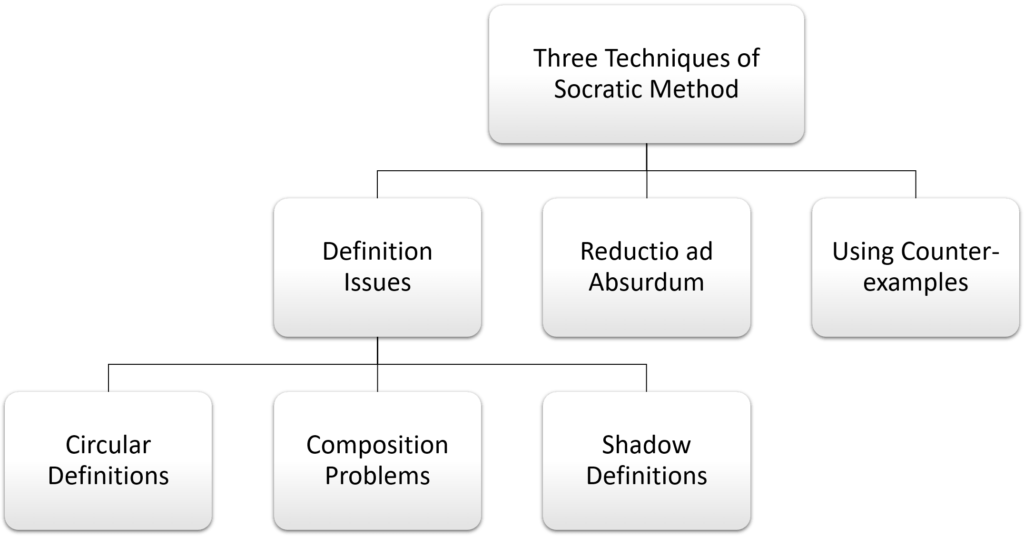
At Stage Four, Socrates has three distinct techniques for exposing why an answer fails. The first — attacking the definition — itself has three sub-types. The second is reductio ad absurdum. The third is counterexample.
- Technique One — Attacking the Definition. When someone offers a definition of a concept, Socrates checks it against three possible failure modes:
- Circular definition: the term being defined reappears — in the same or synonymous form — inside the definition itself, producing a loop rather than an explanation. Examples: ‘Courage is what courageous people do.’ ‘Justice is acting justly.’ ‘Knowledge is what knowledgeable people possess.’ ‘A leader is someone who leads.’ None of these definitions has any real content — they just restate the word in a different form. It is like being told that your house is ‘next to the temple’ and the temple is ‘next to the house’: you have been given a circle, not an address.
- Composition error: the definition uses the properties of the whole to define one of its parts. If someone defines justice as ‘a virtue,’ they have placed justice inside a far larger category. Virtue includes courage, wisdom, temperance, kindness — many things that are not justice. The properties of virtue in general cannot simply be assumed to apply to justice in particular. A penguin is a bird, but it cannot fly — not all properties of the class automatically apply to every member.
- Shadow example (not a definition at all): the person gives a specific instance of the concept rather than a general definition. If asked ‘What is a rectangle?’ and the answer is ‘This book is a rectangle’ or ‘This screen is a rectangle,’ no definition has been provided — only examples. What is needed is the underlying principle: what conditions does any shape have to satisfy in order to count as a rectangle? The correct answer — ‘a plane figure with four sides and four right angles’ — is a definition; ‘this book’ is merely a shadow of it. If asked ‘What is a vegetarian?’ and the answer is ‘I am a vegetarian,’ that is an example, not a definition. Socrates distinguishes sharply between the universal concept and its particular instances.
- Technique Two — Reductio ad Absurdum. Here Socrates does not attack the definition directly. Instead, he provisionally accepts his opponent’s claim as true, then traces its logical implications until they produce a result so absurd or self-contradictory that the original claim must be abandoned. The steps are: (i) grant the opponent’s position; (ii) follow it carefully to its consequences; (iii) show that those consequences are impossible or self-defeating.
Reductio with Thrasymachus (Republic): Thrasymachus defines justice as ‘what benefits the stronger’ — obedience to the ruler’s laws, made in the ruler’s interest. Socrates accepts this and asks: rulers sometimes err and accidentally make laws against their own interests. Citizens who obey those laws (as the definition requires) are thereby acting against the ruler’s interest — which, on Thrasymachus’s own definition, would be unjust. But they are obeying the ruler’s law, which was supposed to be the very definition of justice. The definition makes the same act both just and unjust at once — an impossible result.
Reductio in the Euthyphro: Euthyphro defines piety as ‘what the gods love.’ Socrates asks whether the Greek gods ever disagree. Euthyphro admits they do. Then the same action could be loved by one god and hated by another — making it simultaneously pious and impious. One and the same act cannot be both pious and impious; the definition must be wrong.
Reductio on justice as debt-repayment: Someone defines justice as returning what you have borrowed. Socrates grants this and asks: suppose you borrowed a weapon from a friend who has since lost his mind. Is it just to return it? Returning it would enable harm — which cannot be just. The definition, followed to its consequences, endorses something everyone would call unjust.
- Technique Three — Counterexample. The simplest of the three. A universal definition claims to hold for all cases. A single clear exception is enough to defeat it. Socrates finds one case that the definition should include but does not, or one case it wrongly includes.
Counterexample with Meno: Meno defines a virtuous person as one who has the ability to rule. Counterexample one: a child can be genuinely virtuous without any capacity to rule. Counterexample two: a tyrant has the capacity to rule but is not virtuous. The definition excludes clear members of the category and includes clear non-members — it must be revised.
The general principle: If someone claims ‘all birds can fly,’ a single penguin defeats the claim. If someone claims ‘all fruits are sweet,’ a single lemon defeats the claim. One genuine exception is logically sufficient — universals admit no exceptions.
5. Epistemology — Inductive Arguments, Universal Definitions, and Innate Knowledge
Aristotle credited Socrates with two foundational contributions to epistemology: the use of inductive argument and the pursuit of universal definition. Together, these form the methodological core of what became Western scientific and philosophical thinking.
Universal Definition vs Particular Example
- The central distinction in Socratic epistemology is between the universal (the concept or definition that applies to all members of a category) and the particular (the specific individual examples of that category).
- Consider beauty. A painting, a piece of music, a mathematical proof, a flower, a cloud — these are all beautiful, yet they are radically unlike one another. What do they have in common that makes each of them beautiful? There must be something — some shared feature or quality — that places all of them in the same category. That something is the concept of beauty. It is universal: it applies across all instances. The particular things (flower, painting, music) come and go; the flower wilts, the music ends, the painting fades. But beauty as a concept does not wilt or fade — it remains the same regardless of which particular things instantiate it at any given time.
- Socrates wants the definition, not the examples. When he asks ‘What is justice?’ he is not asking for examples of just acts. He is asking for the universal concept — the essential feature shared by all just acts that makes them just. The definition is what remains constant when particular examples change.
Inductive Argument — The Method for Finding Definitions
- Induction is the logical process of moving from particular observations to a general conclusion — from ‘these specific events have this feature’ to ‘all events of this type have this feature.’
- In practice, Socrates examines many particular instances of a concept — many examples of courage, many just actions, many kinds of friendship — and looks for the common thread that runs through all of them. That common thread, once identified and precisely stated, is the universal definition.
- Definition and induction are complementary: induction is the method for arriving at a definition; the definition is the result — the universal concept extracted from particular cases.
The definition of a human being: Through inductive observation of many human beings, we can identify what is common to all of them that distinguishes humans from other animals: they are rational. The universal definition becomes ‘rational animal’ — a phrase covering every human that has ever lived or will live, captured in two words. This is precisely what Rodin’s The Thinker symbolises: a figure that is animal in its nakedness (biological creature) but human in its posture of reflection (rationality).
Why Precise Definitions Matter
- Concepts are the building blocks of knowledge. Mathematics begins with precisely defined concepts — point, line, angle, circle — and builds upward from them. The precision of mathematical knowledge depends directly on the precision of its foundational definitions. If ‘line’ were vague, geometry would be vague.
- The same is true for natural science. Einstein’s equation E = mc² contains the concepts of energy, mass, speed, light, and vacuum. Without rigorous definitions of each, the equation cannot be understood or applied. Aristotle’s school had defined over fifty such foundational concepts by the time Greek philosophy reached its peak.
- Socrates applied this same logic to human life. To understand and improve how we live together, we need precisely defined concepts of virtue, justice, courage, temperance, friendship, goodness, and happiness — just as physics needs precise concepts of velocity, mass, and force. Without clear concepts, ethical reasoning remains vague and subject to manipulation.
- Some concepts seem to exist independently of their instances. A flower wilts; beauty does not. A particular just act may be misunderstood or forgotten; justice as a concept persists. A drawn line has width; the mathematical concept of a line (length only, no width) has no perfect physical instantiation — no physical line perfectly satisfies the definition. This observation — that concepts seem to be both permanent and somehow ‘more real’ than their imperfect instances — laid the groundwork for Plato’s famous Theory of Forms, which Socrates himself did not fully develop but whose seeds are clearly visible in his practice.
Innate Knowledge — The Midwife Analogy
- Socrates frequently compared himself to his mother, the midwife. A midwife does not give birth herself — she assists the mother in bringing forth the new life that is already there. Socrates said he did the same with ideas: he had no knowledge to teach, but he could help others bring to consciousness the knowledge already present within their own souls.
- The philosophical claim: knowledge is not something we receive from outside through our senses. True knowledge — wisdom, understanding of universal concepts — is already present in the soul, hidden, waiting to be uncovered. What we call ‘learning’ is really recollection — the recovery of knowledge that was always already there.
- The proof in the Meno: Socrates takes Meno’s slave — a young man with no education in geometry, who can speak Greek but knows no mathematics. Without ever telling the slave anything, Socrates asks him a carefully sequenced series of questions about how to double the area of a square. Step by step, led only by questions, the slave works out that the answer is to use the diagonal of the original square as the side of the new one — a sophisticated geometrical insight. Socrates makes the point: he taught nothing; he only asked. The knowledge was in the boy.
- The philosophical legacy of this idea is enormous. It gave rise to the doctrine of innate ideas — the view that some knowledge is built into the human mind prior to experience. Plato developed this into his theory of recollection (we knew all things before birth and must remember them). Descartes drew on innate ideas in his epistemology. Locke famously rejected the whole doctrine, arguing that the mind at birth is a tabula rasa (blank slate) and all knowledge comes from experience. This debate continues today in cognitive science and developmental psychology.
6. Metaphysics — The Soul as the True Self
- Socrates had little interest in cosmological metaphysics — the question of what the world is ultimately made of. He regarded such speculation as practically fruitless: knowing the composition of the sun or the structure of matter would not help a person live better. His metaphysical interests were focused on the human soul.
- Before Socrates, the dominant Greek view treated the body as the real person and the soul as merely the animating breath that kept the body alive — like air inside a football, which matters only insofar as it keeps the ball functional. The real object is the ball; the air is just a support.
- Socrates inverted this completely. For him, the soul is the real person, and the body is merely the vehicle — the instrument through which the soul acts in the world. The soul is the driver; the body is the car. Caring only for the body while neglecting the soul is like polishing your shoes obsessively while ignoring the infection spreading through your foot.
- The soul is the seat of character. When Socrates speaks of the soul, he does not mean something supernatural or ghostly — he means the deep internal reality of a person: their values, their reasoning capacity, their moral character, their intellectual commitments. This is what can be corrupted (by false beliefs, bad values, shallow living) or improved (by philosophical examination and virtuous practice).
- Soul-care is the highest priority. Socrates told his jurors that even if acquitted, he would continue his philosophical mission — not because he was stubborn, but because philosophy was the only genuine form of soul-care, and soul-care was the most important thing a human being could do. Neglecting the soul for the sake of wealth, reputation, or pleasure is the deepest form of self-harm.
- On immortality, Socrates was deliberately non-committal in the early dialogues. He acknowledged two possibilities: either death brings the soul to a better realm where wisdom becomes fully accessible, in which case death is a welcome transition; or death is like a dreamless sleep — an absence of experience — in which case it is nothing to fear either. The equanimity is genuine: neither possibility is bad.
- However, his words to Crito — ‘you will not be able to catch me’ — strongly suggest he believed the soul survives death. He identifies himself with his soul, not his body, and expects to be somewhere after his body is buried. This identification of self with soul, rather than with body, was a philosophical revolution whose effects are felt throughout the subsequent tradition.
7. Ethics — Virtue, Eudaimonia, and Ethical Intellectualism
Ethics — the question of how one ought to live — is the heart of Socratic philosophy. Socrates was the first philosopher to place this question at the absolute centre of philosophical inquiry, and a later writer famously said that ‘Socrates brought philosophy down from the heavens and into the city.’
Arete — Excellence and Its Meaning
- Arete is the Greek concept of excellence or virtue — not virtue in the narrow moral sense, but the excellence of anything in performing its proper function. A knife has arete if it cuts with perfection; a horse has arete if it runs with maximum speed and endurance; a musician has arete if they produce music of the highest quality.
- Human arete is the excellence proper to human beings as such. Humans are living rational beings. Their arete consists in living the life appropriate to that nature — with full rational engagement, moral seriousness, and the kind of excellence that makes a life genuinely well-lived rather than merely experienced.
- The key idea: every kind of thing has a function, and the measure of that thing is how well it performs its function. A human life’s measure is how well it fulfils the function of a human life.
Eudaimonia — The Ultimate Goal
- Eudaimonia (often translated as happiness, well-being, or flourishing) is Socrates’s name for the ultimate goal of human life. It is not a feeling or a pleasant state — it is not what we mean by ‘feeling happy.’ It is a condition of a whole life well-lived.
- The time-test: one cannot have eudaimonia for five minutes, or even for a year. It is not an episode within a life but a quality of the whole life — like being healthy or being wise, these are not momentary states but characteristics of a person over time. A life of eudaimonia is a life that, looked at as a whole, was genuinely excellent and genuinely worth living.
- Eudaimonia is the highest good. Every other good — wealth, reputation, pleasure, health — is valuable only insofar as it contributes to eudaimonia. And none of these can produce eudaimonia on its own or without virtue.
Virtue as Applied Knowledge — Ethical Intellectualism
- Socrates’s most distinctive and controversial ethical claim is that virtue is a form of knowledge — specifically, applied knowledge (techne in Greek, the root of the English ‘technology’).
- The analogy with craft: a skilled doctor has deep knowledge of disease, the body, and medicine — and this knowledge, applied, is what makes them a good doctor. A skilled shoemaker has complete knowledge of materials, construction, and the foot. Their expertise is not just theoretical but practical: it produces results in the world. Virtue, Socrates argues, is precisely analogous. A virtuous person has genuine, deep knowledge of what is good — what goodness actually is, what the good life actually consists in — and this knowledge, applied to their choices and actions, is what makes them virtuous.
- Ethical intellectualism: to know the good is to do the good. If you genuinely know that an action is wrong — not just intellectually, but with real, living understanding — you will not do it. Wrongdoing is always, at bottom, a form of ignorance: the person who does wrong does not truly understand what is good, even if they can recite moral maxims correctly.
- The bank robber example: a robber who is asked why he robs banks says, ‘Because that’s where the money is.’ From his point of view — in which money is the highest good — robbing banks is entirely rational. He is acting consistently with his (mistaken) understanding of life’s ultimate goal. His wrongdoing is his ignorance about what actually matters, not a failure of will against better judgment.
- The celebrity and influence example: a public figure who promotes harmful products for money, or produces degrading content for views, believes they are pursuing the right goal (wealth, fame) by the right means. Their corruption is their ignorance of what genuinely constitutes a good life — not knowing any better, they pursue what glitters.
The Will-Power Objection and Socrates’s Response
- The most common objection to Socratic ethical intellectualism is that people often know what is right and still do the wrong thing — what Aristotle called akrasia (weakness of will). A smoker knows smoking is harmful but continues. A person who knows they waste hours on social media continues to do so. Knowledge does not seem to be sufficient for right action.
- Socrates’s response reframes the objection. He distinguishes between genuine knowledge and superficial information. When someone ‘knows’ smoking is harmful but continues, what they actually have is an abstract piece of information — a label — not genuine living understanding. Their ‘knowledge’ is like the word ‘fire’: saying the word does not burn your mouth. Genuine knowledge of fire — actually touching it — produces an immediate, involuntary response. Real knowledge of harm would produce a similar immediate response.
- The time-horizon argument: the smoker who continues to smoke is making a calculation, implicitly, in which the immediate pleasure of this cigarette outweighs the future harm. But this is a short-term calculation — it compares the near gain with the distant loss and systematically underweights the future. A person with full, genuine knowledge of the long-term harm and the short-term pleasure — accurately measured and compared — would not choose the cigarette. Their ‘weakness of will’ is actually incomplete knowledge: they have not truly integrated the long-term reality.
The snake example: You are walking and a snake appears in your path. You do not deliberate, weigh options, or consult your will-power — you jump aside immediately. The seeing and the acting are simultaneous. This is what genuine knowledge looks like: immediate, involuntary, action-determining. Socrates is calling for this quality of understanding — not information about the good, but genuine grasp of it that produces action as naturally as seeing a snake produces a jump.
- The implication for self-improvement: motivational videos and self-help books fail to produce lasting change because they convey words — other people’s experience — not one’s own genuine understanding. Reading about the dangers of procrastination is not the same as genuinely, personally understanding at a deep level what your own procrastination is costing you. Socrates’s questioning was designed to produce the second kind of understanding, not just the first.
The Unity of Virtue
- Socrates argued that all the virtues are ultimately one. Courage, justice, wisdom, temperance, piety — these appear to be separate qualities, but at root they are expressions of the same thing: genuine knowledge of the good.
- The argument from opposites: both wisdom and temperance have the same opposite — folly (aphrosyne). If they were entirely distinct virtues, they would have distinct opposites. The shared opposite suggests they share a common nature.
- Virtue makes other qualities valuable. Wealth, strength, intelligence, and skill are not goods in themselves — they can be used well or badly. A physically strong person who lacks virtue may use their strength to harm. A wealthy person without virtue may use their money destructively. Only virtue guarantees that other qualities are directed toward genuine good. Without virtue, every other quality is potentially dangerous.
- True virtue never harms. Against Polemarchus’s claim in the Republic that virtue includes harming one’s enemies, Socrates argues that a genuinely virtuous person never makes anyone — friend or enemy — worse. To harm someone is to damage their soul; that is never virtuous, regardless of whether the target is an enemy.
8. Political Philosophy
Scepticism about Democracy
- Socrates did not believe democracy was the best form of government. His objection was consistent with his broader epistemology: every important activity requires expert knowledge. Medicine requires a doctor; shipbuilding requires a shipwright; navigation requires a navigator. Why should governing a city — arguably the most complex and consequential activity of all — be decided by popular vote among people with no special knowledge of governance?
- The medical analogy: no one takes a vote among non-doctors to decide what medicine a patient should receive. The patient goes to the expert. Yet in democracy, decisions of comparable importance for an entire city are made by majority vote of citizens whose expertise lies elsewhere. To Socrates, this is irrational — and the disastrous outcomes of several popular Athenian decisions in the Peloponnesian War seemed to confirm his worry.
The Social Contract — A Seed
- In the Crito, Socrates offers what is arguably the first sketch of social contract theory in Western philosophy. When Crito urges him to escape, Socrates imagines the Laws of Athens speaking to him: ‘We raised you, educated you, protected you for seventy years. You accepted all our benefits. You could have left at any time — but you stayed. In staying, you implicitly agreed to abide by our judgements, including this one.’
- The core idea: citizenship involves an implicit agreement between the individual and the state. The state provides security, law, education, and community; the citizen owes obedience and does not get to opt out of particular decisions that prove inconvenient. This implicit contract is the origin of the concept that Hobbes, Locke, and Rousseau would develop into full social contract theory two millennia later.
- The limits of the contract: Socrates also implies that if a law is genuinely unjust, the proper response is not to break it covertly but to attempt to change it through legitimate means — and if that fails, to leave the state, not to undermine it from within. Two wrongs do not make a right; injustice in response to injustice is still injustice, and it damages the soul of the person who commits it.
Natural Law — A Second Seed
- Socrates makes clear that the jury’s verdict against him is wrong — not just inconvenient but genuinely unjust. By what standard? Not Athenian law, which authorised the verdict. The standard is a higher moral principle — one accessible to reason, independent of what any particular state has decreed.
- This implies the existence of natural law: a moral order above human-made civil law, against which civil law can be judged and found wanting. Civil law should be based on natural law — and when it is not, it is defective. This idea, which Socrates left undeveloped, was taken up by Plato, elaborated by the Stoics, given systematic form by Aquinas in the medieval period, and remains central to theories of human rights today.
9. Socrates and the Sophists — Similarities and Fundamental Differences
Aristophanes’s comedy The Clouds portrays Socrates as a Sophist — someone who teaches young men to make weak arguments appear strong, for money. This portrait is almost certainly polemical rather than accurate, and was potentially damaging (the play was performed shortly before his trial). The actual differences between Socrates and the Sophists are fundamental.
Surface Similarities
- Both questioned Athens’s leading figures and exposed the gap between reputation and actual knowledge. Both engaged primarily through conversation rather than written texts. Both attracted young followers. Both were associated with language, argument, and the examination of concepts.
- Both were interested in human life rather than cosmological speculation — a shared departure from the pre-Socratic tradition that was focused on nature and physical reality.
Fundamental Differences
- Purpose: the Sophists taught rhetoric to produce success — political power, legal victory, social influence. Socrates practised dialectic to produce understanding — truth, virtue, self-knowledge. The Sophists’ goal was persuasion; Socrates’s goal was insight.
- Method: the Sophists trained in eristics — winning arguments by any means. Socrates practised dialectic — testing arguments by the most rigorous logical standards available, regardless of who ‘won’ the exchange. A Sophist teacher made their students more confident; a Socratic exchange often made participants less confident (and more genuinely thoughtful).
- Fees: the Sophists charged substantial fees and were, in effect, entrepreneurs selling an educational product. Socrates charged nothing, claiming he had nothing to teach — and insisting that genuine understanding cannot be transferred from teacher to student like a commodity, only uncovered within the student through the right kind of questioning.
- View of knowledge: the Sophists were relativists — there is no objective truth, only perspectives; what is true for you is true for you. Socrates rejected this completely. Truth exists, is objective, and is accessible through disciplined rational inquiry. This is perhaps the deepest difference: the Sophists made philosophy a tool of power; Socrates made it a search for truth.
- Definition of excellence: for the Sophists, human excellence (arete) meant success in public life — wealth, status, political power. For Socrates, human excellence meant a virtuous character — a well-ordered soul whose actions flow from genuine understanding of the good. These are radically different visions of what a good human life looks like.
Conclusion
Socrates stands at the hinge of the philosophical tradition. Before him, philosophy looked outward — at nature, at the cosmos, at the physical principles underlying reality. With him, it turned inward — toward the human being, the human soul, human values, and the question of how a human life should be lived. His method — patient, rigorous, relentless questioning — became the model for philosophical inquiry that all subsequent thinkers had to engage with. His ethics — centred on the soul, on virtue as knowledge, on eudaimonia as the ultimate good — set the agenda for classical ethics from Plato and Aristotle through the Stoics and beyond. His epistemology — the search for universal definitions through inductive reasoning, and the concept of innate knowledge waiting to be recovered — seeded debates that continued through Descartes, Locke, and Kant to the present day. And his death — chosen freely, faced with complete equanimity, as the logical conclusion of a life spent caring for the soul over the body — gave philosophy its most powerful image of what genuine intellectual and moral commitment looks like. The Oracle at Delphi said: know yourself. Socrates made that commandment his entire life.
Frequently Asked Questions
Why did Socrates write nothing, and how do we know what he thought?
Socrates believed that written texts cannot respond to questions — they say the same thing to every reader, regardless of whether the reader understands. Living philosophical conversation, by contrast, can adapt, probe, and deepen in response to the individual. His commitment to dialogue over writing was itself a philosophical position: genuine understanding is produced in the dynamic exchange of question and answer, not by transmitting fixed words. We know what Socrates thought primarily through Plato’s dialogues, supplemented by Xenophon and Aristophanes. Plato’s early dialogues — the Euthyphro, Apology, Crito, Laches, and Charmides — are generally considered the most reliable record of Socrates’s own views, written while memories of him were fresh and before Plato’s own philosophy had fully diverged.
What was the significance of the Oracle of Delphi declaring Socrates the wisest person?
The Oracle of Delphi carried divine authority in ancient Greece — its declarations were considered the words of Apollo and could not be false. When a friend asked whether anyone was wiser than Socrates, and the Oracle said no, Socrates was placed in a paradox: he knew he possessed no significant wisdom, yet a god — who cannot lie — said he was the wisest. His resolution was to take the Oracle seriously and investigate: if he found someone wiser, the Oracle would be disproved. Through years of questioning Athens’s most eminent figures — politicians, poets, craftsmen — he discovered that none of them possessed the wisdom their reputation implied. They were ignorant but unaware of their ignorance. Socrates then understood the Oracle’s meaning: his wisdom lay precisely in knowing that he did not know — honest ignorance, rather than the far more dangerous illusion of knowledge. This became the foundation of his philosophical mission.
What are the seven stages of the Socratic method, and what is its goal?
The Socratic method proceeds from a casual encounter through the identification of a key concept, the staged humility of Socratic irony, the offer and receipt of a definition, repeated examination and refinement, and finally the experience of aporia — the realisation that one’s confident understanding was groundless. The goal is not to win an argument or defend a position but to reach a deeper understanding of a concept by exposing the inadequacy of existing answers. Three techniques are used at Stage Four: (1) attacking the definition — which itself has three sub-types: circular definition (the word reappears in its own definition), composition error (the part is defined by properties of the whole), and shadow example (a specific instance is offered instead of a general definition); (2) reductio ad absurdum — provisionally accepting the opponent’s claim and following it to a self-contradictory or absurd conclusion; and (3) counterexample — producing a single case that a universal definition wrongly includes or wrongly excludes. The method models dialectic — truth-seeking dialogue — against both eristics (argument to win) and apologetics (argument to defend a pre-held belief).
What is Socrates’s doctrine of ethical intellectualism, and what is the main objection to it?
Ethical intellectualism is the claim that virtue is a form of applied knowledge — that to genuinely know what is good is to do what is good, and that wrongdoing is always a form of ignorance. A person who does wrong does not truly understand the good; if they did, they would act differently. The main objection is akrasia — weakness of will: people often seem to know the right thing but fail to do it (the smoker who knows smoking harms them, the person who wastes time on social media despite knowing the cost). Socrates responds that what such people have is information about the good, not genuine knowledge of it. Their ‘knowledge’ is like the word ‘fire’ — hearing the word does not burn. Genuine knowledge of harm would produce immediate involuntary avoidance, the way seeing a snake produces an immediate jump. What looks like weakness of will is actually incomplete knowledge — specifically, failure to fully integrate the long-term consequences of an action into one’s practical understanding.
How did Socrates differ from the Sophists?
Socrates and the Sophists shared a focus on human life rather than cosmological speculation and both engaged through conversation rather than writing. But their differences were fundamental. The Sophists charged fees; Socrates charged nothing. The Sophists taught rhetoric — persuasion techniques for winning arguments and gaining political power; Socrates practised dialectic — rigorous questioning in pursuit of truth. The Sophists were relativists who denied objective truth; Socrates believed that truth is objective and accessible to disciplined rational inquiry. The Sophists defined human excellence as social and political success; Socrates defined it as a virtuous soul whose actions flow from genuine understanding of the good. In short: the Sophists made philosophy a tool for acquiring power; Socrates made it a tool for acquiring wisdom.

Leave a Reply