
Key Takeaways
- Physics and religion are treated together because they share one foundational claim: Plato’s universe has an intelligent mind at its core. His critique of physical science and his account of divine creation are two sides of the same position — that the universe is rational, purposive, and ordered by intelligence, not a mindless machine governed by random collisions.
- Plato gives two reasons why physics cannot reach truth. First, physical science studies a changing world — but true knowledge must be stable and eternal; a statement that is true now and false later is not knowledge. Second, physics always asks the wrong question: it asks how (conditions / mechanisms) instead of why (cause / purpose). Without the right question, no right answer is possible. At best, physics produces a ‘likely story’ (eikos logos) — an informed approximation, not genuine knowledge.
- The mechanistic vs teleological distinction is one of the most important in all of philosophy. Mechanistic explanation (Newton’s approach) treats the world as a machine — conditions produce effects without purpose or mind. Teleological explanation (Plato’s approach) treats the world as purposive — events happen because they serve a goal, and a mind is directing them toward that goal. This distinction reappears with Aristotle, Newton, Hume, Kant, Darwin, and modern philosophy of science.
- Appearance is not reality. The black colour of a keyboard is not in the keyboard — it is an interaction product between the object’s motion and the observer’s eyes. The red colour, sweetness, and crunch of an apple are all appearances generated by interaction, not intrinsic properties of the apple. Physical qualities are how things appear to us, not how things are in themselves. Between the Forms (pure intelligible reality) and our sensory appearances lies a middle reality — the chora (receptacle / space) — which Plato describes as the formless medium that receives the Forms and reflects them as sensible images.
- The Platonic Solids are Plato’s mathematical account of the four elements: Earth (cube), Fire (tetrahedron), Air (octahedron), Water (icosahedron), Cosmos (dodecahedron). Only these five regular convex solids can exist in three-dimensional space. Plato further reduces them: 3D solids → 2D triangles → lines → numbers — an extreme Pythagorean move that treats physical reality as ultimately mathematical in structure.
- The Demiurge (Greek: craftsman/maker) is Plato’s account of divine creation in the Timaeus. He is not the Abrahamic creator God — he does not create from nothing. He finds a pre-existing chaotic stuff and imposes on it the order, beauty, and goodness of the eternal Forms. The world’s beauty and order come from his rational force; its disorder and imperfection come from the resistance of the irrational material he works with. The Demiurge creates a World-Soul — placing reason within soul and soul within the body of the cosmos — making the universe a living, rational being rather than a mindless machine.
Introduction
Physics and religion appear to belong to entirely different conversations. One studies the natural world through observation and experiment; the other concerns the divine and the transcendent. Plato treats them together — and this is not an accident. The connection is the claim that the universe has an intelligent mind at its foundation. His critique of physical science shows why a mindless, mechanistic account of the world cannot reach truth. His theology of the Demiurge shows what must replace it: a rational, purposive intelligence that orders the cosmos the way a craftsman orders raw material according to a blueprint. Physics without a mind leaves the world unintelligible; the divine mind is what makes the world make sense. This is the thread that runs through the entire lecture.
The primary text for this discussion is Plato’s dialogue Timaeus — his only sustained work on natural philosophy and cosmology. Plato himself describes its account as a ‘likely story’ (eikos logos), and this qualification is philosophically serious: it is not a confession of ignorance but a precise claim about what level of knowledge the subject matter admits of.
Table of Contents
1. Why Physics Cannot Reach Truth — Two Foundational Reasons
Unlike the pre-Socratic philosophers who devoted their entire intellectual lives to explaining the natural world, Plato wrote only one dialogue on physics. His restraint was principled. He believed that the project of achieving scientific truth about the physical world is, in the strictest sense, impossible — not because the physical world is uninteresting, but because of what truth requires and what physics studies.
Reason 1 — The Epistemological Reason: The Changing World Cannot Be Known
- True knowledge must be stable and eternal. Recall from the epistemology lectures: knowledge is justified, true, and — crucially — not subject to becoming false over time. A statement that is true today and false tomorrow does not constitute knowledge; it is, at best, a temporarily accurate belief.
- The physical world is always changing. A cup of tea is hot now and cold in ten minutes. A flower is beautiful today and wilted by the weekend. Every physical object, every physical state, is in the process of becoming something else. This is the Heraclitean flux that Plato accepted as an accurate description of the sensory world.
- The conclusion is strict: if knowledge must be stable, and the physical world is never stable, then statements about the physical world cannot constitute genuine knowledge. Physics — understood as the study of the changing material world — is, by definition, incapable of producing the kind of certainty that true knowledge requires. The best it can offer is well-evidenced, consistent, highly useful approximation — what Plato calls a ‘likely story.’
- This is not a dismissal of science. Plato is not saying that physics is worthless or that physical inquiry should stop. He is making a precise point about the epistemic status of physical theories: they belong to the category of belief (pistis), not knowledge (noesis). They are Section C on the Divided Line — rigorous, useful, real intellectual achievement — but not the direct apprehension of unchanging Forms that constitutes genuine knowledge.
Reason 2 — The Methodological Reason: Physics Asks the Wrong Question
- If you ask the wrong question, no right answer is possible. Plato’s second objection to physics is that it systematically misdirects its inquiry. Physical science is concerned with how things happen — with the conditions and mechanisms that produce events and states. But Plato argues that the genuinely important question is why — what purpose or cause lies behind an event.
- This is the distinction between condition and cause. A condition is a necessary factor that enables an event — a precondition without which the event would not occur. A cause, in Plato’s teleological sense, is the reason or purpose behind the event — the why rather than the how.
Socrates in prison (from the Phaedo): Ask a physicist why Socrates is sitting in prison. The answer will concern bones and muscles: Socrates’s bones are hard and connected at joints; the muscles are elastic and contract to flex the joints; combined, they hold Socrates in a seated posture. This is a mechanistic description of the conditions. But it is not the real answer. Socrates is in prison because the Athenians judged it good that he be there — and Socrates remained because he judged it right not to flee. The actual explanation involves intention, judgment, and moral purpose. No account of bones and muscles touches this.
This distinction — between how and why, between mechanistic conditions and teleological purpose — is one of the most consequential in the history of philosophy and science. It will reappear at every major junction of the tradition.
| Mechanistic Explanation (Physics) | Teleological Explanation (Plato / Aristotle) |
| Asks: how does this happen? | Asks: why does this happen? |
| Identifies conditions that produce an event | Identifies the purpose or goal that explains an event |
| World = machine with no mind or intention | World = purposive system directed by intelligence |
| No role for goals, desires, or mind | Events happen because they serve a goal |
| The vine plant coils because hormones + light → differential growth | The vine plant coils because it wants to reach the sun |
| Developed systematically by Newton | Developed systematically by Aristotle |
| Explains ‘how’ with precision but misses ‘why’ | Explains ‘why’ but leaves ‘how’ underdetermined |
| Why this distinction matters beyond Plato: The mechanistic vs teleological debate runs through the entire subsequent tradition. Aristotle builds his entire physics around teleology. Newton’s revolution makes mechanistic explanation dominant in natural science. Kant argues that biology requires teleological explanation even within a Newtonian framework. Darwin shows that the appearance of purposive design can arise through purely mechanistic selection. The debate is not settled — it simply changes form. Understanding Plato’s version is understanding where the question began. |
The ‘Likely Story’ — What Plato Means
- Eikos logos (likely story or probable account) is Plato’s term for the best possible account of the physical world. It is not a random guess or a fiction. It is the most consistent and coherent account that the subject matter admits of — the equivalent of what modern scientists call a well-confirmed theory or model.
- The qualification is precise. Physical science, on Plato’s account, is the most rigorous possible study of a domain that cannot yield mathematical certainty. It is a story that is as close to truth as the changing, irrational physical world permits — which is not as close as mathematics or philosophy can get. This is why Plato writes one dialogue on physics while writing dozens on ethics, epistemology, and metaphysics.
2. Appearance and Reality — What Physical Objects Actually Are
Before reaching the question of divine creation, Plato examines more carefully what the physical objects we perceive actually are. His answer challenges a very deep assumption: that the qualities we experience belong to the objects themselves.
The Interaction Theory of Sensory Qualities
- The black keyboard. You look at a keyboard and see that it is black. The natural assumption is that the blackness is a property of the keyboard — that it is in the keyboard, as much a part of it as its shape. Plato (following Democritus on this specific point) denies this. What is actually happening is an interaction between two complex motions: the motion of the object and the motion of the observer’s eyes. The colour experience arises from this interaction — it is a product of the encounter, not a property stored in the object.
- The consequence: a keyboard does not ‘have’ a black colour in the way it has a certain length and width. The colour is how the keyboard appears to observers with human-type visual systems. A different kind of perceiver — with different sensory equipment — would have a different colour experience of the same object. The colour is real as an experience, but it does not belong to the object independently of perception.
- The red apple. The same analysis applies to all sensory qualities. The redness, sweetness, juiciness, crunchiness, and fragrance of an apple are not stored in the apple waiting to be discovered. They are all interaction products — the apple’s physical configuration interacting with the observer’s various sense organs: eyes, tongue, nose, ears. The ‘apple’ as we experience it is the total of all these interaction products. None of them are intrinsic properties of the apple in itself.
| The core distinction: Appearing red ≠ being red. Appearing black ≠ being black. The sensory world is a world of appearances — of how things show up to observers in interaction — not a world of intrinsic properties. This is not scepticism; it is precision about what the sensory world actually delivers. |
Three Levels of Reality — Form, Medium, Appearance
If the sensory qualities we perceive are not in the objects, what is in the objects? Plato analyses physical reality into three levels.
- Level 1 — The Form. The eternal, changeless, intelligible reality. The Form of Fire, for example, is what fire is — pure, perfect, accessible only to reason. It is never seen, touched, or felt. It is what all sensory instances of fire participate in.
- Level 2 — The Sensible Image (appearance). What we actually perceive when we look at fire — the orange and red colour, the felt heat, the flickering shape. None of these are the Form itself; they are the Form’s appearance as mediated through physical interaction. They are not in the fire; they arise in the interaction between the fire and the observer’s senses.
- Level 3 — The Real Medium between Form and Appearance. This is the most difficult level. The Form is not directly in the sensible world, and the appearance is not the Form — but there must be something in which the Form appears, something that receives the Form and makes a sensible image of it possible. This is what Plato calls chora — space, or the receptacle. It is neither the Form (intelligible, eternal) nor the appearance (perceived, changing). It is the medium between them.
Chora — The Receptacle / Space
The chora is one of the most difficult concepts in Plato’s philosophy. Even he says it is almost impossible to define directly. What can be said:
- It is neither visible nor fully intelligible. The senses cannot perceive it; reason cannot fully grasp it. It exists at the boundary of both domains. Plato says we can only reach it through ‘a kind of bastard reasoning’ — an oblique, metaphorical approach.
- It is the space/medium that receives Forms and reflects sensible images. The Forms do not appear directly in the physical world — they appear through the chora. The chora provides the space in which Forms can be instantiated and from which sensible images can arise.
- It has no properties of its own. Like sand in a mould, the chora has no intrinsic shape, colour, or character. It is purely receptive — a passive capacity to receive whatever Form is imposed on it. Its own nature is formless.
Plato offers three metaphors for the chora, each illuminating a different aspect:
Metaphor 1 — The cinema screen: The projector is the Form; the screen is the chora; the image we see is the sensible appearance. The screen does not create the image and is not itself visible as an object in the film. It is the medium through which the image becomes visible. Without the screen, there is nothing to project onto.
Metaphor 2 — Sand and mould: Sand (chora) has no intrinsic shape. Press a star-shaped mould (Form) into the sand, and the sand takes on a star shape. Press a cube mould, and the sand becomes a cube. The sand’s own nature contributes nothing — it simply receives. The shape is entirely determined by the Form; the chora provides the medium in which the shape can appear.
Metaphor 3 — A mother’s body: Plato uses the image of a mother who carries and nourishes a child, providing the space in which new life can grow and take form. The chora is the ‘mother’ of all physical existence — not the cause of form, but the space in which form can become embodied.
What the chora produces — what physical objects actually are for Plato — is not matter in the atomist sense but spatial structures: geometric configurations that have length, width, and height but no material substance. The sensible image of a cube is not a solid block of matter; it is a cube-shaped region of space — an extended three-dimensional structure with no material filling. This is the deep difference between Plato’s physics and atomism.
3. The Platonic Solids — Mathematical Structure of Physical Reality
Having established that physical objects are geometric configurations in space rather than material bodies, Plato turns to the question of what configurations correspond to the four fundamental elements. His analysis in the Timaeus produces five regular solids that have become known as the Platonic Solids — one of the most enduring legacies of his natural philosophy.
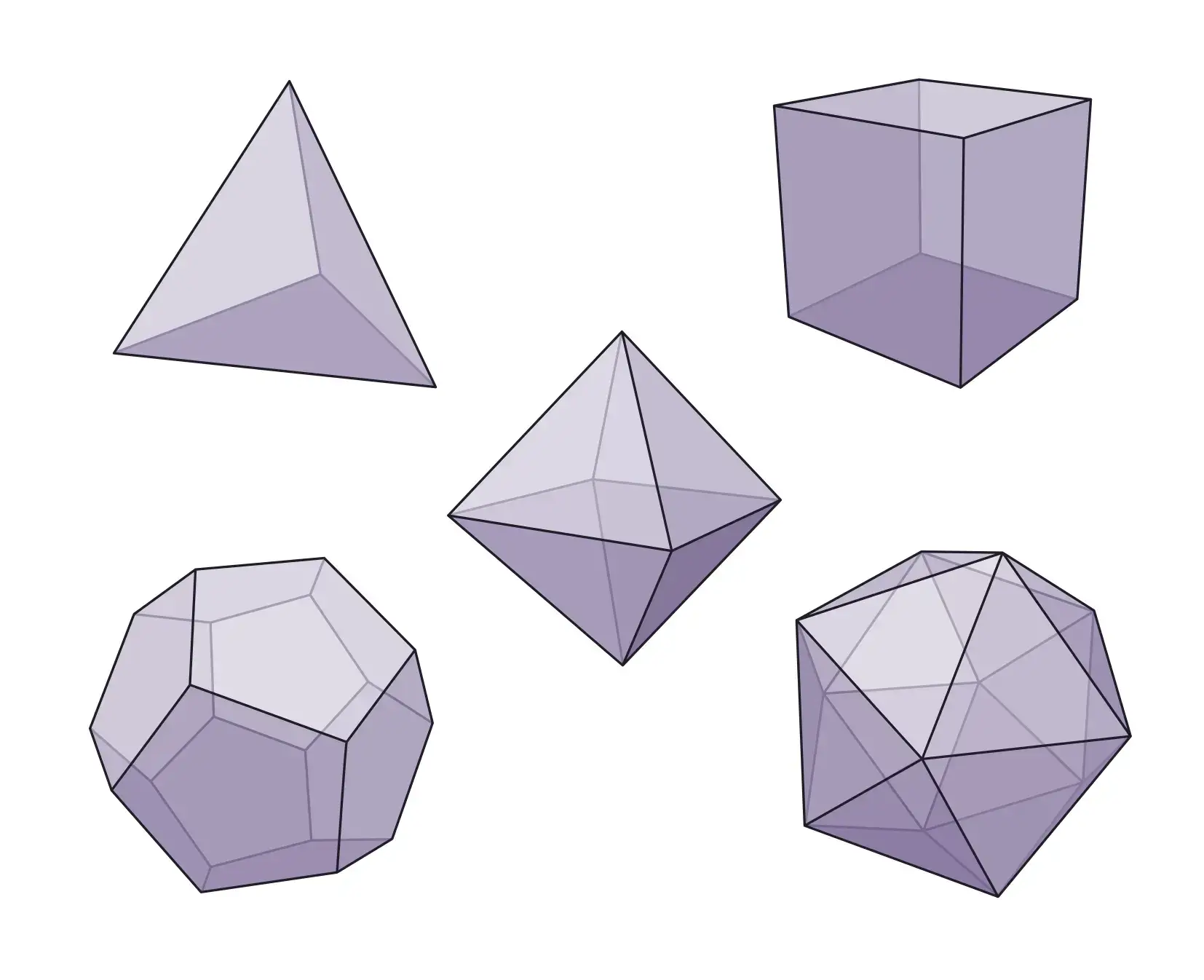
The Five Regular Solids and Their Elements
| Shape | Faces | Element | Symbolic Reason |
| Cube (Hexahedron) | 6 squares | Earth | Most stable, hardest to move — like earth |
| Tetrahedron (Pyramid) | 4 equil. triangles | Fire | Sharp edges, apex pointing upward — like flame |
| Octahedron | 8 equil. triangles | Air | Light and smooth — like air moving through space |
| Icosahedron | 20 equil. triangles | Water | Rounded and smooth — rolls most easily like water |
| Dodecahedron | 12 pentagons | Cosmos | Complex, sphere-like, mysterious — used for the whole |
Why Only Five Platonic Solids Can Exist
Plato notes — and mathematics confirms — that only five solids can satisfy all three of the following conditions simultaneously:
- Regular: all faces of the solid are identical — the same polygon, repeated uniformly. The cube has six identical square faces. The tetrahedron has four identical equilateral triangles. All faces on any given Platonic solid are the same shape and size.
- Internally identical: all edges have the same length, and all angles at every vertex are equal. The solid has no privileged edge or corner — every position within it has the same geometric relationship to every other.
- Convex: the solid has no indentations. No face curves inward. If you draw a straight line between any two points on or inside the solid, that line stays entirely within the solid. (The opposite is concave — a bowl shape, which curves inward.)
- Any attempt to construct a sixth regular convex solid runs into a mathematical impossibility: either the faces cannot close properly into a solid figure, or the solid becomes concave, or the faces are no longer regular. There are exactly five and only five combinations that work — which is why there are exactly five Platonic Solids. This was proved rigorously later in Euclid’s Elements.
The Pythagorean Reduction — Reality as Numbers
Plato does not stop at the geometric solids. He pushes the analysis further, reducing each solid to simpler and simpler structures until physical reality resolves entirely into mathematics.
- Step 1 — Solids to flat faces. A cube unfolds into six squares. A tetrahedron unfolds into four equilateral triangles. Any three-dimensional solid can be reduced to its two-dimensional faces.
- Step 2 — Faces to triangles. Any polygon can be decomposed into triangles. A square consists of two right triangles. All the faces of the Platonic Solids reduce ultimately to triangular shapes.
- Step 3 — Triangles to lines. Triangles are defined by their sides — which are lines. The triangle reduces to its constituent line segments.
- Step 4 — Lines to numbers. Lines are defined by their lengths — which are numbers, specifically ratios and proportions. Physical reality, at its mathematical foundation, is a structure of numbers.
- The Pythagorean conclusion: the physical world — even in its spatial-geometric form — is ultimately reducible to arithmetic. Plato takes Pythagoras’s claim (‘all things are numbers’) and gives it a rigorous metaphysical foundation through the theory of Forms and the analysis of the Platonic Solids.
Max Tegmark’s ‘Our Mathematical Universe’: Contemporary physicist Max Tegmark has argued that the physical universe is not merely described by mathematics but literally is a mathematical structure — one of many abstract mathematical objects that exist independently. This is a modern version of Plato’s claim, grounded in quantum mechanics and cosmology rather than geometry. Plato’s physics, read with sufficient care, anticipated this position by 2,400 years.
Why Physics Still Cannot Be Perfect Knowledge
Even after all this mathematical reduction, Plato’s conclusion stands: physics remains a ‘likely story,’ not genuine knowledge. The reason is precise: physics studies the sensible images — the appearances that arise when the chora receives and reflects the Forms. These sensible images are not the Forms themselves. They participate in mathematical structure but they are not purely mathematical — they involve the chora, which is irrational, and the chaotic matter, which resists order. Mathematical knowledge is 100% certain because it is about the Forms directly. Physics is about the reflections of the Forms in irrational matter — which always introduces an irreducible element of imprecision and contingency.
4. Being and Becoming — The Origin of the World
Two Categories of Existence
- Being: ‘what always is and never becomes.’ The Forms — eternal, changeless, perfect. They have no origin and no end. They simply are, always have been, and always will be.
- Becoming: ‘what becomes and never is.’ The physical world — always in the process of changing, never achieving a final stable state. It is perpetually becoming something else, perpetually in transition, never fully being what it is.
- The crucial implication: everything that belongs to Becoming — every physical object and event — had an origin. It came into existence at some point. And if it came into existence, there must be a cause. As Plato insists, the question is not how it came to be (the mechanistic question) but why — what purpose or intention lies behind its existence. This is the question that demands a teleological answer, and a teleological answer requires a mind.
The Demiurge — The Divine Craftsman
Plato’s answer in the Timaeus is the Demiurge — a Greek word meaning craftsman or artisan, one who works with their hands according to a design. The Demiurge is Plato’s account of the purposive intelligence behind the cosmos.
- What the Demiurge faced: a pre-existing chaotic stuff — formless, disordered, moving randomly without purpose or pattern. This is not nothingness; it is formlessness. The raw material before any order has been imposed on it.
- What the Demiurge had: the eternal Forms — perfect, beautiful, mathematically ordered, supremely good. These served as the blueprints, the models, the standards.
- What the Demiurge did: he looked at the Forms, saw their beauty and goodness, and imposed their order onto the chaotic stuff. He took the formless raw material and shaped it — as closely as the material permitted — into something that participates in the Forms’ beauty, order, and rationality.
The sculptor analogy: A great sculptor has two things: a block of raw stone and a vision of the figure it should become. The sculptor imposes the form of the vision onto the resistance of the stone. The finished sculpture is not the Form itself — it is the closest physical approximation to the Form that the particular stone permits. The Demiurge’s creative act is exactly this, operating at cosmic scale.
- The motive for creation: Plato is explicit on this point. The Demiurge is good — and one of the properties of genuine goodness is the absence of jealousy. A truly good being wants others to share in its goodness. The Demiurge, seeing the disorder of the chaotic stuff and the perfection of the Forms, wanted to bring the chaos as close to the Forms’ perfection as possible — not for his own benefit, but because goodness naturally tends to expand and share itself. This passage (Timaeus: ‘He was good, and in him that is good no envy arises…’) is one of the most theologically significant passages in Greek philosophy.
Why the World Is Not Perfect — Two Forces in Conflict
- Nothing physical can perfectly instantiate its Form. A drawn circle is not the Form of Circle. A sculpted figure is not the Form of Human. The physical medium always falls short of the Form’s perfection — because the Form’s perfection is, by definition, beyond the reach of the changing, material domain.
- The Demiurge did not create from nothing. He worked with pre-existing chaotic matter. That matter has its own character — it is irrational, purposeless, and resistant to order. No amount of divine skill can entirely overcome this resistance.
Plato identifies two forces operating in the universe:
- Reason (the Demiurge’s force): intelligent, purposive, ordering. Wherever there is beauty, harmony, mathematical proportion, and goodness in the world, this is the Demiurge’s contribution — the successful imposition of rational order onto chaos.
- Necessity (the chaotic material’s force): irrational, purposeless, random. Wherever there is disorder, ugliness, decay, evil, and accident in the world, this is the resistance of the irrational material — what Plato calls Necessity, which cannot be entirely tamed by even the most rational will.
| Plato’s solution to the problem of evil: The existence of evil and disorder in the world is explained not by a flaw in the divine but by the intractable irrationality of the material with which the Demiurge had to work. Goodness comes from Reason; evil comes from Necessity. The world is as good as it could possibly be given its material — which is why Plato calls it ‘the best possible world,’ not the best world imaginable. |
The World-Soul — A Living, Rational Cosmos
- Reason cannot exist without soul. This is a key premise: rationality is a property of souls, not of matter alone. A rational universe, therefore, must be a universe with a soul.
- The Demiurge creates a World-Soul. He places reason within the World-Soul and the World-Soul within the body of the cosmos. The result is a cosmos that is, in Plato’s account, a living creature — not a mechanism, but an organism with intelligence, soul, and purpose woven into its very structure.
- Against materialism: this is Plato’s most direct rejection of the atomist worldview. Democritus and the atomists described a universe of atoms bouncing randomly through void — no mind, no purpose, no value, no soul. Plato insists that such a universe could not explain the manifest order, beauty, and harmony of the cosmos. Order requires intelligence; beauty requires soul; purpose requires mind. The cosmos has all three — therefore the cosmos is not a machine. It is a living rational being.
5. Plato’s Theology — Natural Reasoning About the Divine
Plato’s Evolving Portrait of God
One of the most striking features of Plato’s theological thought is its development across his dialogues. He does not present a fixed, systematic theology. Different dialogues approach the divine from different angles, producing portraits that are complementary rather than contradictory — each illuminating a different aspect of what Plato means by ‘the highest reality.’
| Dialogue | Portrait of God / Ultimate Principle | Key Idea |
| Republic | The Form of the Good | The supreme source of all intelligibility and being |
| Symposium | The Form of Beauty | Ultimate beauty motivates the ascent of the soul |
| Timaeus | The Demiurge | Intelligent craftsman who imposes order on chaotic matter |
| Laws | The Self-Moving Mover | Soul as the first cause of all motion in the cosmos |
These are not four different Gods. They are four different conceptual approaches to the same highest principle — approached through epistemology (Form of the Good), aesthetics (Form of Beauty), cosmology (Demiurge), and metaphysics of motion (Self-Moving Mover). Together they constitute what might be called Plato’s ‘evolving theology’ — a single deep conviction (the highest reality is rational, good, and the source of all order) expressed through successive metaphors and arguments.
The Self-Moving Mover — Natural Theology in the Laws
In his final dialogue, the Laws, Plato presents his most systematic cosmological argument for the existence of a divine principle. He enumerates eight types of motion — circular, forward, increase, decrease, combination, separation, and two more — and then points to a crucial gap.
- The regress problem: if everything that moves is moved by something else, we face an infinite regress. Every ball that moves was struck by another ball; every struck ball was set in motion by another. If everything requires an external cause of motion, and if at some past moment everything was at rest — nothing would ever have started moving.
- The only escape: there must exist something that moves itself — that is the source of its own motion, requiring no external cause to set it in motion. This self-moving entity is the first mover, the original source of all motion in the cosmos.
- Plato identifies this with soul. Soul is the self-moving mover. It is the kind of entity that can initiate motion from within itself, without being pushed from without. This is what distinguishes souls from mere bodies: bodies are moved; souls move themselves.
- The theological implication: the cosmos’s motion — the motion of the stars, the planets, the elements, everything — ultimately traces back to a self-moving soul. This cosmic soul is rational, purposive, and good. It is, in Plato’s language, divine.
Natural Theology — Reasoning About God Without Revelation
Plato’s theological arguments are examples of what philosophers call natural theology — arguments for claims about God or the divine derived from pure human reasoning, without appeal to religious revelation, mystical experience, or scripture. This is a crucial methodological point.
- Natural theology uses the same tools as philosophy and mathematics — argument, analysis, inference, evidence from ordinary experience — to reach conclusions about the ultimate nature of reality and its relation to what we call God. No authority is invoked except reason itself.
- What natural theology can establish (on Plato’s account): that the cosmos is rational and ordered; that it has an intelligent cause; that this cause is good (goodness produces no harm, and Plato argues God cannot be the source of evil); that this cause is changeless (any change in the highest good would be a change toward lesser good — i.e. deterioration — which is impossible for something already maximally good).
- What natural theology cannot establish: the personal, relational attributes of God in the Abrahamic traditions — hearing prayers, entering covenants, intervening in individual lives. These require revelation, not reason alone.
Is the Demiurge a Personal God? — A Careful Assessment
Students frequently ask whether Plato’s Demiurge is the same as the God of Judaism, Christianity, or Islam. The answer requires distinguishing carefully between what the Demiurge shares with Abrahamic conceptions of God and what he does not.
| What the Demiurge has in common with personal theism | What the Demiurge does NOT share with Abrahamic God |
| Is conscious and intelligent | Not omnipotent — cannot overcome the resistance of chaotic matter |
| Has a will — chooses order over chaos | Does not create from nothing (ex nihilo) — pre-existing matter exists |
| Is good — no jealousy or selfish interest | Cannot hear prayers or respond to individual humans |
| Has a purpose — wants goodness to spread | Has no personality, emotions, or personal relationships |
| Is the cause of the cosmos’s order | Is NOT the ultimate principle — Forms are above the Demiurge |
| His creative act may be logical/analytical, not a real event in time |
- The Demiurge is not the ultimate principle in Plato’s system. The Forms — especially the Form of the Good — are above the Demiurge. The Demiurge does not create the Forms; he follows them. He is, in a sense, the rational force that enacts the Forms’ implications in the physical world — a principle of cosmic reason that operates according to a higher standard it did not itself set.
- Better described as: a rational ordering principle with intelligence, will, and purpose — but without personality, emotion, omnipotence, or the capacity for personal relationship. The Demiurge is closer to what later thinkers would call the Logos (rational principle) than to what they would call a personal God.
| A note on comparative theology: in Hindu thought, Brahman is the total expansion of ultimate reality — not a creator or maker. In Taoist thought, the Tao is the natural effortless principle of the way things are — not a being at all. In the Abrahamic traditions, God is a personal creator with absolute power. The Demiurge fits none of these exactly. The English word ‘God’ covers very different concepts in different traditions — always check what is meant by the term before comparing. |
The Timaeus Account — Temporal or Logical?
- A central interpretive question is whether Plato’s account of the Demiurge creating the world is a description of a real event that happened at some point in time (temporal interpretation) or a logical/analytical description of the structure of reality that is always the case (logical interpretation).
- Evidence for the temporal interpretation: Plato uses language like ‘the world came into being.’ He describes time itself as created alongside the cosmos (‘time was created with the heavens’ — meaning before creation there was no time). He presents the process in narrative sequence.
- Evidence for the logical interpretation: the Demiurge is described as existing ‘outside of time,’ which means his creative act cannot be a temporal event. Aristotle — Plato’s student — read the Timaeus as a logical description rather than a temporal narrative. And Plato himself calls the account a ‘likely story’ and says it should not be taken literally.
- The most defensible position is that Plato is using the narrative of creation to make a logical point: the physical world’s structure presupposes rational intelligence, purposive ordering, and dependence on eternal Forms. The story of the Demiurge is the most vivid way to express this dependence — not a historical account of an event that happened on a particular day.
Conclusion
Plato’s physics and theology together constitute a single, sustained argument: the universe is not a mindless machine. The pre-Socratic atomists and Plato’s own contemporary Democritus described a world of purposeless particles colliding in void — a world in which beauty, order, goodness, and intelligence are accidents, byproducts of random collision. Plato’s response to this is total and systematic. Physics as the study of the changing world cannot achieve genuine knowledge — it can only achieve likely stories. The physical world’s qualities are appearances generated by interaction, not intrinsic properties of matter. What underlies those appearances is not atomic material but geometric spatial structure — the chora receiving the shapes of the Forms. The cosmos is not self-explanatory: its beauty, harmony, and mathematical order demand a rational cause — the Demiurge — who imposes the Forms’ order onto pre-existing chaos. And the cosmos itself is not dead matter but a living, ensouled, rational being, with a World-Soul that makes it an intelligent organism rather than a mechanism. This vision of an intelligent, purposive, mathematically ordered cosmos shaped two and a half millennia of philosophical and theological reflection — from Aristotle’s teleology through Neoplatonism and Christian theology to contemporary debates in philosophy of mind, philosophy of science, and cosmology.
Frequently Asked Questions
Why does Plato treat physics and religion in the same lecture?
Because they share a single foundational claim: Plato’s universe has an intelligent mind at its core. His critique of physical science shows why a purely mechanistic account of the world cannot reach truth — physics asks ‘how’ when the real question is ‘why,’ and it studies a changing world when genuine knowledge requires stable, unchanging objects. His theology supplies what physics lacks: a rational, purposive intelligence (the Demiurge) whose ordering act explains the cosmos’s beauty, order, and goodness. Physics and theology are two sides of the same position — that the universe is rational and purposive, not a mindless machine driven by random collisions.
What is the difference between mechanistic and teleological explanation, and why does it matter?
Mechanistic explanation treats the world as a machine governed by conditions and causes operating without purpose or mind. It asks ‘how does this happen?’ and answers by identifying the physical conditions that produced the event — hormones, light exposure, and differential growth explain why a vine coils. No intention, goal, or mind is involved. Teleological explanation treats the world as purposive — events happen because they serve a goal or purpose, and a mind directs them toward that goal. It asks ‘why does this happen?’ and answers by identifying the purpose: the vine coils because it seeks sunlight. Plato argues that physics systematically mistakes the former for the latter — it identifies conditions when it should be identifying purposes. Socrates sitting in prison is not explained by his bones and muscles; it is explained by his decision that staying was right and just. This distinction reverberates through the entire subsequent tradition, reappearing with Aristotle, Newton, Hume, Kant, and Darwin.
What is the chora (receptacle/space), and how does it fit into Plato’s three-level analysis of reality?
Plato analyses physical reality into three levels. First are the eternal Forms — pure intelligible structures accessible only to reason. Second are the sensible appearances we perceive — what we experience as the colour, heat, shape, and texture of physical objects. These appearances are interaction products between the object’s configuration and the observer’s sense organs; they are not intrinsic properties of the object. Between these two levels is the chora — a formless, passive medium that receives the Forms and makes sensible appearances possible. The chora is neither visible (the senses cannot perceive it) nor fully intelligible (reason cannot grasp it directly). It is like a cinema screen that neither creates the projected image nor is itself part of the image, but makes the image possible. Or like sand in a mould: the sand has no intrinsic shape but receives whatever form is imposed on it, and the resulting shaped sand is neither the mould (Form) nor simply sand — it is a spatial configuration. Physical objects, for Plato, are spatial configurations in this chora — geometric structures with length, width, and height, but no material substance. This is what separates Plato’s physics from atomism: Plato’s basic ‘particles’ are mathematical shapes in space, not material bodies.
What are the Platonic Solids, and why can there only be five?
The Platonic Solids are the five three-dimensional shapes that satisfy three conditions simultaneously: regular (all faces identical), internally identical (all edges and angles equal), and convex (no indentations). They are: the cube (6 square faces, representing Earth), tetrahedron (4 triangular faces, representing Fire), octahedron (8 triangular faces, representing Air), icosahedron (20 triangular faces, representing Water), and dodecahedron (12 pentagonal faces, representing the Cosmos). Only five such solids exist because any attempt to construct a sixth violates at least one of the three defining conditions — the faces either cannot close into a solid, the resulting shape becomes concave, or the faces are no longer regular. Plato uses these shapes to give a mathematical account of the four elements, then further reduces them: solids → flat faces → triangles → lines → numbers, arriving at an extreme Pythagorean position that physical reality is ultimately a mathematical structure. This is what Max Tegmark’s ‘Our Mathematical Universe’ develops in modern cosmological terms.
What is the Demiurge, and is he the same as the Abrahamic God?
The Demiurge (Greek: craftsman or maker) is Plato’s account in the Timaeus of the rational intelligence behind the cosmos. He is not the Abrahamic creator God — he does not create the world from nothing. A pre-existing chaotic stuff already exists; the Demiurge finds it formless and purposeless and imposes on it the order, beauty, and goodness he sees in the eternal Forms. He is good and not jealous, and so he wants everything to share in his goodness — this is his motive for ordering the chaos. He creates a World-Soul, places reason within it, and places it within the cosmos, making the universe a living rational being. The Demiurge is conscious, has will and purpose, and is good — but he is not omnipotent (he cannot fully overcome the resistance of chaotic matter), he cannot create from nothing, he cannot hear prayers or enter personal relationships, and he is not the ultimate principle (the Forms are above him). He is better described as a rational ordering principle than as a personal God. Plato’s theology also evolves across his dialogues: the Republic calls the highest principle the Form of the Good; the Symposium calls it the Form of Beauty; the Laws calls it the Self-Moving Mover. These are not different Gods but different approaches to the same highest reality.
Leave a Reply