
Key Takeaways
- Aristotle (384–322 BCE) was born in Stagira, Macedonia, the son of Nicomachus, physician to the Macedonian king. His father’s scientific temperament likely shaped the empirical, observational quality that distinguishes Aristotle’s philosophy from Plato’s more mathematical orientation. He is sometimes called ‘the second father of Western philosophy.’
- Aristotle spent nearly 20 years at Plato’s Academy — first as a student, then as a teacher — before leaving after Plato’s death in 347 BCE. He later tutored the young Alexander (who would become Alexander the Great) for two to three years. In 335 BCE he founded his own school, the Lyceum, in Athens, where he produced most of his major works over the next twelve years.
- A crucial asymmetry distinguishes Plato’s and Aristotle’s surviving texts. Plato’s popular dialogues (written for general audiences) survived; his technical lectures for advanced students were lost. Aristotle’s situation is the reverse: his technical lecture notes for the Lyceum survived; his popular dialogues for general audiences were lost. This is why Aristotle’s texts are harder to read — they were never intended for the public.
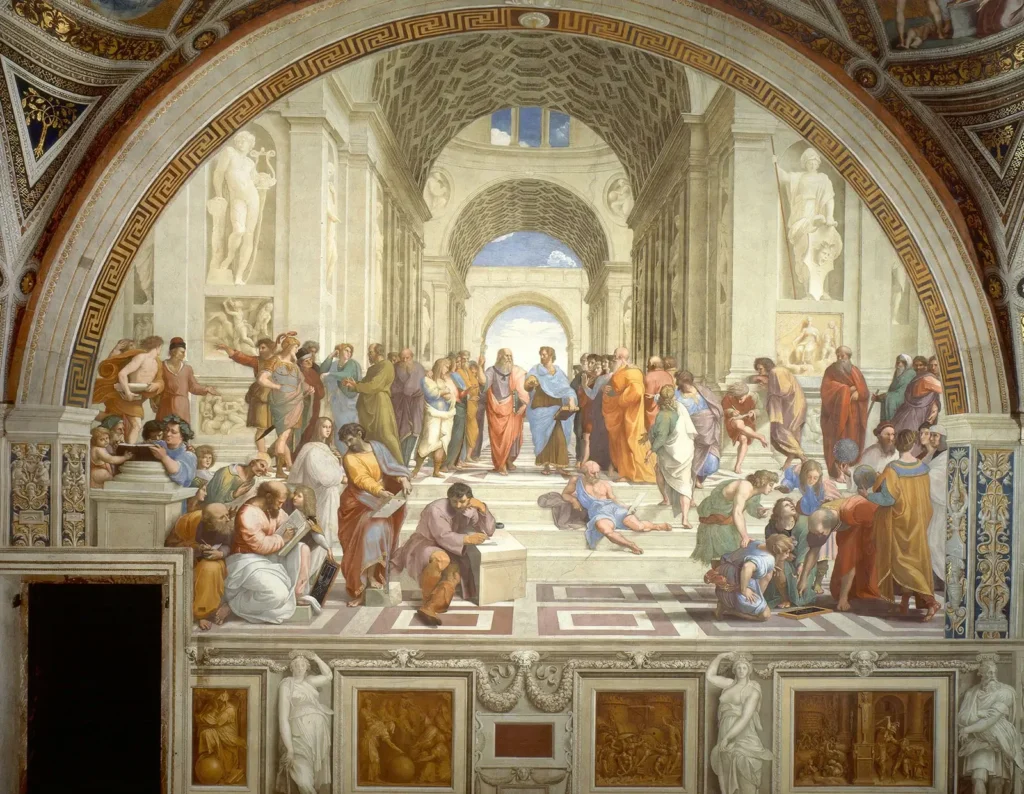
- The core difference between Plato and Aristotle is one of fundamental orientation. Plato, shaped by mathematics, sought perfection in an eternal world of Forms beyond the senses. Aristotle, shaped by biology, insisted that genuine knowledge must be grounded in this world — in the concrete, changing, observable reality around us. Their two positions are encoded in Raphael’s School of Athens: Plato’s hand points upward; Aristotle’s points toward the earth.
- Aristotle faced multiple philosophical problems simultaneously. The materialists (Thales through Democritus) had left no room for moral values in their accounts of reality. The problem of change had never been satisfactorily resolved. And Parmenides and Zeno had made misleading use of logic and language that needed to be corrected before any further progress was possible. Aristotle’s philosophical agenda followed from these problems: first fix logic (Organon), then explain change (Physics), then define reality (Metaphysics).
- The Nicomachean Ethics — Aristotle’s masterwork on the good life, virtue, and happiness — is named for both his father and his son, both of whom were called Nicomachus. It is considered one of the greatest works ever written on ethics, and unlike a code of rules or a fixed system, it invites the reader to develop their own vision of the good life through active reflection.
Introduction
Aristotle is, by any measure, one of the most consequential thinkers in human history. He made foundational contributions to logic, biology, physics, metaphysics, ethics, politics, rhetoric, and poetics — fields so diverse that even specialists in one rarely have more than a working acquaintance with the others. He studied under Plato for twenty years, then spent the rest of his life building a philosophical system that departed from Plato’s in almost every fundamental respect — while remaining, in temperament if not in conclusion, a deeply Platonic thinker. Understanding where Aristotle came from, what problems he was trying to solve, and how his instincts differed from his teacher’s is the essential preparation for the lecture series that follows.
Table of Contents
1. Life and Historical Context — A Timeline
Aristotle’s life unfolded against a backdrop of political upheaval: the long decline of Athens after the Peloponnesian War, the rise of Macedonian power under Philip and Alexander, and the recurring tension between Macedonian rulers and the Athenian democratic tradition. These external forces shaped his movements and, at key moments, his safety.
| Date | Age | Event |
| 384 BCE | — | Born in Stagira, Macedonia. Father Nicomachus is physician to the Macedonian king. Father’s scientific temperament leaves a lasting mark. |
| 367 BCE | 17–18 | Sent to Athens to study at Plato’s Academy. Remains for nearly 20 years — first as student, then as teacher. |
| 347 BCE | ~37 | Plato dies. His nephew Speusippus takes over the Academy, focusing exclusively on mathematics. Anti-Macedonian sentiment grows in Athens. Aristotle leaves to travel and conduct biological research. |
| 342 BCE | ~42 | King Philip of Macedonia invites Aristotle to tutor his son Alexander (age 13). Aristotle spends approximately 2–3 years as Alexander’s teacher. |
| 338 BCE | ~46 | Philip conquers Greece. Alexander assumes command after Philip’s death. |
| 335 BCE | ~49 | Aristotle returns to Athens and founds the Lyceum — less a conventional school than a research centre focused on natural science. His most important works are written here over the next 12 years. |
| 323 BCE | ~61 | Alexander the Great dies. Anti-Macedonian fury resurges in Athens. Knowing what happened to Socrates, Aristotle leaves, saying: ‘I will not allow Athens to sin twice against philosophy.’ |
| 322 BCE | ~62 | Aristotle dies, probably of a stomach illness, one year after leaving Athens. |
Key Relationships
- Father — Nicomachus. Physician to the Macedonian king, and the probable source of Aristotle’s lifelong interest in biological observation and empirical method. A doctor’s training in observation, classification, and the study of living organisms left its mark on how Aristotle approached every domain of inquiry.
- Teacher — Plato. Aristotle was Plato’s student for nearly two decades and clearly revered him. When Plato died, Aristotle said that Plato was a man who showed us, by his own life and by his arguments, how a person becomes good and happy — and that only the unworthy dare speak ill of him. Yet Aristotle was also willing, when argument demanded it, to correct his teacher: ‘I love Plato, but I love truth more.’
- Pupil — Alexander. The young Alexander was thirteen when Aristotle began tutoring him. Their relationship lasted two or three years. Alexander’s later political vision — a vast cosmopolitan empire based on conquest — diverged sharply from Aristotle’s political philosophy, which was rooted in the small Greek city-state. The story that Alexander sent Aristotle biological specimens from every corner of his conquests is probably true in spirit if not in every detail.
- Wife and family. Aristotle married Pythias; after her death he lived with Herpyllis, with whom he had a son. He named the son Nicomachus — the same name as his own father. The Nicomachean Ethics is named for this Nicomachus (though whether it means father, son, or both is debated). The name’s double resonance — linking three generations — gives the book an unusually personal quality.
| The famous farewell: ‘I will not allow the Athenians to sin twice against philosophy.’ — Aristotle’s reported words when leaving Athens for the last time in 323 BCE, after Alexander’s death reawakened the city’s anti-Macedonian anger. The reference is to Socrates, executed by Athens 76 years earlier. Aristotle knew exactly what mob sentiment could do to a philosopher. |
2. Aristotle’s Works — What Survived and How to Read Them
A Crucial Asymmetry: Plato vs Aristotle
There is a remarkable asymmetry between the texts of Plato and Aristotle that every student of philosophy needs to understand from the beginning.
- Plato wrote two kinds of texts: popular dialogues (designed for general audiences, richly literary, dramatically staged) and technical lectures for his advanced students at the Academy. What survived is the popular dialogues — the Republic, the Meno, the Symposium, and the rest. His technical lectures for advanced students are almost entirely lost.
- Aristotle also wrote two kinds of texts: technical lecture notes for his school at the Lyceum, and popular dialogues for general audiences. The situation is the exact reverse of Plato’s: what survived is the technical lecture notes. His popular dialogues — which ancient readers praised for their literary beauty — are almost entirely lost.
- The practical consequence: Plato is relatively accessible because we have his public-facing work. Aristotle is difficult precisely because what we have was never meant for outside audiences. The surviving Aristotle texts are, in effect, a teacher’s working notes — internally dense, sometimes unfinished, often changed and compiled by editors after his death. Reading Aristotle requires patience and a willingness to engage with material that was not designed to be read as literature.
The Developmental Approach
- Aristotle’s thought evolved significantly over his career, and his surviving texts reflect this evolution. A book like the Politics, for example, is actually a compilation of writings from different periods — within a single ‘book,’ Aristotle’s views develop, shift, and sometimes even contradict earlier positions.
- The developmental approach was formalised by the German scholar Werner Jaeger and remains the standard framework for serious Aristotle scholarship. Rather than trying to extract a single consistent system from all of Aristotle’s writings, this approach reads the texts as a developing thinker working through problems across a career — sometimes changing his mind, sometimes leaving questions open.
- This means Aristotle cannot be read the way Euclid is read — as a fixed, axiomatic system where every part fits every other part with mathematical precision. He is better read the way one reads a great scientist’s collected notebooks: rich with insight, internally developing, and most valuable when the movement of thought is followed rather than the conclusions extracted.
Essential Reading
- The Nicomachean Ethics (Oxford or Penguin Edition) is the text most indispensable for understanding Aristotle — and arguably for any educated person, regardless of their field. Unlike a moral rulebook or a fixed system of obligations, it invites the reader into an ongoing inquiry about what a good life is, what virtues it requires, and what genuine happiness means. Aristotle does not hand the reader conclusions; he walks alongside them, asking questions, drawing distinctions, examining examples. The effect, for a careful reader, is the gradual formation of one’s own considered view of how to live.
- The Philosophy of Aristotle (Signet Classics) a useful introductory anthology exists that collects major sections from seven of Aristotle’s works in a single volume: Metaphysics, Logic, Physics, Psychology, Ethics, Politics, and Poetics. For a first encounter with Aristotle’s range, this is an effective starting point — though none of the individual works is complete, the selection includes what is most essential.
3. Plato and Aristotle — The Philosophical Divide
Aristotle is sometimes described as Plato’s most brilliant student and most formidable critic. Both descriptions are accurate. He absorbed Plato’s questions completely; almost none of his own work is intelligible without understanding what Plato said first. But on question after question — the nature of Forms, the relationship between soul and body, the source of knowledge, the purpose of political theory — Aristotle arrived at answers diametrically opposed to Plato’s.
The table below maps the six most important dimensions of contrast between them.
| Dimension | Plato | Aristotle |
| Primary intellectual orientation | Mathematics — perfect, eternal, unchanging entities (circle, triangle) accessible only to reason | Biology — living, changing organisms studied in their natural environment through observation |
| Relationship to the sensory world | Escape the flux — the sensory world is shadow and appearance; genuine reality lies in the eternal Forms beyond the senses | Embrace this world — the sensory world IS the real world; knowledge must begin with what we observe around us |
| Soul and body | Soul = real person; body = container; soul can exist without body (and did, in the world of Forms before birth) | Soul and body are inseparable; soul is the ‘form’ of the body — it cannot exist apart from it any more than sight can exist without eyes |
| Political philosophy | Describes the ideal perfect state (modelled on mathematical Forms) without explaining how to get there in practice | Surveys 158 actual constitutions; comparative analysis; asks what works under what conditions — empirical and practical |
| Driving motivation | Primarily: refute Sophist relativism and scepticism; prove that objective moral truth exists | Multiple problems: define reality WITH room for moral values; explain change; fix logic and language; build a system from the ground up |
| Attitude toward prior philosophy | Deep respect for Socrates; strong reaction against the Sophists; builds upward from Socratic ethics | Deep respect for Plato (‘I love Plato, but I love truth more’); willing to refute his own teacher when argument demands it |
The Root of the Difference
The deepest source of the divergence between Plato and Aristotle is not a specific argument that one of them got wrong. It is a difference in philosophical temperament — in what they found most real, most interesting, and most worth studying.
- Plato was a mathematician at heart. What fascinated him was the perfect, eternal, unchanging structure that mathematics reveals — the circle that is always and exactly circular, the number that is always and exactly what it is, the Form that never becomes other than itself. For Plato, this eternal mathematical order is more real than anything the senses can reach. The changing, imperfect, transient world of experience is less real — a shadow, an imperfect copy, a moving image of eternity.
- Aristotle was a biologist at heart. What fascinated him was the living, developing, complex organism — the plant that grows toward the light, the animal that hunts and mates and dies, the human being that deliberates and acts and seeks happiness in the middle of a complicated and only partially predictable world. For Aristotle, this concrete, changing, observable world is not less real — it is the only real world there is. The task of philosophy is to understand it, not to escape from it.
- The disagreement about Forms is the clearest expression of this difference. Plato locates the Forms in a separate, non-physical realm and says that physical things are copies of Forms. Aristotle accepts that there are universal features (what he will call ‘universals’) but insists that they exist only in and through particular things — not in a separate realm. There is no separate Form of ‘humanness’ floating in an eternal world above; there is humanness, present in each actual human being, intelligible through observation and reasoning about actual humans.
- The disagreement about soul and body follows the same pattern. Plato separates soul from body — the soul is the real person, the body a temporary container, and the soul existed in the world of Forms before entering the body at birth. Aristotle insists that soul and body are not separable: the soul is the form of the body (its organising principle, what makes a body a living body), and it no more makes sense to ask where the soul is when the body is gone than to ask where the sight is when the eye is destroyed.
Aristotle on Plato: ‘Plato is my friend, but truth is a better friend still.’ (Sometimes rendered as ‘amicus Plato, sed magis amica veritas.’) This became one of the most quoted lines in philosophy — a model of intellectual integrity: full respect for one’s teacher combined with an unconditional commitment to following the argument wherever it leads.
4. The Philosophical Agenda — Problems Aristotle Set Out to Solve
To understand why Aristotle’s works unfold in the order they do, and why he begins with logic rather than metaphysics, it is necessary to understand the specific problems he identified as needing solution before anything else could be built.
Problem 1 — Reality Without Moral Values
- The pre-Socratic materialists — from Thales to Democritus — had proposed accounts of reality in terms of physical substances: water, air, earth, fire, the Apeiron, atoms. These accounts had real explanatory power for the natural world. But they left no conceptual room for moral values. In a world of atoms bouncing through void, where does good or bad, right or wrong, just or unjust enter? The answer, for the atomists, is: nowhere. These are human projections, not features of reality.
- Plato solved this by locating moral values in the world of Forms — the Form of the Good, the Form of Justice, the Form of Beauty. But, as the previous lectures showed, he located them so far from the physical world that connecting them to actual human life and action became deeply problematic. The Forms are perfect, eternal, and non-physical; human actions are imperfect, temporal, and physical. The bridge between them was always strained.
- Aristotle’s task: to find a way of understanding reality that makes moral values genuinely real features of the world — not floating in a separate realm, but present and operative in the natural, changing, observable world that we actually inhabit. His answer — built around teleology, the concept of function (ergon), and natural kinds — will occupy us in the lectures ahead.
Problem 2 — The Problem of Change
- Change is the most basic fact of experience, yet it had proven stubbornly resistant to philosophical analysis since Thales. Heraclitus embraced it (everything is flux); Parmenides denied it (change is impossible, an illusion of the senses); Plato placed genuine reality beyond change (the Forms are changeless; the physical world changes because it is only a copy). None of these was satisfactory.
- The atomists made the most serious attempt: change is motion — atoms moving, colliding, and rearranging. But this reduces all change to local motion of particles, which cannot account for growth, development, generation, or the apparent purposiveness of living things.
- Aristotle’s task: to give a philosophically rigorous analysis of change that does justice to its actual variety — not just local motion but growth, generation, alteration, and the development of a living organism toward its mature form. Without this, a genuine natural science is impossible. This is the central project of his Physics.
Problem 3 — Logic and Language
- Parmenides and Zeno had used language in ways that led to paradoxical and misleading conclusions — ‘non-being cannot exist,’ ‘change is impossible,’ ‘motion cannot occur.’ These conclusions seemed to follow from apparently valid arguments, yet contradicted obvious facts of experience. The problem was partly in the logic, partly in how language was being used.
- Before building anything else, Aristotle recognised, the tools of argument themselves needed to be properly analysed and corrected. What makes an argument valid? What are the forms of inference that reliably preserve truth? How do words relate to things? How can language mislead us, and how can it be made precise? These questions are the subject of the Organon (Greek: instrument or tool) — Aristotle’s collection of works on logic.
- The sequence is deliberate: Organon (fix the tools) → Physics (explain change) → Metaphysics (define reality). Each step depends on the previous one. Aristotle would not attempt to define reality before he had a proper account of change, and he would not attempt either before he had reliable logical tools to work with.
| The agenda in three steps: Step 1 — Organon: build a proper logic and theory of language. Step 2 — Physics: use that logic to give a rigorous account of change and natural motion. Step 3 — Metaphysics: having solved the prior problems, define what reality fundamentally is. This sequence is Aristotle’s philosophical architecture. |
5. The School of Athens — Raphael’s Painting
In 1511, the Italian Renaissance painter Raphael completed one of the most celebrated paintings in Western art: The School of Athens, now in the Vatican Museums in Rome. The painting imagines the greatest thinkers of ancient Greece assembled in a single magnificent architectural space — Pythagoras, Euclid, Socrates, Diogenes, and dozens of others, arranged in a vast hall. At the very centre of the composition, framed by the arches of the hall, walk two figures side by side. They are Plato and Aristotle.
What the Two Figures Show
- Plato is on the left, dressed in a robe of red and violet. He holds a copy of the Timaeus — his work on cosmology and the nature of the physical world. His right hand is raised, with one finger pointing directly upward — toward the sky, toward the heavens, toward whatever lies beyond the visible world. The gesture speaks without words: true knowledge is not here. It is up there — in the eternal, changeless world of Forms that lies beyond the senses and beyond the imperfect, shadowy world we inhabit.
- Aristotle is on the right, dressed in a brown robe — the colour of earth, of soil, of the natural world. He holds a copy of the Nicomachean Ethics — his work on human action, virtue, and happiness. His right hand is extended with the palm facing downward, toward the ground, toward the earth beneath their feet. The gesture speaks as clearly as Plato’s: true knowledge is not up there. It is here — in this world, in the concrete observable reality around us, in the complex, untidy, irreducibly human experience of living a life.
Two hands. Two gestures. Two philosophies, encoded in the body language of painted figures — and the contrast captures, with a precision that no single paragraph could achieve, the essential difference between the greatest teacher and the greatest student in the history of Western thought.
What the Painting Hides
Raphael’s painting is not merely decorative. It is philosophically sophisticated. The figure of Plato is often said to resemble Leonardo da Vinci — perhaps a tribute to a contemporary master. The architectural setting of the painting echoes the ideal proportions of Platonic geometry. The figures are grouped thematically: mathematicians cluster near Euclid; naturalists near those interested in the physical world; contemplatives apart from those engaged in debate.
But the painting also sets a challenge for the student. Right now, standing before this lecture, you can see the surface of it: two figures walking, two gestures, two books. What you cannot yet fully see is the depth — what it means that Aristotle holds the Ethics rather than the Metaphysics; why Plato holds the Timaeus and not the Republic; what is implied by the fact that they walk side by side rather than facing each other. These choices are not decorative. They encode specific philosophical claims.
By the time the Aristotle lecture series is complete, the painting will have acquired new layers of meaning. Every name, every gesture, every placement will read differently — more richly, more precisely, more beautifully — than it does today. This is one of the rewards of philosophical education: you do not just learn new information; you learn to see things you were already looking at.
Conclusion
Aristotle stands at one of the great hinges of intellectual history. Behind him lies the Platonic tradition — the world of Forms, the soul’s ascent to the Good, the philosopher-king’s vision of the perfect state, the mathematics-inflected metaphysics of eternal and unchanging truth. Ahead of him lies something entirely new: a philosophy that takes the changing, concrete, observable world seriously, that roots knowledge in empirical inquiry rather than rational ascent, that finds the Form in the thing rather than above it, and that measures the good life not by proximity to an ideal but by the full and proper exercise of what it is to be a human being. The lectures that follow will trace this philosophy in detail — through logic, epistemology, physics, metaphysics, ethics, and politics. But to follow them well, one needs to hold in mind the simple, decisive contrast that Raphael painted in 1511: one hand pointing up, one hand pointing down, and between them, the entire history of Western philosophy.
Frequently Asked Questions
Why is Aristotle often called ‘the second father of Western philosophy’?
The title acknowledges that Aristotle’s influence on Western thought is comparable only to Plato’s — and in some periods, considerably greater. While Plato set the fundamental questions that Western philosophy would wrestle with for centuries, Aristotle was the first to build a comprehensive, systematic philosophical framework that addressed all of them together. He founded formal logic, developed the first systematic biology, gave the first rigorous account of change and motion, wrote the most influential works on ethics and politics in the classical tradition, and produced treatises on rhetoric, poetics, and psychology that shaped those fields for two millennia. The medieval university curriculum was organised largely around Aristotle’s works. Aquinas called him simply ‘the Philosopher.’ His influence was so pervasive that in the Islamic Golden Age, al-Farabi and Averroës devoted careers to recovering and extending his thought. ‘Second father’ understates the case in some respects; in others, the phrasing is exactly right: he stands in the tradition Plato founded, but he rebuilt it almost from the ground up.
Why are Aristotle’s texts more difficult to read than Plato’s?
Because of a historical accident in what survived. Plato wrote popular dialogues for general audiences — richly literary, dramatically engaging, designed to be read by people without philosophical training — and these are what we have. He also gave highly technical lectures at the Academy for advanced students, but those are almost entirely lost. Aristotle’s situation is reversed: his popular dialogues, which ancient readers praised as beautiful and accessible, are almost entirely lost. What we have are his technical lecture notes for the Lyceum — documents written for students who were already deeply educated in philosophy, never intended for outside audiences, and sometimes compiled and edited after his death from multiple different periods of his career. Reading Aristotle is therefore like reading a brilliant scientist’s working notebooks rather than their polished public lectures. The reward is great, but the access requires patience and preparation.
What is the ‘developmental approach’ to reading Aristotle, and why does it matter?
The developmental approach, pioneered by the German scholar Werner Jaeger, treats Aristotle’s works not as a single consistent system to be read synchronically but as the record of a developing thinker whose views changed significantly over a long career. A book like the Politics, for example, is actually a compilation of writings from different periods, and the reader can trace changing and sometimes contradictory positions within its pages. Rather than trying to reconcile every statement into a unified doctrine, the developmental approach asks: at what stage in his career did Aristotle write this? What problem was he addressing then? What had he concluded earlier, and what was he revising? This matters because it makes Aristotle’s thought richer and more honest — it shows him working through genuinely difficult problems over decades, changing his mind when argument demanded it, rather than delivering a finished system from the start.
What were the three main philosophical problems Aristotle set out to solve?
First, he needed to find a way to account for moral values — good, bad, right, wrong, just — as genuine features of reality rather than mere human projections. The pre-Socratic materialists had left no room for moral values in their accounts of atoms and physical substances. Plato had found room for them in the world of Forms, but had placed them so far from the observable world that connecting them to actual human life remained strained. Second, Aristotle needed to give a rigorous philosophical account of change — the most basic fact of experience, yet unresolved since Thales. Without a proper theory of change, natural science was impossible. Third, he needed to correct the misleading uses of logic and language exemplified by Parmenides and Zeno, whose valid-seeming arguments led to conclusions (change is impossible, motion cannot exist) that contradicted obvious facts. His solution was to address these problems in sequence: first the Organon (logic and language), then Physics (change), then Metaphysics (reality as a whole).
What does Raphael’s School of Athens painting show about the difference between Plato and Aristotle? Raphael’s 1511 fresco, now in the Vatican Museums, places Plato and Aristotle at the geometric centre of the composition, walking side by side. Every detail of the two figures encodes the philosophical contrast between them. Plato holds the Timaeus (his work on cosmology and the physical world) and points his hand upward — toward the sky, toward the eternal world of Forms beyond the senses. His gesture says: true knowledge is up there, beyond this changing world of appearances. Aristotle holds the Nicomachean Ethics (his work on human action and the good life) and extends his hand downward, palm toward the earth — the brown earth colour of his robe reinforcing the gesture. His gesture says: true knowledge is here, in this world, in the concrete complexity of actual human experience. Two figures, two gestures, two books — and between them, the entire Plato-Aristotle divide made visible. The painting encodes far more than this, but its central contrast is immediately readable in the body language of the two central figures.
Leave a Reply