
Key Takeaways
- Aristotle agrees with Plato that sense perception alone is not genuine knowledge — but draws the opposite conclusion. Rather than abandoning the sensory world for a separate realm of Forms, Aristotle insists that the right method can carry us from particular sense experience all the way to universal, necessary, demonstrated scientific knowledge. The entire Organon is that method.
- Aristotle’s foundational conviction is the Reality–Thought–Language affinity: the structure of the world, the structure of our thoughts about it, and the structure of the language we use to express those thoughts are aligned. Analysing language carefully therefore reveals how we think, and how we think reveals how reality is structured. This conviction underpins the entire Organon project.
- The Organon (‘instrument’) is Aristotle’s six-book logical system, covering: (1) Categories — how to classify everything that exists; (2) On Interpretation — the nature of propositions and the principle of non-contradiction; (3) Prior Analytics — the syllogism and the validity/truth distinction; (4) Posterior Analytics — scientific knowledge, demonstration, first principles, and the inductive path from experience to principles; (5) Topics — dialectic for real-life debates; (6) On Sophistical Refutations — identifying and exposing logical fallacies.
- The validity/truth distinction is one of Aristotle’s greatest contributions. Validity is a property of an argument’s structure — it tells you whether the conclusion follows from the premises. Truth is a property of the premises themselves. A valid argument with false premises is not sound. A sound argument requires both: true premises AND a valid structure. This distinction is the foundation of formal logic, mathematics, computer science, and AI.
- The path to first principles runs through Nous and Induction. First principles — the self-evident starting points of all knowledge — cannot themselves be demonstrated (that would cause an infinite regress). Instead, we arrive at them by observing many particulars (perception → memory → experience), then using our innate intuitive capacity (nous) to grasp the universal principle in the particulars. This process — moving from many cases to a universal generalisation — is induction.
- The Correspondence Theory of Truth is Aristotle’s classical definition: a statement is true if it corresponds to reality (‘to say of what is that it is, is true’), and false if it does not. This is the foundational definition of truth that the Western philosophical tradition has worked with, argued about, and refined ever since.
Introduction
Aristotle’s epistemology begins from the same observation as Plato’s — that sense experience alone cannot yield genuine, stable, universal knowledge — but reaches a radically different conclusion about what to do next. Where Plato responded by leaving the sensory world behind and ascending to eternal, non-physical Forms, Aristotle stayed put and asked: given that we live in this world and can only begin with what we can observe, what method do we need in order to extract genuine knowledge from that observational starting point? The Organon — his six-book logical system — is the answer. It is not a collection of interesting logical puzzles. It is a practical instrument for doing something very specific: moving reliably from sense experience to scientific knowledge, and being able to distinguish valid from invalid reasoning along the way.
A note on the Organon’s relationship to logic: the Organon is not the same as logic in general. Logic is a vast and diverse discipline with many different branches (propositional logic, predicate logic, modal logic, paraconsistent logic, and others). The Organon specifically establishes syllogistic logic — also called formal deductive logic — which is one foundational part of the broader logical enterprise. That said, it is the foundational part: the part on which all the others build.
Table of Contents
1. The Desire to Know — Where Knowledge Begins
All Human Beings, by Nature, Desire to Know
The opening sentence of Aristotle’s Metaphysics is one of the most celebrated in philosophical literature: ‘All human beings, by nature, desire to know.’ This is not a prescription — it is an observation. Aristotle is not saying we ought to want knowledge; he is saying we already do, as a fundamental feature of what it is to be human. The evidence he offers is immediate: we enjoy using our senses even when we have no practical purpose for doing so. For example, we look at stars on a clear night not because it helps us survive but because looking is pleasurable in itself. We smell flowers, listen to rain, feel textures — and we take delight in these acts of perception for their own sake.
- This natural desire to know does not stop at perception. We want to go deeper. We want to understand not just what things are but why they are that way — what causes them, what principles govern them, what they are for. This desire drives us from mere sensation toward science and wisdom.
- Wisdom, for Aristotle, is a specific kind of knowledge. A wise person is not merely someone who knows many facts. A wise person knows what things are AND why they are so — they understand the ultimate causes and reasons behind what they observe. Wisdom = statement (how things are) + reason (why they are so) + truth (that both are correct).
Three Levels of Knowing — The Painter, the Gardener, and the Scientist
Aristotle distinguishes different levels of knowledge, moving from experience to art (techne) and finally to scientific understanding (episteme). This can be illustrated by an example: a gardener may know from experience that a plant grows better in certain conditions, while a scientist understands the underlying causes that explain why this happens.
- The painter stands before a tree and attends to its colours, shapes, branch patterns, and visual texture. They are capturing sense experience — the appearance of the particular tree before them. They are excellent perceivers, but their knowledge goes no further than what the senses deliver.
- The gardener knows more. They know how to care for the tree — when to water it, what fertiliser to use, how to prune it to produce more fruit. This is practical knowledge — knowledge of what works. But the gardener typically cannot explain why their interventions work. They know that watering at a certain time produces good results; they do not know the mechanisms of photosynthesis or soil chemistry. Their knowledge is real and useful, but it lacks the reason behind the fact.
- The scientist goes further still. They want universal knowledge — not about this particular tree but about all trees of this kind, about all plants, about biological processes as such. They want to know what causes what they observe, what principles govern growth and development, and what necessary connections hold between properties and processes. This is the level Aristotle calls wisdom: universal, causal, necessary knowledge.
The progression — from perception to practical skill to scientific understanding — is Aristotle’s epistemological map. His system is designed to make the last step reliable and explicit.
2. The Three Tasks That Generated the Organon
Aristotle identifies three distinct requirements for genuine knowledge — and these three requirements become the three tasks that the Organon must address.
- Task 1 — How to frame statements correctly. Knowledge is expressed in statements (propositions). Before we can evaluate whether a statement is true and whether a reason supports it, we need to understand what a statement is, what its components are, and how terms should be used precisely. This is the work of Categories and On Interpretation.
- Task 2 — How to give reasons or causes. The wise person knows not just what is true but why it is true. Giving a reason means showing how one statement follows from others — how a conclusion is supported by premises. This requires a theory of valid inference. This is the work of Prior Analytics and Posterior Analytics.
- Task 3 — How to determine truth or falsity. A reason or inference is only as good as the premises it starts from. If the premises are false, even a valid argument leads nowhere. So we need an account of how we arrive at true starting points. This too is addressed in Posterior Analytics and connects to the Correspondence Theory of Truth.
3. The Foundational Conviction — Reality, Thought, and Language
Before examining the individual books of the Organon, it is essential to understand the conviction that underlies the entire enterprise. Aristotle believes that the structure of the world, the structure of our thoughts about it, and the structure of the language we use to express those thoughts are not three independent, unrelated things. They are aligned — they share a common architecture.

- Our knowledge represents reality, not just our minds. When Aristotle discusses knowledge, he is not describing a mere mental state but a grasp of how things are in reality. For instance, when we say “water boils at 100°C,” we are stating a fact about the world, not merely reporting a belief. This helps illustrate Aristotle’s idea that knowledge corresponds to reality.
- Reasoning about the world yields new discoveries. When we reason validly from true premises, we do not merely rearrange mental furniture — we arrive at new truths about the world that we had not previously observed. The famous example: you come home to find the fridge open, the chocolate gone, and your younger brother with chocolate smeared on his face. You did not observe the eating. But reasoning from the facts you did observe, you discover a new fact about the world — something that actually happened.
- Language can express thought, which expresses reality. If language, thought, and reality were not structurally aligned, this would be impossible. The fact that we can express discoveries in language, and that others can understand those expressions and check them against reality, is evidence that all three share a common structure.
| The practical implication: If reality, thought, and language share a common structure, then analysing language carefully will reveal how we think — and how we think will reveal how reality is structured. Aristotle’s Organon is, in this sense, simultaneously a logic, a theory of mind, and a metaphysics of reality. All three are accessible through careful attention to language and argument. |
4. Book 1 — Categories: Classifying Everything That Exists
The first task is to understand the building blocks of statements — terms — and to classify everything in the world that terms can refer to. Before we can say anything clearly, we need to know what kinds of things there are and how terms can legitimately be used.
Three Types of Terms
- Synonymous terms: two different things share the same name AND the same definition. ‘Animal’ applies to both humans and horses — both share the definition ‘living creature capable of sensation.’ The name is the same; the definition is the same.
- Homonymous terms: two different things share the same name but have different definitions. ‘Bank’ can mean a financial institution or the edge of a river. The name is the same; the definitions are entirely different. Homonymous terms are a primary source of fallacies and confused arguments — much of the Sophists’ rhetorical effectiveness depended on exploiting homonymy.
- Paronymous terms: one word is derived from another, with a related meaning. ‘Wisdom’ from ‘wise’; ‘bravery’ from ‘brave’; ‘health’ from ‘healthy.’ The terms are grammatically related and semantically related, but not identical in form or meaning.
The Ten Categories of Existence
The central contribution of the Categories is the identification of ten fundamental ways in which anything can exist — ten ‘modes of being.’ Every term in language refers to something that falls into one of these ten categories. Every statement predicate belongs to one of the ten. Together they constitute an exhaustive classification of what there is.
| # | Category | Meaning | Example | Key Note |
| 1 | Substance | The fundamental category — individual existing things | Socrates, this apple, that dog | Always the subject, never the predicate |
| 2 | Quantity | How much or how many | 6 feet tall, 3 kilograms | Measured in numbers or amounts |
| 3 | Quality | What kind — attributes and properties | Wise, red, soft, beautiful | Describes what the substance is like |
| 4 | Relation | Compared to or connected with something else | Double, teacher of, larger than | Links to another substance |
| 5 | Place | Where the substance exists | In the park, on the Moon | Locates in space |
| 6 | Time | When the substance exists | In the 5th century, yesterday | Locates in time |
| 7 | Position | Static arrangement or posture | Sitting, standing, horizontal | A fixed arrangement — not an action |
| 8 | State / Condition | What condition the substance is in | Wearing a cloak, sleeping, armed | A temporary condition or state |
| 9 | Action | What the substance is doing | Running, speaking, writing | The substance acts on something else |
| 10 | Passivity | What is being done to the substance | Being cut, being arrested | Something acts upon the substance |
Substance — The Foundational Category
- Substance is the only category that exists in its own right. Every other category — quality, quantity, place, time, and the rest — is always a quality of something, a quantity of something, a place where something is. They all depend on substance for their existence. Substance alone is independent.
- Primary substances are individual things: this particular Socrates, this specific tree, that dog named Fido. They are the most real things in Aristotle’s world — concrete, particular, directly observable. In any statement, substance always occupies the subject position (‘Socrates is wise’; not ‘Wise is Socrates’).
- Secondary substances are the universal classes or kinds to which primary substances belong: Human, Animal, Dog, Tree. Secondary substance is more abstract — it exists only because primary substances exist. It can appear both as a subject (‘Man is a rational animal’) and as a predicate (‘Socrates is a man’). Secondary substances are less real than primary substances, but more universal — they capture what all members of a kind share.
| Feature | Primary Substance | Secondary Substance |
| What it is | A specific individual | A group/category of individuals |
| Example | Socrates, a tree, a dog | Human, Animal, Tree |
| Dependence | Independent | Depends on primary substances |
| Reality | More real | Less real, a mental concept |
| Role | Only a subject | Subject & predicate |
Why this matters for Parmenides: Parmenides had argued that change is impossible because ‘being cannot come from non-being.’ His argument treated existence as a single, simple, undifferentiated thing. Aristotle’s ten categories show that existence is multi-dimensional — something can change in quality (from cold to hot), in quantity (from small to large), in place (from here to there), or in state (from sleeping to waking) without ceasing to exist as a substance. Change is change of mode, not change from being to non-being. This is the logical groundwork for Aristotle’s later account of change in the Physics.
5. Book 2 — On Interpretation: Statements and Their Logic
Statements vs Sentences
- A statement (proposition) is a linguistic act that declares something about reality — it has a truth value (it is either true or false). ‘The teacher is in the office’ is a statement: it is either accurate or inaccurate.
- A sentence is any use of language — including commands, questions, exclamations. ‘Open the door’ is a sentence, but it is not true or false. It makes no claim about how reality is. Only statements — Aristotle calls them propositions — are the proper objects of logical analysis, because only they can be true or false.
- The structure of every statement: a subject term (what the statement is about) + a copula (‘is’ — connecting existence to its mode) + a predicate term (how the subject exists or what it is). ‘Apple is red’: apple (subject) + is (copula) + red (predicate). The copula does not merely connect words; it links the substance’s existence to one of the ten categorical modes of existing.
The Principle of Non-Contradiction
- One statement cannot be both true and false at the same time in the same respect. This is the most fundamental principle of all reasoning. ‘It is raining’ and ‘It is not raining’ cannot both be true simultaneously (in the same place, at the same time). One must be true, one false.
- Aristotle calls this a first principle — it is self-evident, not demonstrable by argument (any argument for it would already have to use it), and without it no reasoning at all is possible. It is the bedrock on which the entire logical edifice rests.
Four Types of Propositions
Any proposition can be classified along two independent dimensions: whether it applies to all members of a class or only some (universal vs particular), and whether it affirms or denies (affirmative vs negative). Combining these two dimensions gives four types.
| Affirmative (yes) | Negative (no) | |
| Universal (all/none) | All men are mortal | No men are mortal |
| Particular (some) | Some men are mortal | Some men are not mortal |
Relations Between Propositions
- Contradictory relation: exactly one of the two must be true, and exactly one must be false. They cannot both be true; they cannot both be false. Example: ‘Socrates is wise’ vs ‘Socrates is not wise.’ One is certainly true; one is certainly false.
- Contrary relation: both cannot be true simultaneously, but both can be false simultaneously. Example: ‘All men are mortal’ vs ‘No men are mortal.’ If in fact some men are mortal and some are not, then both these universal propositions are false. But if one is true, the other must be false.
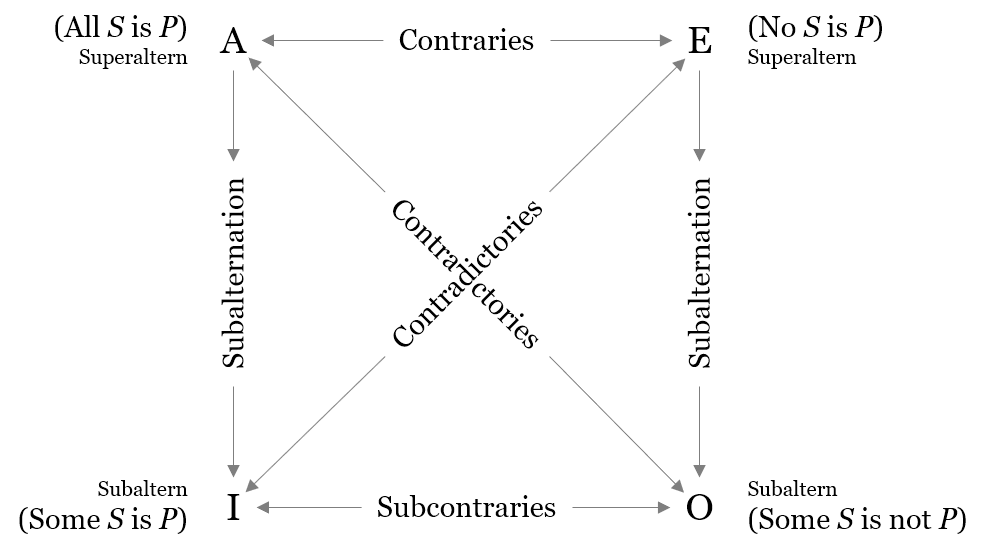
Aristotle represented these logical relationships in a diagram called the Square of Opposition — with the four proposition types at the four corners and the logical relationships between them shown as the sides and diagonals. The Square of Opposition became a standard tool of logic education for over two millennia.
6. Book 3 — Prior Analytics: The Syllogism and the Validity/Truth Distinction
With terms classified and proposition types established, Aristotle turns to the question of how propositions can be combined into arguments. The Prior Analytics is where formal logic as a discipline begins.
The Syllogism
A syllogism is an argument consisting of two premises and one conclusion, where the conclusion follows necessarily from the premises if the argument is valid.
The classic syllogism: All men are mortal. (Premise 1) / Socrates is a man. (Premise 2) / Therefore, Socrates is mortal. (Conclusion) — The conclusion follows from the premises by virtue of the logical relationship between the terms. ‘Men’ appears in both premises and connects them; ‘Socrates’ and ‘mortal’ appear in the conclusion.

Aristotle analyses syllogistic reasoning in terms of the relationships between categories. We can represent this using three circles. If ‘all men’ are inside the circle of ‘mortals,’ and ‘Socrates’ is inside the circle of ‘men,’ then Socrates must also be inside the circle of ‘mortals.’ The relationship between the categories determines whether the argument is valid, independently of what the categories actually refer to.
The Validity/Truth Distinction — Aristotle’s Most Important Contribution
| This distinction is the foundation of all formal logic. Students who miss it will misunderstand every logical argument they encounter thereafter. Read this section with full attention. |
- Validity is a property of the argument’s STRUCTURE (form), not its content. An argument is valid if the conclusion MUST follow from the premises — if there is no possible way for the premises to be true and the conclusion to be false. Validity is entirely independent of whether the premises are actually true.
- Truth is a property of the individual PREMISES (content). A premise is true if it corresponds to reality; false if it does not. Truth has nothing to do with logical structure.
- Soundness = Validity + True Premises. A sound argument is one in which the reasoning structure is valid AND all the premises are actually true. Only sound arguments guarantee true conclusions.
The four possible combinations are best seen in a table:
| Premises | Structure | Argument | Example + Explanation |
| TRUE | VALID | SOUND ✓ | All men are mortal. Socrates is a man. ∴ Socrates is mortal. → Best kind: both form and content are correct. |
| TRUE | INVALID | UNSOUND ✗ | All cats are animals. All dogs are animals. ∴ All dogs are cats. → True premises, but invalid structure produces false conclusion. |
| FALSE | VALID | UNSOUND ✗ | All fish can talk. Nemo is a fish. ∴ Nemo can talk. → Valid structure, but false premise makes the argument unsound. |
| FALSE | INVALID | UNSOUND ✗ | All fish are birds. Nemo is a mammal. ∴ Nemo is a plant. → Wrong on every level — false premises and invalid structure. |
Aristotle’s achievement in the Prior Analytics was to develop a complete system of rules for testing whether an argument’s structure is valid — rules based purely on the form of the syllogism, independently of its content. This system, known as syllogistic or formal deductive logic, remained the dominant logical framework for nearly 2,000 years and forms the foundation of modern logic, mathematics, computer science, and artificial intelligence.
7. Book 4 — Posterior Analytics: Scientific Knowledge, First Principles, and Induction
The Prior Analytics solved the structural problem — how to assess the validity of arguments. The Posterior Analytics solves the content problem — how we arrive at true premises to feed into those valid arguments — and defines what genuine scientific knowledge is.
Three Requirements for True Knowledge
- Universal: genuine knowledge must apply to all cases without exception — to every instance of the phenomenon, in every time and place. ‘This crow is black’ is not knowledge; ‘all crows are black’ is a step toward it.
- Necessary: the truth must be of the kind that could not be otherwise. ‘A triangle has three interior angles’ is necessary — no triangle could have two or four. Compare this to ‘Socrates is a philosopher’ — he could have been a farmer; his being a philosopher is contingent (true but not necessarily so). Knowledge, for Aristotle, is of necessary truths, not contingent ones.
- Demonstrated: the truth must be derivable by systematic logical reasoning from premises. It should be possible to lay out, step by step, why it is true — not merely assert it, but show it.
The Regress Problem — Why Infinite Demonstration Is Impossible
If every truth must be demonstrated from prior truths, and those prior truths must be demonstrated from further prior truths, then the chain of demonstrations never ends — and no truth is ever finally established.

The Fido regress: ‘Fido needs oxygen’ ← demonstrated from ‘Fido is a living being’ ← demonstrated from ‘Fido is a dog’ ← demonstrated from ‘Fido is a Labrador’ ← demonstrated from… and so on, forever. If every premise requires its own demonstration, and that demonstration requires its own premises, and those premises require their own demonstrations — the chain never reaches a stopping point. Nothing is ever finally known.
This is the Regress Problem, and it is one of the deepest problems in epistemology. Aristotle’s solution is decisive.
First Principles — The Solution to the Regress
- Not everything can be demonstrated. The regress must stop somewhere. The stopping points are what Aristotle calls first principles (also called immediate premises) — truths that are self-evident, that can be known directly without requiring any prior demonstration.
- First principles are immediately known. They are not demonstrated; they are grasped directly. Examples: ‘A triangle has three sides.’ ‘The whole is greater than any of its parts.’ ‘Every bachelor is unmarried.’ ‘No statement can be both true and false at the same time.’ These do not require proof — trying to prove them would already assume them.
- All sciences begin from first principles. In mathematics they are called axioms or postulates. In logic they are the laws of thought. In physics they are fundamental laws. Different sciences have different first principles, but all of them are immediate, self-evident, and universal. No science can demonstrate its own first principles from within itself — it must simply begin from them.
How First Principles Are Known — Nous and Induction
If first principles cannot be demonstrated, how do we come to know them? This is the most philosophically interesting question in the Posterior Analytics, and Aristotle’s answer is subtle.
- The path begins with sense perception. We observe many particular things — many crows, many stars, many animals. Perception gives us individual cases.
- Perception retained in the mind becomes memory. When sense experience is not immediately forgotten but lingers in the mind, producing a lasting impression, this is memory. Memory is what distinguishes humans (and some animals) from creatures that merely react to the present stimulus.
- Many memories of the same kind produce experience. When we have seen hundreds of crows and they were all black, we have an experience — a felt familiarity with how crows are. Experience is richer than any single memory; it is the accumulative grasp of a pattern.
- From experience, nous grasps the first principle. This is the crucial and philosophically most interesting step. Nous (Greek: mind, intellect, intuition) is an innate cognitive capacity — not for innate content (unlike Plato’s recollection), but for the ability to see universal patterns in particular experiences. When we have enough experience of crows being black, nous grasps the universal principle: ‘all crows are black.’ The principle was not in any single crow; it was in the pattern across all of them. Nous is the faculty that perceives the universal in the particulars.
- This process — from many particulars to a universal principle — is induction. Induction is the movement from the many to the one: from many observed instances of the same kind to a generalisation about all instances. It is not mere guessing; it is the disciplined extraction of pattern from accumulated experience.
| The complete epistemological chain: Sense Perception → Memory → Experience → Nous + Induction → First Principles → Demonstration → Scientific Knowledge |
| Sense Perception | Observing particular objects with eyes, ears, touch, smell, taste |
| Memory | Sense data retained in the mind — traces that persist beyond the moment of experience |
| Experience | Accumulated memories producing a felt familiarity with the world — ‘learning by experience’ |
| Nous + Induction | The mind’s intuitive capacity to extract universal principles from particular experience — the crucial step |
| First Principles | Self-evident universal truths that need no proof — the foundation of all knowledge |
| Demonstration (Syllogism) | Applying first principles via valid logical reasoning to derive new truths |
| Scientific Knowledge | Universal, necessary, demonstrated — the highest form of knowledge |
The Two Directions of Science
- Going UP (induction): from many particular observations → through accumulated experience → using nous → to universal first principles. This is how science acquires its starting points.
- Going DOWN (deduction/demonstration): from universal first principles → using valid syllogistic reasoning → to explain and predict particular cases. Once we know that all animals need oxygen, we can immediately deduce that this specific fish needs oxygen.
- Science oscillates between these two movements. Neither alone is sufficient. Induction without deduction gives us principles without the ability to apply them systematically. Deduction without induction gives us logical structure without substantive content. Scientific knowledge is built by continuously moving between them — up from experience to principles, and down from principles to particular explanations.
The Correspondence Theory of Truth
In the Metaphysics, Aristotle gives what became the classical definition of truth — the starting point for 2,500 years of subsequent debate:
Aristotle’s definition of truth (Metaphysics 4.7): ‘To say of what is that it is not, or of what is not that it is, is false, while to say of what is that it is, and of what is not that it is not, is true.’
Unpacked, this gives four precise claims:
- Saying ‘what exists does not exist’ = FALSE
- Saying ‘what does not exist does exist’ = FALSE
- Saying ‘what exists exists’ = TRUE
- Saying ‘what does not exist does not exist’ = TRUE
The common principle in all four: a statement is true if and only if it corresponds to reality. If I say ‘the teacher is in the office’ and the teacher actually is there, my statement is true. If they are not there, my statement is false. Truth is not determined by what I wish, what is convenient, or what most people believe — it is determined by how things actually are.
This is called the Correspondence Theory of Truth — the classical, or realist, view of truth. It remains the dominant philosophical account of truth in the Western tradition, and the starting point against which every alternative theory of truth (coherence theory, pragmatic theory, deflationary theory) has defined itself.
8. Book 5 — Topics: Dialectic for Real-Life Reasoning
The Prior and Posterior Analytics describe the ideal of scientific reasoning — starting from certain first principles, reasoning by valid syllogisms to necessary conclusions. But most of human life is not like that. Most practical, political, ethical, and legal questions cannot be settled by first principles and demonstrations. We have to reason from what is probably true, from what people generally accept, from plausible assumptions. The Topics provides a system for this more practical kind of reasoning.
Three Modes of Reasoning — Compared
| Demonstration | Dialectic | Rhetoric | |
| Starting point | First principles — certain, self-evident truths | Endoxa — reputable opinions accepted by all or most | Emotions, desires, prejudices of the audience |
| Goal | Scientific/philosophical truth | Practical reasoning — finding the best position in a debate | Persuasion — changing the listener’s mind or action |
| Context | Science and philosophy | Political debates, legal disputes, ethics | Political speeches, advertising, legal advocacy |
| Certainty | Highest — conclusion follows necessarily | Probable — based on likely premises | Not concerned with truth, only effectiveness |
| Aristotle’s attitude | The ideal — aims for here | Necessary and legitimate in practical life | Acceptable only when used honestly; misused by Sophists |
Endoxa — The Starting Point for Dialectic
- Endoxa (Greek: reputable opinions) are the starting points of dialectical argument. They are propositions that are accepted by everyone, or by most people, or by the wisest and most respected thinkers. ‘All humans seek happiness.’ ‘Justice is giving to each what they deserve.’ ‘Courage lies between cowardice and recklessness.’ These are not first principles in the demonstrative sense — they may not be necessarily true — but they are widely accepted and provide stable ground for debate.
- Dialectic is the appropriate method for ethics, politics, and practical philosophy — domains where certainty is unavailable but reasoned debate is still possible and necessary. Aristotle taught dialectic at the Lyceum precisely because it develops the reasoning skills needed for real-life engagement with contested questions.
The ‘Toolbox’ — Methods for Dialectical Argument
- Definition-based arguments: challenge or defend a definition, and use the outcome to drive the argument. If your opponent defines a dog as ‘a loyal animal,’ ask whether a dog that bites its owner has thereby ceased to be a dog. The answer reveals something about the definition.
- Genus and species arguments: correctly categorise the subject of discussion. Is a whale a fish? No — a whale is a mammal. Placing something in the wrong genus undermines every argument built on that classification.
- Essential vs accidental property arguments: distinguish what something necessarily is from what it happens to be. Is being green essential to a parrot, or is it an accident? A parrot could be another colour and still be a parrot. Being rational, Aristotle would argue, is essential to humans — not an accident.
- Inductive arguments with examples: support a general claim by accumulating particular instances. ‘Athletes exercise and are healthy; soldiers train and are fit; dancers practise and are strong — therefore exercise promotes health.’
- Exposing contradictions: if an opponent’s position contains a hidden contradiction, revealing it defeats the position without needing to establish an alternative.
A real contradiction (the party invitation): An invitation card read: ‘Your presence is the most beautiful gift to us’ — followed by ‘You are not required to bring a gift to the party.’ If your presence is the gift, and gifts are not required, then your presence is not required. The contradiction in the invitation is the same kind of internal inconsistency that dialectical argument seeks to expose.
9. Book 6 — On Sophistical Refutations: Identifying Logical Fallacies
The final book of the Organon addresses what Aristotle considered one of the most dangerous intellectual diseases: arguments that appear valid but are not. The Sophists had made careers out of deploying such arguments, winning debates through sleight of hand rather than genuine reasoning. Aristotle’s goal is to equip the reader with the tools to recognise and dismantle them. He identifies thirteen fallacies in total; the most important are described here.
Fallacies from Language
- Equivocation — using the same word in two different senses within a single argument. If the argument works only because the same word is doing two different jobs at different points, it is not genuinely valid.
Example: ‘A feather is light. Light is not dark. Therefore, a feather is not dark.’ — ‘light’ in the first premise means low in weight; ‘light’ in the second means illumination. These are two entirely different meanings. The argument exploits the homonymy of the word ‘light’ to produce a nonsense conclusion. Remove the homonymy and the argument collapses.
- Amphiboly — ambiguity arising from grammatical structure, not individual words. A sentence that can be read in two different ways is amphibolous.
Example: ‘I saw the man with the telescope.’ Does the speaker have the telescope and use it to see the man? Or does the man have the telescope? The grammatical structure allows both readings. Arguments built on amphibolous premises can seem to prove things they do not actually establish.
Fallacies from Argument Structure
- The special case fallacy — applying a general rule to a case the rule was not designed to cover. General rules typically have exceptions or special contexts; ignoring these produces invalid arguments.
Example: ‘Cutting someone with a knife is a criminal act. Surgeons cut patients with knives. Therefore, surgeons are criminals.’ — The general rule about knife-cutting was designed for assault, not medical treatment. The medical context is explicitly exempt from the rule. Applying the general rule to this special case produces an absurd and false conclusion.
- Circular reasoning (petitio principii) — smuggling the conclusion into the premises. If the premises already assume what the argument is supposed to prove, no genuine demonstration has taken place.
Example: ‘God exists, because the Bible says so. The Bible is true, because it is the word of God.’ — The existence of God is used to establish the reliability of the Bible, and the reliability of the Bible is used to establish the existence of God. The argument goes in a circle: each claim depends on the other without either being independently established.
10. The Complete Picture — From Perception to Scientific Knowledge
The six books of the Organon fit together as a single, coherent system designed to do one thing: provide reliable tools for moving from sense experience to genuine knowledge. Here is the complete picture.
- Categories: classifies everything that exists and every term we use — substance (the ten categories) — ensuring that terms are used precisely and consistently.
- On Interpretation: defines the proposition (statement), establishes the principle of non-contradiction, classifies propositions into four types, and analyses the logical relations between them.
- Prior Analytics: defines the syllogism, establishes the vital distinction between validity (of structure) and truth (of content), and builds a complete system for testing argument validity.
- Posterior Analytics: defines scientific knowledge (universal + necessary + demonstrated), solves the demonstration regress through first principles, explains how first principles are known through nous and induction, and states the Correspondence Theory of Truth.
- Topics: provides a system for dialectical reasoning in practical contexts, using endoxa (reputable opinions) as starting points and a toolbox of argumentative methods for debate.
- On Sophistical Refutations: identifies and explains logical fallacies — arguments that appear valid but are not — giving the reader tools to recognise and expose deceptive reasoning.
Underneath all six books is the foundational conviction: reality, thought, and language share a common structure. Analysing language carefully reveals the structure of thought; the structure of thought reflects the structure of reality. The Organon makes this analysis rigorous, systematic, and practically applicable.
11. Limitations and Open Questions in Aristotle’s System
Aristotle himself was aware that his system raised questions he had not fully resolved. Two deserve particular mention — not to diminish the achievement, but because they point toward debates that will occupy later philosophy.
Are First Principles Genuinely Informative?
- Consider: ‘All bachelors are unmarried.’ This is certainly true, and certainly a first principle of a kind — it needs no proof. But it is true by definition: ‘bachelor’ simply means ‘unmarried man.’ The statement does not tell us anything about the world that is not already contained in the meaning of the word ‘bachelor.’
- Similarly: ‘The whole is greater than any of its parts’ is necessarily true, but it follows from what ‘whole’ and ‘part’ mean — not from any observation of the world.
- The question: if some first principles are true merely by virtue of the meanings of the words they contain, do they actually give us information about reality? Or do they just unpack what we already meant when we used those words? This question will be developed into one of the most important distinctions in later philosophy — David Hume’s distinction between ‘relations of ideas’ and ‘matters of fact,’ and Immanuel Kant’s distinction between ‘analytic’ and ‘synthetic’ judgements. These debates are reserved for their respective lectures.
Can All Statements Be Cast in Subject-Predicate Form?
- Aristotle assumes that every statement has the form S-P (subject term + predicate term), and his entire logical system is built on this assumption. This works well for many purposes, but modern logic (developed by Frege, Russell, and others in the late 19th and early 20th centuries) showed that many important relationships and quantified statements cannot be properly expressed in simple subject-predicate form. Relations, nested quantifiers, and complex logical structures require a richer framework than syllogistic logic provides.
- This is not a failure but a starting point. Aristotle’s syllogistic logic was not wrong for its domain — it was, and remains, genuinely powerful and correct. But it was incomplete. Modern predicate logic extends and enriches it. Understanding where Aristotle’s system both succeeds and reaches its limits is part of understanding the development of logic as a discipline.
Conclusion
Aristotle’s epistemology and the Organon represent one of the most ambitious and successful intellectual projects in the history of thought. Starting from the observation that all human beings naturally desire to know, and refusing to abandon the sensory world as the starting point for knowledge, Aristotle built a complete instrument for the reliable acquisition of truth. The system moves from the precise classification of terms (Categories) through the analysis of propositions (On Interpretation) to the structure of valid arguments (Prior Analytics), the foundations of scientific demonstration (Posterior Analytics), the method of practical reasoning (Topics), and the detection of fallacious arguments (Sophistical Refutations). The bedrock conviction holding all of this together is that reality, thought, and language are structurally aligned — and that this alignment is what makes knowledge of the world possible at all. This lecture is, as Aristotle himself acknowledged, a single block in a much larger philosophical building. The blocks that follow — physics, metaphysics, psychology, ethics, and politics — will all rest on what has been established here. When those blocks are in place, the complete architecture of Aristotle’s philosophy will become visible.
Frequently Asked Questions
What is the Organon, and how does it differ from logic as a whole?
The Organon (Greek: ‘instrument’ or ‘tool’) is Aristotle’s collection of six books on logical method — his instrument for the reliable acquisition of knowledge. It is not identical to logic in general. Logic is a vast discipline with many branches: propositional logic, predicate logic, modal logic, fuzzy logic, paraconsistent logic, and others. The Organon specifically establishes syllogistic logic (also called formal deductive logic), which is one foundational branch of the broader discipline. It is, however, the foundational branch — the one on which the rest of formal logic builds. Aristotle’s achievement was so complete and so effective that for nearly 2,000 years, the Organon was essentially the entirety of what was taught under the heading of logic. The six books are: Categories, On Interpretation, Prior Analytics, Posterior Analytics, Topics, and On Sophistical Refutations.
What are Aristotle’s ten categories, and why do they matter?
The ten categories are the ten fundamental ways in which anything can exist — the ten modes of being. They are: Substance (the individual existing thing itself), Quantity (how much), Quality (what kind), Relation (compared to what), Place (where), Time (when), Position (static arrangement), State (condition), Action (what the thing does), and Passivity (what is done to the thing). They matter for three reasons. First, they are an exhaustive classification of everything in the world — every term in language refers to something in one of these ten categories. Second, they solve the problem that Parmenides and Zeno had with change: change is not change from being to non-being; it is change from one mode of being to another (a substance changes in quality, or place, or state, while remaining the same substance). Third, they establish that Substance is the foundational category on which all others depend — individual things are the most real objects in Aristotle’s world, and everything else is a property, state, or relation of some substance.
What is the difference between validity and truth, and why is this distinction so important?
Validity and truth are properties of different things. Truth is a property of individual propositions or premises: a statement is true if it corresponds to reality, false if it does not. Validity is a property of argument structure: an argument is valid if the conclusion cannot possibly be false when all the premises are true — the conclusion follows necessarily from the premises by virtue of the logical relationship between them. These are entirely independent. You can have a valid argument with false premises (all fish can talk; Nemo is a fish; therefore Nemo can talk — valid structure, false premise). You can have true premises in an invalid argument (all cats are animals; all dogs are animals; therefore all dogs are cats — both premises true, conclusion false because structure is invalid). A sound argument requires both: true premises AND a valid structure. Only a sound argument guarantees a true conclusion. This distinction is fundamental to all formal logic, mathematics, legal reasoning, scientific argument, and computer science — fields that are built on Aristotle’s foundational work in the Prior Analytics.
What are first principles, and how does Aristotle explain how we come to know them?
First principles are self-evident, immediate truths that serve as the starting points of all demonstration and all scientific knowledge. They cannot themselves be demonstrated — any attempt to demonstrate them would already assume them. Examples include the principle of non-contradiction, mathematical axioms, and definitions like ‘a triangle has three sides.’ Their function is to stop the regress of justification: if every claim must be proved from prior claims, and those prior claims must also be proved, the chain never ends and nothing is ever finally known. First principles provide the bedrock. How do we know them? Not through innate ideas (as Plato claimed) and not through demonstration. Aristotle’s answer is nous and induction: nous is an intuitive cognitive capacity — the mind’s ability to perceive universal patterns in particular experience; induction is the process of moving from many observed particulars to a universal generalisation. After observing many crows and finding all of them black, nous grasps the first principle ‘all crows are black.’ The chain runs: perception → memory → experience → nous/induction → first principles.
What is the Correspondence Theory of Truth, and what makes it the ‘classical’ view? The Correspondence Theory of Truth states that a proposition is true if and only if it corresponds to reality — if what the statement says is the case actually is the case. Aristotle’s formulation in the Metaphysics runs: ‘To say of what is that it is not, or of what is not that it is, is false, while to say of what is that it is, and of what is not that it is not, is true.’ Simplified: if you say something exists and it does, you are speaking truly; if you say something exists and it does not, you are speaking falsely. It is called the ‘classical’ view because it has been the dominant philosophical account of truth in Western thought since Aristotle stated it — virtually all philosophers before the 19th century either accepted it or implicitly assumed it. Every alternative theory of truth (the coherence theory, the pragmatic theory, the deflationary theory) has defined itself by explaining what it finds inadequate in the correspondence account. Whether correspondence is necessary, sufficient, or even coherent as a definition of truth remains one of the central debates in contemporary epistemology and philosophy of language.
Leave a Reply