
How can anything ever genuinely change without simply ceasing to exist? Every philosopher before Aristotle had failed to answer this cleanly — Parmenides denied change was even possible, Plato quietly exiled it to an inferior copy-world. This lecture builds Aristotle’s complete solution: substance, form, matter, and the four causes that finally make change intelligible.
Key Takeaways
- Aristotle built his metaphysics to solve a specific problem: the problem of change. Every philosopher from Thales to Plato had failed to give a satisfactory account of how change is possible without violating the logic of being. Aristotle’s entire metaphysical framework — substance, form, matter, potentiality, actuality, the four causes, teleology, and entelechy — is designed to put change on solid philosophical footing and thereby make natural science possible.
- Three preliminary points govern everything that follows. First, ‘metaphysics’ is an accidental label: Aristotle called the subject First Philosophy, meaning the study of being qua being — existence as such, not any particular kind. Second, the word ‘form’ means something fundamentally different in Plato and Aristotle and must never be conflated. Third, where Plato’s approach is mathematical (perfect, ideal, eternal entities), Aristotle’s is biological (living, changing, observable organisms studied empirically).
- Reality, for Aristotle, is individual substances — particular, concrete things: this keyboard, this person, this seed. He rejects Plato’s transcendent Forms as unnecessary, unexplanatory, and vulnerable to the Third Man Argument regress. Forms are not independent realities inhabiting a separate world; they are common features we abstract intellectually from particular objects. The crucial distinction is between intellectual analysis (we can separate the rectangle from this book in thought) and ontological status (the rectangle does not therefore exist independently).
- Every substance has two analytically distinct aspects — form and matter — each carrying a deeper meaning than the obvious one. Form is not merely physical shape; it is the purpose, function, and essence of a thing — what it actually does and is for. Matter is not merely physical stuff; it is potentiality — the capacity to receive a form and actualise a purpose. A cup’s form is its function of holding liquid, not its shape; its matter is whatever material has the potential to receive that function.
- Aristotle analyses every substance in two complementary ways. The static analysis (form + matter) describes the substance at a single time-point — what it is right now. The dynamic analysis (potentiality → actuality) describes the substance developing through time — how it changes and grows. Change is precisely matter retaining its identity while successively receiving new forms; development is a purposively unified chain of such changes guided toward a final goal.
- Four causes are necessary to fully explain any change or development: the material cause (what it is made of), the efficient cause (what initiated the process), the formal cause (the essence or defining structure), and the final cause (the purpose or goal). Aristotle was the first to articulate the final cause explicitly — all prior thinkers had identified one or more of the others. Teleology holds that every natural thing has a final cause; entelechy holds that this final cause and its developmental programme are internal to the thing itself, not externally imposed.
Table of Contents
Introduction
The Metaphysics is the philosophical summit of Aristotle’s system — the work toward which his logic and epistemology were building, and from which his physics, biology, psychology, ethics, and politics all flow. But it is important to approach it with the right expectations. Aristotle’s metaphysics is not speculative cosmology or abstract ontology for its own sake. It is a precise and motivated philosophical project: to give an account of reality capable of making change intelligible, and thereby making natural science possible. Every major concept introduced in this lecture — substance, form, matter, potentiality, actuality, the four causes, teleology, entelechy — is answering the same underlying challenge: how can genuine change occur without violating the logic of being? That question, unanswered since the pre-Socratics, is what Aristotle’s metaphysics finally resolves.
1. Three Points to Keep in Mind Before Reading Aristotle
Three important clarifications must precede any serious engagement with Aristotle’s metaphysical views. Students who skip these find themselves confused almost immediately — either misreading his arguments through a Platonic lens or applying his technical terms in ways he never intended.
Point 1 — The Aim: Solving the Problem of Change
The central problem Aristotle inherited from the philosophical tradition was one that had defeated every thinker before him: how to give a coherent account of change. Heraclitus had affirmed change so completely that he seemed to deny stable identity altogether. Parmenides had denied change so completely that he seemed to contradict every observable fact. The atomists had reduced change to local motion of unchanging particles — clever, but incapable of explaining growth, development, generation, or the purposive patterns of living organisms. Plato had effectively bracketed the problem by placing real reality in a changeless realm of Forms.
Aristotle refuses this evasion. He insists that change is a genuine, observable feature of the world — and that any theory of reality that cannot account for it is a failed theory. His metaphysics is therefore constructed specifically to make change philosophically intelligible. Every concept he introduces should be understood against this backdrop: does it help explain how change is possible? Does it make the natural world more or less comprehensible?
Point 2 — A Language Warning: ‘Form’ Means Different Things
CRITICAL: Plato and Aristotle both use the word ‘form,’ but with entirely different meanings. In Plato, ‘form’ (eidos) denotes an eternal, non-physical, independent reality existing in a separate world — the most real things in existence. In Aristotle, ‘form’ (morphē or eidos) denotes the purpose, function, or essence of a particular physical thing — always dependent on that thing, never independent of it. Confusing these two meanings will make the entire lecture unintelligible.
Point 3 — The Approach: Biological, Empirical, Practical
- Plato’s approach is mathematical. Mathematics deals with perfect, eternal, unchanging entities — circles, triangles, numbers. These can be grasped by pure reason alone; the senses are actually misleading when it comes to understanding them. This orientation leads Plato naturally toward a metaphysics of perfect, unchanging Forms accessible only to reason.
- Aristotle’s approach is biological. Biology studies living organisms in the natural world — organisms that change, grow, develop, reproduce, and die. Knowledge of them requires careful observation of particular instances, not abstraction away from them. This orientation leads Aristotle naturally toward a metaphysics that takes the changing, observable world as its primary subject.
- The practical consequence is striking. Plato’s political philosophy describes the ideal perfect state, modelled on mathematical perfection, without explaining how to actually achieve it. Aristotle surveys 158 actual constitutions, analyses what works under what conditions, and builds his political theory from that empirical foundation. The difference in philosophical temperament is total — and it runs through every domain they both address.
2. What Aristotle Actually Called This Subject — First Philosophy
The word ‘metaphysics’ was not Aristotle’s. It is an accident of editorial history. About 250 years after Aristotle’s death, a philosopher named Andronicus of Rhodes compiled Aristotle’s surviving manuscripts into an organised collection. He labelled the works on natural philosophy ‘Physics.’ When he came to compile the manuscripts dealing with being, existence, and substance, he needed a title — and since these writings had been placed after the physics in his compilation, he labelled them meta-ta-physika: the writings that come after the physics. That editorial label eventually became the technical philosophical term ‘metaphysics.’
Aristotle himself called this subject First Philosophy. His definition is precise: it is the study of being qua being — of existence as such, not of any particular kind or aspect of existence.
- Every special science studies being as a particular kind. Biology studies being insofar as it is living (living being). Physics studies being insofar as it is material (material being). Mathematics studies being insofar as it is quantitative (quantitative being). Ethics studies being insofar as it is moral (being as an agent capable of good and evil). Each science takes being and restricts its attention to one dimension of it.
- First philosophy studies being itself — not this or that kind of being, but existence as such. What does it mean for anything at all to exist? What are the most fundamental structures common to everything that is? These are First Philosophy’s questions — and they are prior to the questions of all the special sciences, which is why Aristotle calls it first.
3. Aristotle’s Critique of Plato’s Theory of Forms
Aristotle spent twenty years at Plato’s Academy and had the deepest respect for his teacher. Yet his philosophical integrity demanded that he follow the argument wherever it led — and it led him to reject the cornerstone of Platonic metaphysics. His critique of the Theory of Forms is not peripheral but foundational: he cannot build his own account of reality until he has cleared the Platonic framework out of the way.
Five Core Objections
- Forms fail to explain the natural world. Rather than accounting for observable nature, the theory simply posits a second, parallel world — the world of Forms — and declares it to be the real one. This is not an explanation; it is a redescription of the problem at one remove. The world we live in is no better understood once we have been told that perfect chairs exist somewhere beyond the senses.
- Forms cannot account for change. Plato’s Forms are eternal, perfect, and absolutely changeless. But change is the most pervasive feature of the natural world. If reality consists of changeless Forms, and the observable world merely copies them, then the observed fact of change — growth, decay, transformation — cannot be made intelligible. Plato himself sometimes treats change as an imperfection of the physical world rather than a phenomenon to be explained.
- The concept of ‘participation’ is never clarified. Plato says that physical objects participate in their corresponding Forms — this pen participates in the Form of Pen. But what does participation actually mean? Does it mean sharing? Copying? A causal relation? Resemblance? Plato never provides a clear answer, and without one, the central explanatory mechanism of the theory remains undefined.
- Forms multiply rather than simplify. A good scientific theory explains more with less — it reduces complex phenomena to simpler underlying principles. The Theory of Forms does the opposite: for every type of thing in the physical world, it posits a corresponding Form in the ideal world. The result is not explanation but duplication.
- There is no compelling reason to posit them. Aristotle demands that any serious metaphysical claim be grounded in evidence or argument. The Theory of Forms, he contends, rests on an inferential leap that is not warranted. The fact that multiple horses share something in common does not require us to posit a separate, non-physical ‘horseness’ existing independently somewhere.
The Third Man Argument — Aristotle’s Sharpest Critique
Aristotle’s most devastating critique of the Theory of Forms is a regress argument now known as the Third Man Argument. Plato had formulated a version of it himself in the Parmenides; Aristotle sharpens it into a reductio.
The regress: Socrates and Plato are both men. What explains their shared humanity? The Form of Man — a third entity, over and above Socrates and Plato, in which both participate. But now: Socrates, Plato, and the Form of Man are all ‘man.’ What explains their shared humanity? A second Form of Man is needed — a fourth entity. And Socrates, Plato, Form-of-Man-1, and Form-of-Man-2 are all ‘man’… and so on, indefinitely. The regress has no stopping point. The Theory of Forms, rather than explaining what Socrates and Plato have in common, generates an infinite chain of explanatory entities, each requiring the next. It explains nothing.
Aristotle’s conclusion is that the Forms are explanatorily idle — they generate infinite regress rather than genuine understanding.
4. Forms as Immanent, Not Transcendent — The Key Distinction
Aristotle does not abolish forms — he relocates them. His objection is not that there are no common features among particular things, but that those common features do not exist as independent realities in a separate world. They exist within particular things, as aspects of those things, dependent on those things for their existence.
Transcendent vs Immanent Forms
| Question | Plato — Transcendent Forms | Aristotle — Immanent Forms |
|---|---|---|
| Where do forms exist? | In a separate, non-physical world of Forms — independent of physical objects | Inside physical objects — dependent on them, not separable |
| Relationship to objects | Objects participate in Forms (mechanism undefined) | Forms ARE the common features/abstractions of objects |
| Can forms exist without objects? | Yes — Forms are eternal and exist even if no objects instantiate them | No — forms depend on substances for their existence |
| What are forms, ultimately? | Independent realities — the most real things in existence | Abstractions — conceptual tools we extract through intellectual analysis |
| Descriptive term | Transcendent — Forms are beyond and outside the physical world | Immanent — forms are within and inseparable from physical objects |
| How we access forms | Through pure reason alone (senses cannot reach them) | Through observation + abstraction (empirical + intellectual) |
| Problem with this view | Third Man Argument regress; change cannot be explained; participation undefined | Forms lose independent ontological reality; raises questions about universals |
The Critical Distinction: Intellectual Analysis vs Ontological Status
The confusion at the heart of Platonic metaphysics, Aristotle argues, is a conflation of two completely different kinds of claim.
- Intellectual analysis is the mental operation of isolating one aspect of a complex object for separate consideration. This book has a rectangular shape and a black colour. I can think about the rectangle independently of the colour; I can think about the colour independently of the physical material; I can consider the shape in abstraction from the weight. This is a legitimate and indispensable intellectual operation. A mathematician does exactly this — they think about the geometrical properties of physical objects in abstraction from their physical material.
- Ontological status is a claim about what actually exists independently in the world. The fact that I can think about the rectangular shape of this book separately from the book itself says nothing about whether the rectangle exists somewhere independently of the book. It does not. The rectangle is an aspect of this particular physical book. Remove all rectangular objects from existence, and ‘rectangularity’ vanishes with them.
- Plato confused these two. Noticing that we can think about the Form of Triangle independently of any particular triangle, he inferred that the Form of Triangle exists independently of all triangles — in a separate, non-physical world. Aristotle’s response: the ability to separate things in thought does not entail their separation in reality. An abstraction is a conceptual tool, not a separately existing entity.
The key terms: Immanent (from Latin immanere = to remain within): forms exist inside and within the physical objects they characterise. Transcendent (from Latin transcendere = to climb beyond): forms exist outside and beyond the physical world. Abstraction: the intellectual operation of extracting an idea from an object in thought — without that idea thereby gaining independent existence.
5. Reality as Individual Substance — Whatness and Thisness
If forms are not reality, what is? For Aristotle, the answer is the particular, individual things from which we abstract forms in the first place. The things themselves — this keyboard, this person, this seed, this stone — are reality. Aristotle calls these individual things substances (ousia). Reality is the collection of particular substances, not a collection of abstract Forms.
Two Aspects of Every Substance
Understanding any individual substance requires attending to two irreducibly different dimensions. Aristotle calls them whatness and thisness.

- Whatness (form) — the set of common properties that a substance shares with other substances of the same kind. When we ask ‘what is Socrates?’, we answer by listing such properties: Socrates is a human being, a philosopher, a rational animal, an Athenian. These are features that Socrates shares with others — Plato is also a human being, also a philosopher, also a rational animal. The whatness captures the kind of thing this is, by specifying what it has in common with things of the same kind.
- Thisness (matter) — whatever makes this particular thing this particular thing rather than any other. No matter how long the list of common properties, you can never arrive at the individual through shared properties alone. Every property Socrates has, in principle, some other being might share. What makes Socrates specifically Socrates — rather than a twin, a very similar person, or any other human being — is something beyond all common properties. This dimension of irreducible individuality is what Aristotle calls thisness.
The police sketch example: Police compile a sketch of a suspect: short hair, thick moustache, flat nose, dark complexion. An officer arrests someone who matches every feature. His superior says: ‘This is not the right person.’ All the common features match perfectly — yet it is the wrong individual. The thisness of the actual suspect is what the sketch, however detailed, cannot capture. Individual identity always exceeds the sum of shared characteristics.
These two aspects map directly onto two of Aristotle’s foundational metaphysical concepts:
| Whatness → Form | Thisness → Matter |
|---|---|
| Common properties shared with other members of the same kind | Whatever makes this individual irreducibly THIS individual |
| Answers ‘What kind of thing is this?’ | Answers ‘Which particular thing is this?’ |
| Accessible through reason and abstraction | Not fully captured by any set of descriptions |
| Makes classification possible | Makes individuation possible |
| Examples: human, rational, philosopher, Athenian (Socrates) | Examples: this specific body, this specific material constitution |
6. Form — The Deeper Meaning: Purpose, Function, Essence
Having established that whatness corresponds to form, Aristotle now deepens the concept. Form is not — at least not primarily — physical shape. Two objects can have identical physical shapes and yet one is a genuine instance of a kind while the other is not. This tells us that shape alone is not what form is.
The Cup Illustration
Consider two objects with identical dimensions: the same height, the same diameter, the same open-top structure, and the same white colour. One is a ceramic cup; the other is a paper model with no structural integrity. They are geometrically indistinguishable. But one is a cup and the other is not — because one can hold liquid and be drunk from, while the other cannot.
Now consider a mug with an entirely different shape — a squat body, a handle, a wider rim. Its physical form bears little resemblance to the first cup. Yet it is unambiguously a cup, because it performs the function of holding liquid for drinking.
- Conclusion: form is not physical shape. It is the purpose, function, and essence of a thing — what it actually does and is designed to do. The cup’s form is its function of holding liquid. Shape, colour, material, and size are secondary — they are what they are because they serve that function.
- Shape follows function. The cup is open at the top specifically so that liquid can be poured in and accessed. The handle is shaped the way it is specifically to enable a secure grip. Every physical feature of the cup is intelligible as serving its purpose. Understanding the purpose illuminates the design; without the purpose, the design is arbitrary.
- Essence is Aristotle’s term for what a thing truly and fundamentally is — its real identity, independent of any particular instantiation. The essence of a cup is not ‘white ceramic cylinder’ but ‘vessel for holding and conveying liquid for drinking.’ This essence can be instantiated in countless different shapes, colours, and materials. What matters is whether the function is served.
- Unity through function. A substance’s form (purpose/function) is also what makes it a single, unified thing rather than an arbitrary assembly of parts. A car has thousands of components, but it is one thing because all those components work together in service of a single unified purpose: transporting people. The purpose is what makes ‘car’ a natural unit of description, not merely a convenient grouping of disconnected parts.
7. Matter — The Deeper Meaning: Potentiality
Just as form is not merely physical shape, matter is not merely physical stuff. It carries a deeper meaning that is essential to understanding how Aristotle accounts for change and development.
Matter as Potentiality — The Clay–Brick–Wall Chain
The simplest and clearest illustration of matter’s deeper meaning is the developmental chain from raw material to formed object to larger structure.
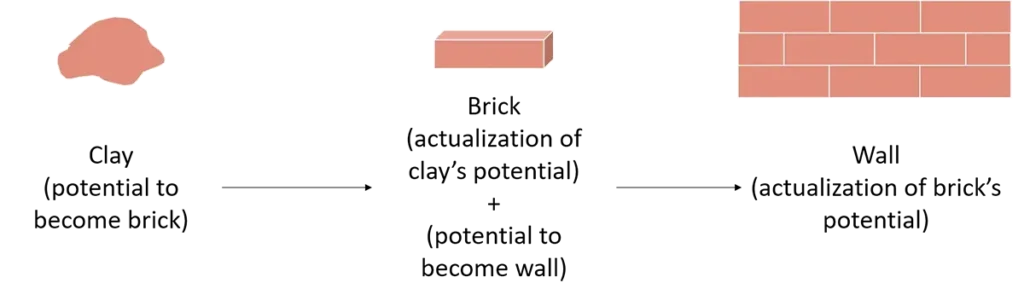
- Clay is the raw material — the matter — for a brick. In the obvious sense, clay is the physical stuff from which bricks are made. But Aristotle’s deeper point is that clay also has the potential to become a brick. It has the capacity, the ability, the openness to receive the form of a brick. If clay lacked this potential — if it were constitutionally incapable of holding the brick form — it could not be the matter for bricks, regardless of its physical properties.
- The brick is formed clay — clay that has received the form of ‘brick.’ At this stage, the brick is simultaneously two things: it is the actualisation of the clay’s potential (the clay’s potential to be a brick has been fulfilled), and it is the matter for a wall (the brick now has the potential to be part of a wall).
- The wall is formed bricks — bricks that have received the form of ‘wall.’ And the wall may itself be the matter for a building — which may itself be the matter for a city. The chain can be extended as far as analysis requires.
This chain reveals what matter truly is:
Matter = a collection of possibilities; the potentiality to receive a form and thereby actualise a purpose. It is not passive dead stuff — it is the locus of potential that every stage of development draws upon and partly fulfils.
- Hylomorphic composition: Aristotle uses the Greek term hylomorphic (hylo = matter; morphic = form) to describe every physical substance as a formed matter — a unity of form and matter that are never, in actual reality, found apart from each other. You will never encounter a ‘pure form’ floating free of matter, or ‘pure matter’ without any form at all. They are analytically distinguishable aspects of one concrete reality.
Development as Successive Actualisation
The clay–brick–wall chain illustrates something profound about development. Each stage occupies a dual position:
- It is the fulfilment of the potential of what came before — the brick actualises what the clay could be.
- It is the basis for what comes next — the brick’s potential to become part of a wall has not yet been actualised.
Matter remains the same throughout; what changes is the form it has received. This is precisely Aristotle’s solution to the problem of change. Change is not, as Parmenides feared, a move from being to non-being — as if the clay were destroyed when it became a brick. The clay persists; it has simply received a new form. Change is the acquisition of a new form by matter that retains its identity throughout.
8. Two Ways of Analysing Substance — Static and Dynamic
Aristotle’s greatest contribution to the metaphysics of change is his recognition that a complete understanding of any substance requires not one but two complementary modes of analysis. Neither alone is sufficient; together they provide the full picture.

| # | Static Analysis (one time-point) | Dynamic Analysis (through time) |
|---|---|---|
| Core concepts | Form + Matter (Hylomorphic) | Potentiality + Actuality |
| What it describes | The substance as it IS at this moment — frozen, fixed | The substance DEVELOPING through time — growing, changing |
| Analogy | A photograph of the substance | A film of the substance over its lifetime |
| Key insight | Everything is a ‘formed matter’ — form and matter are always together | Matter retains identity; form changes = change; chain of changes = development |
| Question it answers | ‘What is this thing right now?’ | ‘How and why is this thing changing and growing?’ |
| When to apply | Analysing the current state or structure of a substance | Analysing growth, change, and development of a substance |
The common mistake is to apply one mode of analysis where the other is needed. When students ask ‘what is this seed?’ and receive the answer ‘clay-like material organised by the form of a seed,’ they have a correct but radically incomplete answer — because the seed is not a static thing. It is a dynamic process, a trajectory from potential to actual. To understand it fully, you must understand not just what it is now but what it is becoming, and why.
The chess game analogy: Your opponent makes moves that appear random, even stupid — pointless sacrifices, incomprehensible manoeuvres. You cannot understand them because you do not know where they are heading. Then, with a single final move, checkmate. Now every previous move becomes intelligible: each was purposively directed toward this conclusion. The ending reveals the meaning of the entire process. Aristotle’s insight is analogous: understanding a substance’s final form — its telos, its purpose — is what makes each stage of its development intelligible. Without the endpoint, the stages appear random. With it, they form a coherent, purposive sequence.
9. The Four Causes — A Complete Account of Change
Identifying what a thing is made of, who made it, what structure it has, and what it is for are four distinct and irreducible explanatory tasks. Aristotle argues that genuine scientific understanding of any change or development requires answering all four. He calls these the four causes (aitia — better translated as ‘explanatory factors’ than ’causes’ in the modern, narrowly mechanical sense).
| Cause | Core question it answers | Statue example | Knife (archaeologist) | Historical precedent |
|---|---|---|---|---|
| Material Cause | What is it made of? | Marble or stone | Copper | Thales, Anaximander, Empedocles (four elements), Democritus (atoms) |
| Efficient Cause | What initiated / caused the process? | The sculptor and tools | The abc tribe who forged it | Anaxagoras (Nous), Empedocles (Love / Hate), Plato (Demiurge) |
| Formal Cause | What is its essence — what defines what it IS? | The design/form in the sculptor’s mind, imposed on stone | Its knife-shape and structure | Plato’s Forms — but transcendent; Aristotle makes forms immanent |
| Final Cause | What is its purpose, goal, or function? | To resemble a specific person | Hunting, cooking, or shaving | Aristotle’s unique addition; implicit in Plato’s Form of the Good |
Worked Example — The Archaeologist
An archaeologist uncovers an unfamiliar object at a dig site. Working through the four causes systematically:
- Material cause: analysis of the object reveals it is made of copper. Copper is the matter in which the object exists.
- Efficient cause: the markings, construction technique, and stylistic features suggest it was made by a particular tribe — call them the abc tribe — in a specific historical period. They and their tools are the efficient cause: the source of the action that brought this object into being.
- Formal cause: the shape, edge geometry, and structural design of the object allow the archaeologist to classify it: this is a knife. Its form — its essence as a cutting instrument of a particular kind — is what defines what it is.
- Final cause: the question of purpose requires further inference. Was this knife used for hunting large game, for food preparation, for ritual purposes, or for shaving? Different interpretations of the archaeological context will yield different answers about the final cause.
Only when all four are known does the archaeologist genuinely understand the object — not just what it is made of or who made it, but what it is and what it was for.
Historical Tracing — Who Discovered Which Cause
Aristotle is not merely proposing the four causes; he is arguing that the entire history of philosophy before him was, unconsciously, the progressive discovery of different causes — each thinker adding one piece of the explanatory picture.
- Material cause was the primary concern from Thales through Democritus. What is the world made of? Water (Thales), the Apeiron (Anaximander), air (Anaximenes), fire (Heraclitus), earth-water-fire-air (Empedocles), atoms (Leucippus, Democritus). Every pre-Socratic cosmological theory is, in Aristotle’s retrospective analysis, an inquiry into the material cause of the cosmos.
- Efficient cause was recognised by Anaxagoras, who proposed Nous (Mind/Intelligence) as the original organising force — the source of cosmic order. Empedocles also identified quasi-efficient causes in Love (which unites the elements) and Strife (which separates them). These are forces that initiate change rather than constituting its material.
- Formal cause was Plato’s great contribution — the Forms as the defining essences of things. Aristotle accepts the insight while relocating it: the Form of Bed does explain what makes something a bed, but this form is immanent in actual beds, not transcendent in a separate world. The Demiurge in the Timaeus also functions as a kind of formal cause, imposing the mathematical structure of the Forms onto chaotic matter.
- Final cause is Aristotle’s own unique addition. No prior philosopher had explicitly identified purpose or goal as an irreducible explanatory factor. The Form of the Good in Plato comes closest — it is the ultimate standard toward which all things aim — but Plato never developed this into a systematic theory of final causation applicable to every natural thing. Aristotle made the final cause both explicit and universal.
10. Teleology and Entelechy — Nature as Purposive Self-Unfolding
The most philosophically distinctive and debated element of Aristotle’s metaphysics is his teleological conception of nature. Mechanism — the view that natural events are fully explained by prior physical conditions and material interactions — had powerful champions in antiquity and even more powerful ones after Newton. Aristotle argues for a fundamentally different view: that nature is inherently purposive, that natural processes are directed toward goals, and that these goals are internal to natural things themselves.
Teleology — Nature Is Goal-Directed
- Teleology (from Greek telos = end, goal, purpose) is the doctrine that natural things have final causes — purposes or goals toward which they are directed. It is not only human artefacts that have purposes; natural organisms do too.
- The evidence from natural regularity: an apple seed, planted in suitable conditions, always and invariably becomes an apple tree — never a mango tree, never an oak, never anything else. This is not accidental. The regularity of natural development across countless instances of the same kind is, for Aristotle, evidence that each kind of thing has a fixed, directed developmental trajectory. Nature is not random. It is patterned and purposive.
- The contrast with mechanism: a purely mechanistic account describes the chemical and physical conditions that make the seed grow. Aristotle does not deny this level of description — it corresponds to the material and efficient causes. But he insists it is incomplete. It tells us how the seed grows; it cannot tell us why the result is always and specifically an apple tree, or why the development is teleologically unified rather than a series of disconnected physical events.
Entelechy — The Goal Is Internal
- Entelechy (entelécheia) is Aristotle’s term for the internal developmental programme — the coding, as it were, that is built into a natural substance and directs its development toward its proper end. It is derived from enteles (complete, having its end within itself).
- The apple seed’s entelechy is the full developmental programme — encoded within the seed itself — that directs its growth through all stages until it becomes a mature, fruit-bearing apple tree. This programme is not consciousness, intention, or desire. The seed does not want to be an apple tree. The entelechy is a potential or capacity — what the seed is structured to become — not a mental state.
- The Thales connection. When Thales said ‘everything is full of gods,’ he was — in Aristotle’s reading — gesturing at the idea that the controlling or directing power in natural things is internal to them, not external. The gods of Homer and Hesiod resided outside things (on Olympus, in the sea, in the sky) and directed events from without. Thales’ radical move was to suggest that the directedness of things comes from within. This is the conceptual seed of entelechy — even if Thales never systematised it.
The Distinction Between Teleology and Entelechy
These two concepts are closely related but distinct. Many students conflate them; the difference matters.
| # | Teleology | Entelechy |
|---|---|---|
| Core claim | Every thing is directed toward a final goal or purpose | The developmental pattern for reaching that goal is inside the thing itself |
| The question it answers | Where is this thing going? What is it for? | How does it know how to get there? Who/what guides it? |
| The answer | There is an end (telos) — apple seed → apple tree | The end is encoded within from the start — not imposed from outside |
| Analogy | A ship is going to a destination | The navigation programme is already inside the ship |
| Relation to causation | Grounds the FINAL cause — there is a final goal | Grounds the FORMAL cause — the form is immanent, guiding from within |
| In one phrase | Going somewhere | Unfolding itself |
| Connection to Thales | — | ‘Everything is full of gods’ → controlling power is internal, not external |
Teleology and entelechy are two aspects of the same fundamental insight: nature is goal-directed (teleology), and that directedness is intrinsic rather than imposed (entelechy). Together they constitute Aristotle’s most original and enduring contribution to the metaphysics of living things — a contribution that resurfaced, in modified form, in Kant’s account of biological purpose, in Hegel’s developmental philosophy, and in contemporary debates about biological function and natural teleology.
11. The Complete Picture — Aristotle’s Metaphysics as a System
Aristotle’s metaphysics is not a collection of independent doctrines but a single unified system in which every component answers the central question: how can we understand a changing world scientifically? Here is the system in its entirety.
- Reality = individual substances. The world consists of particular, concrete things — this seed, this person, this stone. Abstract forms are not independent realities; they are common features we extract from substances through intellectual analysis.
- Static analysis (form + matter). At any given moment, every substance is a formed matter — a unity of form (its purpose, function, essence) and matter (its physical constitution, which is also its potentiality). These two aspects are always found together; neither exists without the other.
- Dynamic analysis (potentiality → actuality). Through time, every substance is engaged in a process of development — moving from what it has the potential to be toward what it actually becomes. Matter retains its identity; form changes. Each change is the acquisition of a new form by matter that is thereby fulfilling one potential while opening another.
- Change defined. Change is matter retaining its identity while successively receiving new forms. It is not movement from being to non-being (contra Parmenides) but the actualisation of a potential that was genuinely present in the matter. This is Aristotle’s solution to the problem of change that had eluded every prior philosopher.
- Four causes. Every change or development requires four explanations: what it is made of (material cause), what initiated the process (efficient cause), what defines its essence (formal cause), and what its purpose or goal is (final cause). No genuine scientific understanding is complete without all four.
- Teleology and entelechy. Every natural substance has a final cause — a proper end toward which its development is directed. And the developmental programme for reaching that end is internal to the substance itself, encoded in its nature from the beginning. Nature is not mechanical randomness but purposive self-unfolding.
- Universal laws from developmental regularities. Because every apple seed develops according to the same internal programme, every seed of the same kind exhibits the same developmental trajectory. The regularity of these patterns across all instances of a natural kind is the basis for universal laws of nature — the ultimate goal of Aristotelian science.
Conclusion
Aristotle’s metaphysics is, at its core, a philosophy of the dynamic, purposive, intelligible world we actually inhabit. Where Plato sought truth by ascending away from the changing world toward eternal, unchanging Forms, Aristotle stays in the world and asks how we can understand it rigorously on its own terms. His answer is layered and precise: reality is individual substances, each simultaneously a formed matter (the static view) and a potential-actualising development (the dynamic view), each governed by four causes that together provide complete explanatory satisfaction, each directed by an internal developmental programme toward a proper end.
This framework did not merely answer the philosophical problems of Aristotle’s own day. It shaped the entire subsequent Western intellectual tradition. His four causes provided the vocabulary of scientific explanation until Newton. His teleological biology remained the dominant framework for understanding living organisms until Darwin — and the debate about biological teleology has not ended even now. His hylomorphic analysis of substance runs as a live thread through medieval Scholasticism, through Aquinas’s theology, and into contemporary philosophy of mind and metaphysics. Aristotle built a system that proved, quite literally, impossible to ignore.
Frequently Asked Questions
Why does Aristotle call metaphysics ‘First Philosophy,’ and how does it differ from the special sciences?
Aristotle’s own term for the subject we call metaphysics was ‘First Philosophy’ — the study of being qua being, or being as such. The label ‘metaphysics’ was an accident: roughly 250 years after Aristotle’s death, a scholar named Andronicus compiled his writings and placed the works on being and substance after the physics texts, labelling them meta-ta-physika (after the physics). This editorial convention became the technical term. First Philosophy differs from the special sciences precisely in scope and priority. Every special science restricts its inquiry to a particular kind or aspect of being: biology studies living beings, physics studies material beings, mathematics studies quantitative beings. None of them examines being itself — what it means for anything at all to exist, and what the most fundamental structures of existence are. That is First Philosophy’s task, which is why it is prior to — ‘first’ with respect to — all the others.
What is the Third Man Argument, and why does it present such a serious problem for Plato’s Theory of Forms?
The Third Man Argument is a regress argument that targets the explanatory mechanism at the heart of Plato’s metaphysics. The Theory of Forms is supposed to explain what multiple particular things have in common — Socrates and Plato are both men because they both participate in the Form of Man. But Plato also holds that anything falling under a predicate must share that predicate with its corresponding Form. If the Form of Man is itself ‘man’ (and Plato implies this, since forms are self-predicating), then Socrates, Plato, and the Form of Man are all ‘man.’ This shared property requires explanation: they must all participate in a higher Form of Man — a second Form. But now Socrates, Plato, Form-of-Man-1, and Form-of-Man-2 are all ‘man,’ requiring a third Form… and so the regress continues without end. Instead of providing a stopping-point explanation for what makes particular men men, the theory generates an infinite chain of increasingly abstract Forms, each requiring the next. The Theory of Forms, rather than grounding explanation, undermines it.
What is the difference between form and matter in Aristotle’s deeper sense?
In their elementary sense, form means physical shape and matter means physical stuff — the shape of the cup, the clay it is made from. But these definitions are inadequate, and Aristotle goes deeper. Form, properly understood, is the purpose, function, or essence of a thing: what it actually does and is for. A cup’s form is its function of holding liquid for drinking, not its cylindrical shape — because an object with a completely different shape can be a cup (if it holds liquid), while an object with the identical shape may not be (if it cannot). The shape is what it is precisely because it serves the function; the function defines the form. Matter, properly understood, is potentiality — the capacity of a physical constitution to receive a form and thereby actualise a purpose. Clay is the matter of a brick not merely because bricks are made of clay, but because clay has the potential to take on the structural form of a brick. Matter is therefore a collection of possibilities: what a substance can become as it develops. These deeper meanings are essential to understanding how Aristotle uses form and matter to explain change and development throughout his philosophy.
What is the difference between the static analysis (form/matter) and the dynamic analysis (potentiality/actuality)?
These are two complementary but distinct ways of understanding the same substance, each appropriate to a different type of question. The static analysis (form and matter) describes the substance as it exists at a particular moment — what it is right now. It is like a photograph: it captures the current state accurately but tells you nothing about where the substance came from or where it is going. The dynamic analysis (potentiality and actuality) describes the substance as it develops through time — what it has the potential to become, and to what degree that potential has been actualised. It is like a film of the substance across its entire lifespan. A seed, statically analysed, is a formed matter: a specific organic material organised by the form of a seed. Dynamically analysed, it is a potentiality-actualising process: it has the potential to become a mature tree, and at any given moment it is at some point on the trajectory from fully potential (just planted) to fully actual (mature fruit-bearing tree). The mistake is to apply one framework where the other is needed: static analysis alone cannot capture the purposive developmental character of living things; dynamic analysis alone cannot describe the structure of a thing at a given instant.
What are the four causes, and how does each contribute to understanding a phenomenon?
The four causes are Aristotle’s four irreducible explanatory factors, each answering a distinct question about any change or natural phenomenon. The material cause answers ‘what is it made of?’ — the marble from which a statue is carved, the copper from which a knife is forged. The efficient cause answers ‘what initiated or produced this?’ — the sculptor and their tools, the tribe who forged the knife. The formal cause answers ‘what is its essence, what defines what it is?’ — the design in the sculptor’s mind imposed on the stone, the knife-shape that makes the object a knife rather than anything else. The final cause answers ‘what is it for, what is its purpose or goal?’ — to resemble a person (the statue), to cut (the knife). Aristotle argues that no explanation is complete without all four. Prior philosophers had, collectively and unknowingly, discovered different causes: the pre-Socratics focused on material causes, Anaxagoras and Empedocles identified efficient causes, Plato contributed formal causes (through the Theory of Forms). Aristotle’s unique contribution was to identify the final cause explicitly and insist that purposive explanation is irreducible — you cannot translate ‘for the sake of X’ into purely material or efficient terms without losing something essential.
What is the difference between teleology and entelechy, and why does it matter?
Both concepts concern the purposive directedness of natural things, but they answer different questions. Teleology (from telos = goal, end) is the general doctrine that natural things have final causes — that an apple seed’s development is directed toward the goal of becoming an apple tree, not a mango or an oak. It tells us that there IS a goal and that natural development is goal-directed. Entelechy (entelécheia = having one’s end within oneself) answers the question of how the goal is achieved: the developmental programme that guides the seed through all its stages to the mature tree is encoded within the seed itself. The goal is not imposed by an external agent or environment; it unfolds from within. Teleology says: everything is going somewhere. Entelechy says: the map for how to get there is already inside the thing. The distinction matters because it blocks two misreadings. Without teleology, nature looks mechanically random. Without entelechy, teleological guidance seems to require an external designer — which Aristotle does not posit. The internal developmental programme makes purposive, directed development possible without invoking any agency or intention beyond the nature of the substance itself.

Leave a Reply