
Plato admits he cannot describe the highest truth directly — language itself breaks down at that level. So instead he gives you three doors into the same room: a line, a sun, and a cave. Walk through all three, and you’ll understand not just Plato’s metaphysics, but why Socrates was willing to die for it.
Key Takeaways
- These three metaphors are not separate topics — they are three expressions of the same underlying structure. The Divided Line gives the cognitive/epistemological view (four levels of the mind); the Myth of the Sun gives the metaphysical/ontological view (what illuminates all knowledge); and the Allegory of the Cave gives the existential and educational view (what the journey from ignorance to wisdom actually looks like in a human life). All three were made necessary because the Form of the Good cannot be stated in direct language.
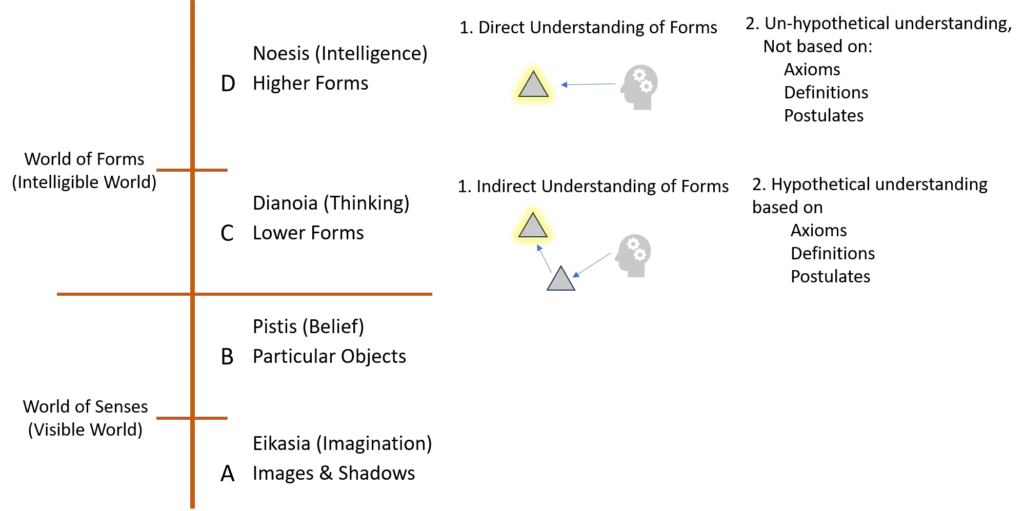
- The Divided Line is a vertical line divided into four sections (from bottom to top): Section A — shadows and images (Eikasia: imagination/illusion); Section B — physical objects (Pistis: belief); Section C — mathematical and scientific concepts (Dianoia: discursive thinking); Section D — the Forms themselves (Noesis: intelligence/direct intuition). Higher sections represent greater reality, greater clarity, and more abstract knowledge.
- Section C (science and mathematics) has two critical limitations: it reaches Forms only indirectly, through diagrams and images as a medium; and it begins from axioms and postulates that are accepted without proof. Reasoning at this level moves forward — from axioms to conclusions — but the axioms themselves are never examined. This is the difference between science and philosophy.
- Section D is distinguished by two features: knowledge of Forms is direct, without any medium or diagram; and reasoning moves backward — instead of building forward from axioms, the philosopher turns around and examines the axioms themselves, tracing them back to their foundation: the Form of the Good, the unconditioned First Principle that grounds everything.
- The Myth of the Sun establishes three parallels between the Sun and the Form of the Good: the Sun illuminates physical objects for the eyes; the Form of the Good illuminates Forms for the intellect. The eyes have an affinity with the Sun; the human soul has an affinity with the Good. The Sun produces and nourishes life; the Form of the Good is an active, creative force — not a dead abstraction — which is why later religious thinkers identified it with God.
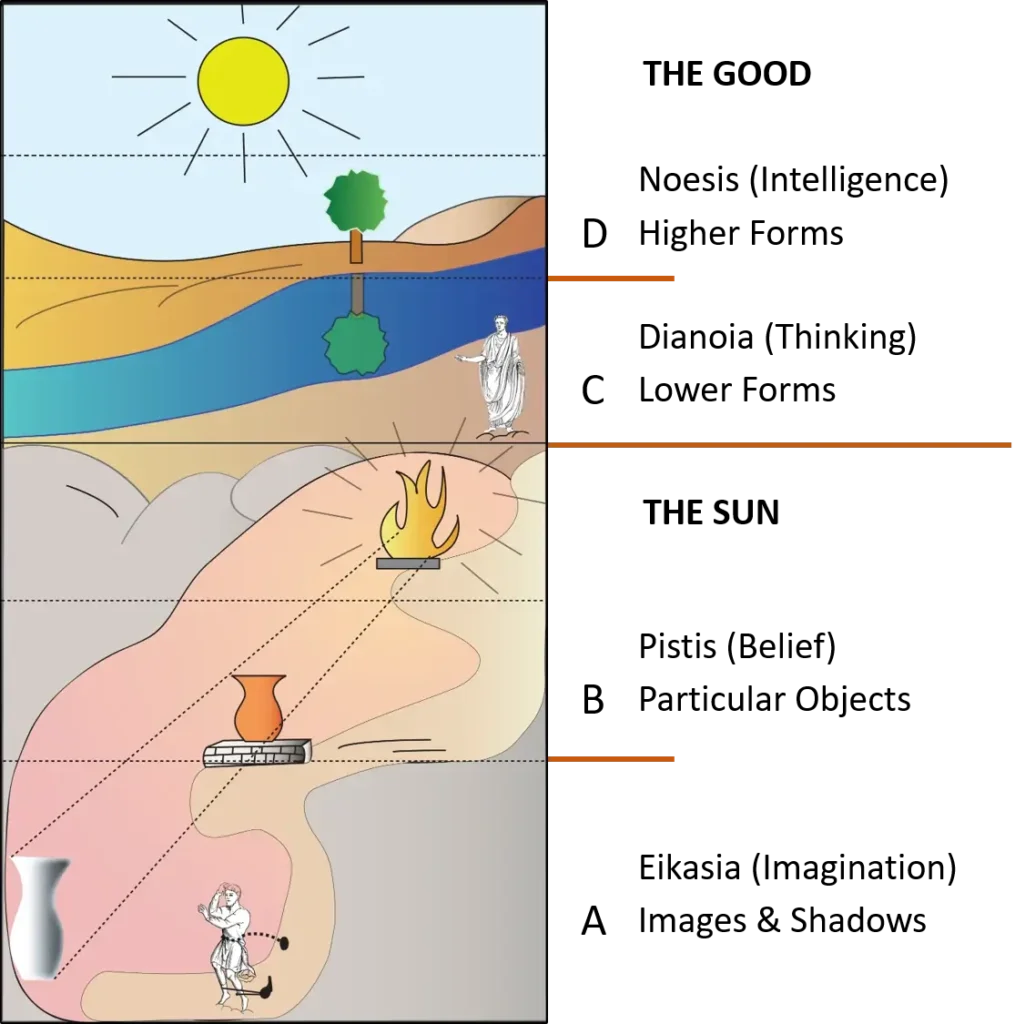
- The Allegory of the Cave maps precisely onto the Divided Line: shadows on the cave wall = Section A; objects in the cave = Section B; the fire in the cave = the Sun of the visible world; shadows and reflections seen just outside the cave = Section C; real objects in daylight = Section D; the Sun outside = the Form of the Good. The allegory also raises two questions the story itself does not answer: why would anyone make this painful journey? (Answer: Love — from the Symposium) and why call it ‘the Good’? (Answer: purpose is the ultimate cause — from the Phaedo).
Table of Contents
Introduction
In the previous two lectures, we established Plato’s epistemology — that genuine knowledge is justified, stable, and not sensory — and his metaphysics — that the objects of knowledge are non-physical, eternal Forms existing in a separate intelligible realm. Those two lectures were not ends in themselves. They were the necessary preparation for what comes now.
Plato faces a fundamental problem: he cannot describe the Forms in direct language. The moment you attempt to state what a Form is, the statement becomes a mental concept — a shadow of the Form, not the Form itself. Language operates by creating concepts in the hearer’s mind, but concepts are already one step removed from the Form. And the highest Form — the Form of the Good — is so far beyond ordinary discourse that Plato freely admits, in his own voice, that he does not know how to describe it directly. His solution, as he himself explains in the Republic, is three great metaphors: the Divided Line, the Myth of the Sun, and the Allegory of the Cave. These are not ornamental illustrations. They are the closest Plato can get to pointing at what cannot be said.
The three metaphors appear together in the Republic, in a conversation between Socrates and Plato’s brother Glaucon. Each metaphor approaches the same underlying structure from a different angle: the Divided Line through epistemology and cognition; the Sun through metaphysics and ontology; the Cave through human existence, education, and politics. Understanding all three together gives a far richer picture than any one alone.
1. Why Metaphors? The Limits of Language and the Shadow Analogy
Before examining the three metaphors, Plato makes a preliminary point that is worth holding in mind throughout. Consider the relationship between a hand and its shadow. The hand is more real; the shadow is less real but still genuinely exists. The shadow depends on the hand — no hand, no shadow. It resembles the hand. And it is caused by the hand. Now: if you were in a room where you could only see the shadow but not the hand, you could still study the shadow carefully and develop a reasonable idea of what the hand must look like — though your understanding would always be mediated, indirect, and imperfect.
This relationship — something more real casting an image that is less real but still meaningful — is the structural template for both the physical world and the Forms. Physical objects are the shadows of Forms. And the light that enables the shadow to appear at all — that gives the shadow its intelligibility — corresponds to what Plato will call the Form of the Good. The hand-and-shadow analogy lives entirely within the physical world. Plato’s three metaphors are his attempt to project this same structure across the two worlds: physical and intelligible.
2. The Divided Line
The Divided Line is a single vertical line divided first into two unequal segments — the visible world below, the intelligible world above — and then each segment divided again in the same proportion, producing four sections. The higher the section, the greater the reality, the greater the clarity, and the more abstract the subject matter. Here is the structure from bottom to top.

SECTION A: Eikasia — Imagination / Illusion
- Subject matter: shadows, reflections, and images — the least real things in the visible world. Photographs, reflections in water, shadows on a wall.
- State of mind: a person at this level takes images for reality. They have not questioned the source of what they see. If the shadow on the wall says something is true, they believe it. Their mind is passive, uncritical, and entirely dependent on what is presented to them.
- Modern parallel: a person whose entire understanding of a topic comes from social media headlines, film portrayals, or secondhand rumours — who has never engaged with the actual phenomenon — lives intellectually at Section A. The news cycle, advertising, political slogans: these are the shadows on the wall.
- Key term: eikasia — this Greek word is often translated as ‘imagination,’ but Plato means something closer to ‘illusion’ or ‘image-based cognition’ — a mental state in which appearances are mistaken for the real.
SECTION B: Pistis — Belief
- Subject matter: physical objects — all the particular things of the visible world. People, animals, plants, buildings, furniture, tools. Everything you can see, touch, hear, smell, or taste.
- State of mind: a person at this level observes the physical world directly through their senses. They have moved beyond mere images — they engage with actual objects. But they have not yet applied reason to what they observe. They trust their senses and form beliefs on that basis.
- Why this is still only belief: recall from the epistemology lecture that belief can be true or false, and that knowledge requires justification in addition to truth. A person at Section B may form beliefs that happen to be true, but they cannot justify them — they cannot explain the underlying principles. Their beliefs, however accurate, rest on sense experience alone, with no rational foundation.
Horse-racing example: A horse-racing enthusiast who has watched thousands of races notices that horses with heavy chests tend to run faster. This is an empirical observation — a belief based on sense experience. It may even be consistently correct. But they cannot explain why chest formation affects speed; they have no knowledge of musculature, cardiovascular mechanics, or biomechanics. Their true belief is not yet knowledge.
SECTION C: Dianoia — Discursive Thinking / Understanding
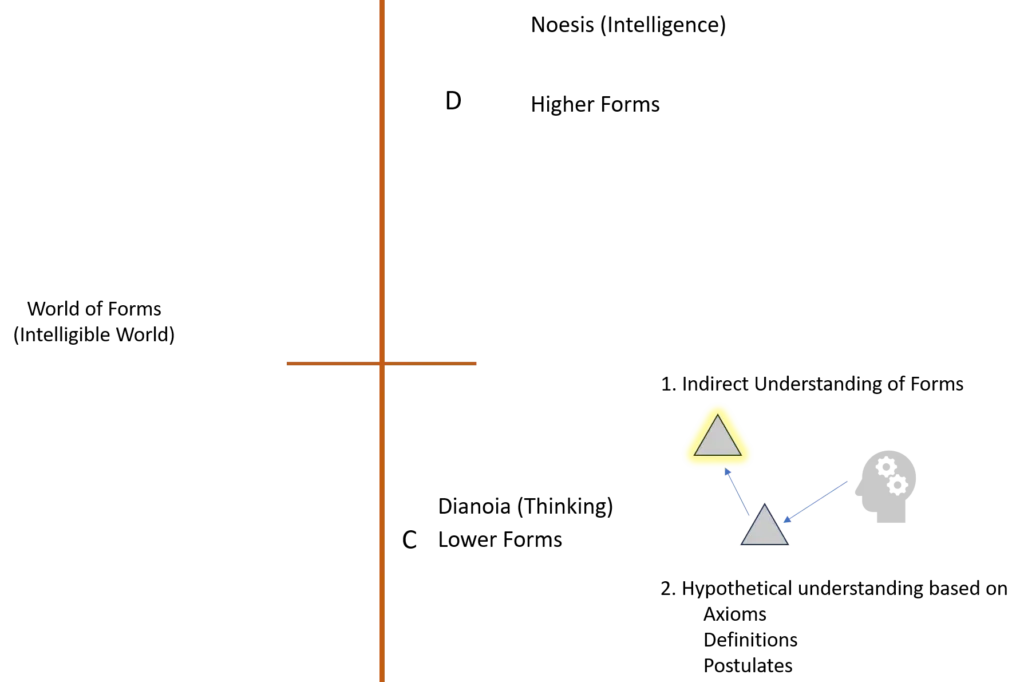
Section C is where science and mathematics operate. It is significantly more advanced than Section B — reasoning is now active, and the mind reaches toward the Forms. But it has two fundamental limitations that prevent it from constituting full knowledge.
Limitation 1 — Indirect Contact with Forms (The Medium Problem)
- At Section C, the mind reaches toward Forms through images and diagrams. A mathematician studying triangularity draws a triangle on paper. The drawn triangle is a physical object — it has some line width, some imprecision of angle, some unevenness of curve. It is not Triangularity itself; it is a poor representation of the Form. The mathematician uses this diagram as a stepping stone toward the Form, knowing that the diagram is not what they are ultimately studying.
- This is indirect knowledge. The mathematician is not in direct contact with the Form of the Triangle; they are working through a medium — the diagram — that represents the Form imperfectly. Their understanding of the Form is real and valuable, but it is always filtered through this physical intermediary.
- The same applies across all sciences. A biologist observes particular bodies to understand the universal properties of human anatomy. A physicist conducts particular experiments to understand universal laws. In every case, the universal (the Form-like object of scientific knowledge) is approached through particular physical instances. The universal itself is never touched directly.
Limitation 2 — Unproven Axioms (The Foundation Problem)
- At Section C, reasoning proceeds forward from axioms accepted as self-evident. Geometry begins with postulates: ‘through two points, exactly one straight line can be drawn’; ‘a circle can be drawn with any centre and any radius.’ Arithmetic begins with axioms about numbers. Physics assumes that every effect has a cause. Ethics assumes that humans have free will. These starting points are taken for granted — they are called self-evident, meaning they are assumed to need no proof.
- The problem: axioms are never proved. The entire edifice of mathematical and scientific knowledge is built upward from these foundations — but the foundations themselves float unsupported. They are accepted on the basis of intuitive plausibility, not demonstration. If even one axiom turns out to be false, every conclusion derived from it may collapse.
The example of Euclid’s fifth postulate: For two thousand years, Euclid’s fifth postulate — that through a point not on a given line, exactly one parallel line can be drawn — was accepted as self-evidently true. The entire structure of plane geometry rested on it. Then, in the 19th century, mathematicians demonstrated that consistent geometries could be constructed in which this postulate is false. Non-Euclidean geometry was born. The postulate was not self-evident after all — it was a hypothesis. All of Euclidean geometry had been, in Plato’s sense, hypothetical.
- This is what Plato means: Section C knowledge is solid from the axioms upward but has no grounding below the axioms. It is a building with sound walls but no foundation. The reasoning is valid — if the axioms are true, the conclusions follow. But the truth of the axioms is assumed, not established.
- The cognitive name: Plato calls this state dianoia — discursive thinking, or understanding. It is genuine intellectual activity, and far superior to mere belief. But it is not yet wisdom, because it cannot reach down to its own foundations.
SECTION D: Noesis — Intelligence / Direct Intuition
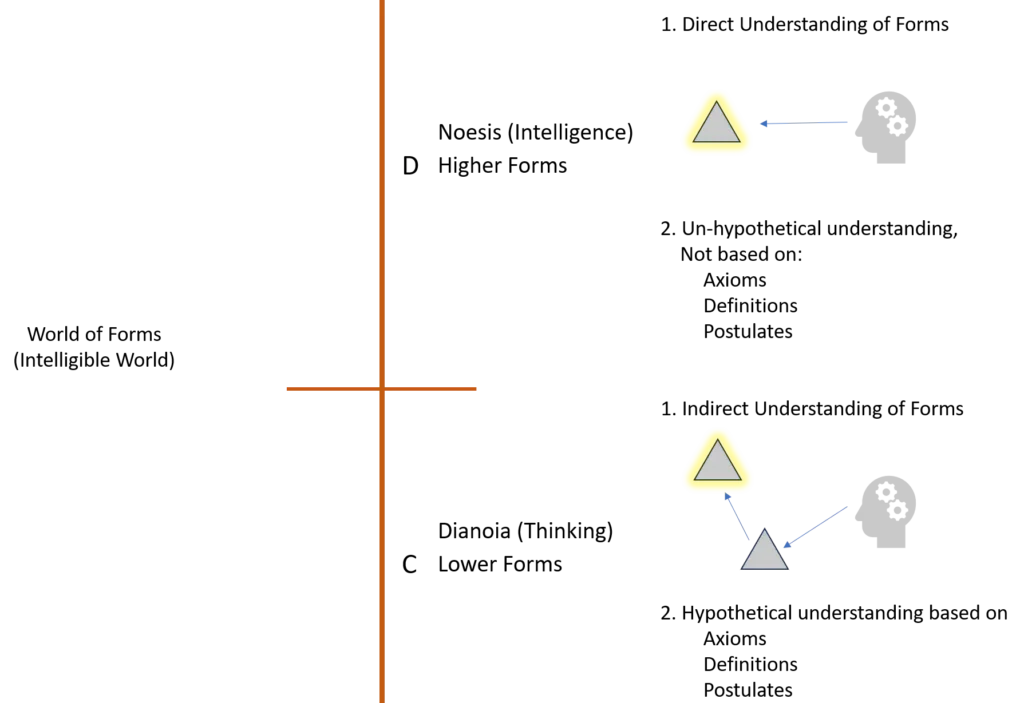
Section D is the highest level — the level of genuine philosophical knowledge. It differs from Section C in two fundamental respects.
Feature 1 — Direct Contact with Forms, Without Medium
- At Section D, the mind grasps Forms directly — not through diagrams, not through particular physical instances, not through any intermediary. The mathematician at Section C uses a drawn triangle to approach Triangularity; the philosopher at Section D apprehends Triangularity itself, in its pure and perfect state, without any physical representation.
- This is what Plato calls noesis — often translated as ‘intelligence’ or ‘pure intellect.’ It is a direct intellectual intuition: the mind touching the Form without any sensory medium in the way. This kind of knowledge is certain, not because it is based on stronger evidence, but because it is the knowledge of something that cannot be otherwise — the Form itself, eternally and unchangingly what it is.
Feature 2 — Reasoning Moves Backward (The Dialectical Turn)
- At Section C, reasoning moves forward: you accept the axioms and derive conclusions from them. At Section D, you reverse direction. Instead of taking the axioms as given and building upward, you turn around and ask: where do these axioms come from? What justifies them? What is the foundation on which they rest?
- This backward movement is dialectic — the method Plato describes as the highest form of philosophical inquiry. Through systematic questioning, the dialectician traces each assumption back toward its source, each hypothesis back toward what makes it true, until they reach a point that is not itself hypothetical: the First Principle, which grounds everything and requires nothing further to ground it.
What does ‘backward’ look like in practice? In mathematics, you use the concept of a ‘number’ without ever asking what a number fundamentally is. In the philosophy of mathematics, you ask that question — and find that answering it requires examining logic, set theory, and the nature of abstract objects. In science, you use induction without asking whether induction is a reliable method. In philosophy of science, you examine induction itself. In religion, you begin by assuming God exists and derive moral obligations from that. In philosophy of religion, you begin by asking whether God exists. The ‘turn’ — stopping to examine what you assumed rather than what you derived — is the move from Section C to Section D.
- The method of Section D is also different in a second way: it does not use physical objects or diagrams at all. Where a scientist studies a particular body to reach universal biological truths, a philosopher at Section D works with abstract concepts directly — not with any physical instantiation of them. This is what distinguishes philosophy from all other disciplines.
The Comparison: Science/Mathematics vs Philosophy/Dialectic
The distinction between Sections C and D captures one of Plato’s most important contributions to the philosophy of knowledge. It is worth making this comparison explicit.
| Science and Mathematics (Section C) | Philosophy and Dialectic (Section D) |
|---|---|
| Takes axioms as self-evident starting points | Treats axioms as hypotheses to be examined |
| Reasoning moves forward: from axioms to conclusions | Reasoning moves backward: from axioms to their foundations |
| Uses diagrams, images, and physical examples as medium | Works directly with abstract concepts — no physical medium |
| Contact with Forms is indirect and mediated | Contact with Forms is direct and unmediated |
| Can tell you whether a proof is valid | Asks whether the foundations of the proof are sound |
| Uses logic as a tool | Studies logic itself (meta-logic) |
| Assumes: induction is a reliable method | Examines: whether induction is a reliable method |
Logic as an example: Scientists, mathematicians, lawyers, and journalists all use logic. But a scientist uses logic the way a driver uses a car — they operate it well but do not necessarily understand how the engine works. A logician understands the engine: what makes an argument valid, under what conditions deductive inference preserves truth, how different logical systems relate to one another. The same distinction holds across every discipline. Every field uses reasoning; philosophy examines reasoning itself.
The First Principle — Form of the Good
The backward movement of dialectic does not go on forever. It converges on a single point: an object of knowledge that does not itself rest on any further assumption, that explains itself, that grounds everything below it without itself needing grounding. This is the First Principle — what Plato calls the Form of the Good.
- The Form of the Good is the unconditioned ground of all knowledge. Every lower level of the divided line is intelligible because of the Form of the Good. Section C is intelligible because the Forms it imperfectly approaches are intelligible. The Forms are intelligible because the Form of the Good illuminates them. Remove the Form of the Good, and the entire structure — all knowledge, all meaning, all intelligibility — collapses.
- The pyramid image: think of the Divided Line as a pyramid. At the base are the most conditioned, most dependent, crudest forms of awareness — shadows. As you ascend, the knowledge becomes more abstract, more independent, more clear. At the apex stands the Form of the Good: perfectly unconditioned, independent of everything, absolutely clear, the source of the reality and intelligibility of everything below it. Knowing this apex means knowing, in a sense, everything — because you know the source from which all else flows.
- How is the Divided Line to be drawn? Plato specifies in the Republic that the line is vertical (he speaks of ‘higher’ and ‘lower’ sections), and that the higher sections are longer — because greater length represents greater clarity and greater reality. The lowest section (Section A — shadows) is the shortest; the highest (Section D — Forms) is the longest.
3. The Myth of the Sun — The Form of the Good
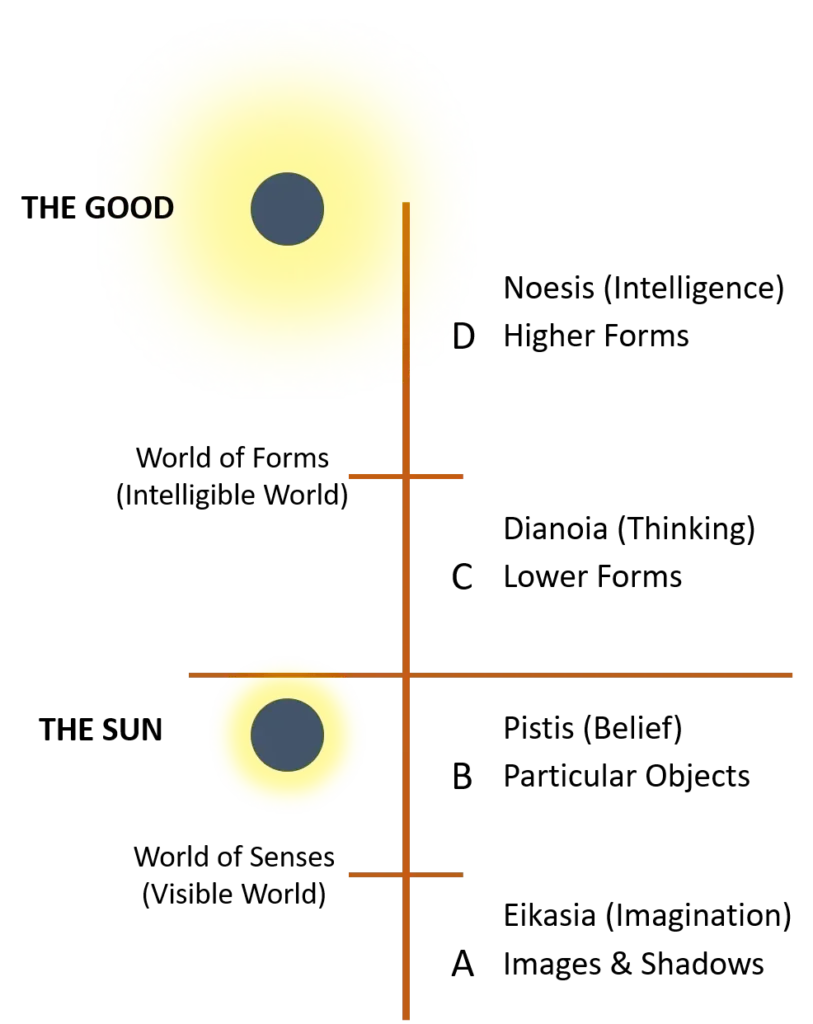
The Form of the Good sits at the apex of the Divided Line, grounding everything below it. But what is it? How can we understand something that is, by Plato’s own admission, beyond direct description? His answer is analogy: the Form of the Good is to the intelligible world as the Sun is to the physical world. When Glaucon asks Socrates to describe ultimate goodness directly, Socrates says he cannot — but he can describe something that resembles it. The analogy has three components.

Parallel 1 — Illumination
- In the physical world: the Sun is the source of light. Objects have colours and forms, and eyes have the capacity to see — but without light, neither fact matters. Colours are invisible in darkness; eyes cannot operate without illumination. The Sun is what makes the act of vision possible.
- In the intelligible world: Forms are real and the intellect is capable of grasping them — but without the Form of the Good, the intellect cannot engage with the Forms. The Form of the Good illuminates the Forms, making them intelligible — understandable, meaningful, knowable. Just as the Sun does not create the physical objects it illuminates but makes them visible, the Form of the Good does not create the other Forms but makes them intelligible.
- The implication: the Form of the Good is the condition of possibility for all knowledge. Not merely knowledge of moral things — all knowledge, including mathematical and scientific. This is why the Form of the Good stands at the top of the Divided Line rather than merely at the top of the ethical section.
Parallel 2 — Affinity
- Eyes and Sun have an affinity. The human eye did not develop arbitrarily — its structure reflects the nature of sunlight. The eye perceives the visible spectrum of sunlight precisely because it is adapted to sunlight. There is a kinship between the organ and its object.
- The soul and the Form of the Good have a corresponding affinity. The human soul is not merely a random cognitive device pointed at whatever is in front of it. It is oriented toward the Good. This is why philosophical understanding is possible at all — the mind is structured to reach toward the Form of the Good. There is a fundamental kinship between the human intellect and the highest reality.
- This affinity has a crucial implication for how Plato understands the human person. Humans are not merely ‘knowers’ — information-processing machines. They are beings whose deepest nature is oriented toward the Good. The longing for knowledge, the longing for justice, the longing for beauty — these are all expressions of the same underlying orientation of the soul toward the Form of the Good.
Parallel 3 — Causation and Nourishment
- The Sun does not merely illuminate. It produces life: plants grow because of sunlight; animals eat those plants; the entire web of biological existence on Earth traces back to solar energy. The Sun is not a passive backdrop — it is an active, productive force.
- The Form of the Good is not a passive object of contemplation but an active, creative force. It is the ultimate source and sustainer of existence — not merely the condition for knowledge of Forms, but in some sense the cause of their being what they are. This is the most metaphysically ambitious claim in Plato’s philosophy.
- The religious connection: this third parallel — the Form of the Good as a creative, life-giving force, source and sustainer of all reality — is the reason later religious thinkers, particularly in the Neoplatonic tradition and in Christian theology (especially Augustine), identified the Form of the Good with God. For Plato, the Form of the Good is not personal or relational in the way the Christian God is. But it is not a mere abstract object either. It is the active ground of all being and all value.
The Form of the Good Answers All Human Demands
Plato’s vision here is broader than a purely epistemological theory. He insists that the Form of the Good is not merely the object of intellectual knowledge. It is also the fulfillment of every genuine human demand — for justice, for beauty, for meaning, for purpose. The human person is a composite being: they need knowledge, but they also need justice and beauty and meaning. Plato’s claim is that these are not separate needs satisfied by separate objects. They all converge on the same first principle. The Form of the Good is simultaneously the Form of Truth, the Form of Beauty, and the Form of Justice — not as separate Forms, but as aspects of the same ultimate reality. This is what Plato means when he says that epistemology, ethics, and aesthetics all meet at the highest point.
4. The Allegory of the Cave
The Allegory of the Cave is the Divided Line dramatised as a myth — made into a story, given characters, movement, conflict, and consequence. Where the Divided Line shows the cognitive structure in abstract schematic form, the Cave shows what it is actually like to live through the ascent from ignorance to wisdom. It is also — as Plato undoubtedly intended — a story about Socrates.
The Cave Setting
- The physical space: an underground cave whose entrance opens to the outside world. Deep inside, at the lowest level, is a chamber where prisoners live.
- The prisoners: they have been there since childhood. Their hands, feet, and heads are chained so that they cannot move — crucially, they cannot turn around. They face only one direction: the blank wall of the cave in front of them.
- The fire and the parade: behind the prisoners, at some distance and elevated on a kind of raised walkway, a fire burns. Between the fire and the prisoners, people walk along the path carrying various objects on their heads and conversing with each other. The fire casts the shadows of these objects onto the cave wall.
- What the prisoners see: only the shadows. They have never seen anything else. The shadows are their entire reality. When they hear the voices of the people on the path, they believe the sounds are coming from the shadows. They give the shadows names; they develop theories about their patterns and sequences. They compete with each other over who can best predict which shadow will appear next — and they award honour to whoever is most skilled at this.
The full irony of the cave: The prisoners are not studying reality. They are studying the shadows of objects that are themselves only present inside the cave — which is itself underground, cut off from the real world outside. Shadow of object inside cave → object inside cave → object outside cave in daylight → the Sun. The prisoners are four degrees removed from full reality, and they do not know it.
The Journey Out — Mapped to the Divided Line
(https://commons.wikimedia.org/wiki/
File:Allegory_of_the_Cave_blank.png)
https://creativecommons.org/licenses/by-sa/4.0/legalcode
Plato now narrates the journey from the lowest level to the highest, and each stage corresponds precisely to a section of the Divided Line.
- Stage 1 — Breaking free (Section A → Section B): a prisoner somehow breaks free and is able to turn around. For the first time, they see the fire and the objects being carried — the actual things whose shadows they had been watching. The eyes, accustomed only to dim shadows, are assaulted by the fire’s brightness. There is pain. The prisoner instinctively turns back toward the shadows, which are easier to look at. But they are forced — or force themselves — to keep looking. Gradually, they begin to see the objects themselves. This is the move from Eikasia (shadow-images) to Pistis (the actual objects of the visible world).
- Stage 2 — Dragged out of the cave (Section B → Section C): the prisoner is dragged upward, out of the cave and into the sunlight. The transition is violent and disorienting. Outside, the sunlight is overwhelming. They cannot see anything at first. Slowly, they begin to make out what is around them. But they start with the easiest things: shadows of trees on the ground, reflections in pools of water. These are still indirect — they are seeing things mediated by shadow and reflection — but the things they represent are real things in the real world. This is Section C: real Forms, but still approached indirectly through a medium.
- Stage 3 — Seeing things directly (Section C → Section D): as the eyes continue to adjust, the prisoner can look at the objects themselves — the trees, the rocks, the people, the sky. Real things in direct daylight, no longer mediated by shadow or reflection. This is Section D: direct contact with reality.
- Stage 4 — Looking at the Sun (the Form of the Good): finally, the prisoner is able to look directly at the Sun itself — not its reflection, not its effect, but the Sun as it is. They understand that the Sun is the source of everything they have seen: it produces the seasons, nourishes living things, governs the visible world. This is the Form of the Good: the First Principle, the source of all intelligibility.
The Return
- The philosopher returns. After this encounter with the highest reality, the person returns to the cave to help the others. Coming back in from sunlight, they are temporarily blinded by the darkness. Their fellow prisoners notice that they can no longer predict the shadows accurately — and they mock them, saying that going outside has damaged their eyes. They recommend to each other that no one else attempt the journey.
- The danger: if the returning philosopher tries to unchain the others and lead them toward the exit, the prisoners may resist violently. They may attack. They may kill. Plato says this explicitly — and then adds, very quietly, that the philosopher who came down and was killed was probably Socrates.
- The political meaning: the Republic as a whole is about the just city. Plato’s point is that a just city can only be governed by those who have made the journey all the way to the Form of the Good — the philosopher-kings. And yet such people are precisely the ones that unjust cities attack and destroy. The execution of Socrates is Plato’s permanent evidence for this claim.
5. Three Key Lessons from the Allegory
Lesson 1 — Crude Knowledge Without Understanding
Even in the cave — living entirely on shadows — the prisoners can develop a kind of crude empirical system. They observe the shadows, notice patterns, make predictions, and reward accuracy. This is not nothing — it is a form of adaptation and learning. But it is not knowledge, because it has no justification. The prisoner cannot explain why the shadows behave as they do, because they do not know about the fire, the objects, or the path. They are missing the explanatory framework that would turn accurate observation into genuine understanding.
The car mechanic analogy: A mechanic who has worked on engines for decades can diagnose many faults by sound, feel, and experience alone. They may fix a car perfectly without being able to explain the underlying physics. Their practical skill is real and valuable. But it is not the same as knowledge — they cannot explain why tightening a particular bolt eliminates a particular vibration in terms of combustion dynamics or fluid mechanics. Knowledge requires justification that reaches to the underlying principles.
The same distinction applies everywhere: between a skilled tradesman and an engineer, between a weather-watcher and a meteorologist, between someone who knows what to eat to feel well and a nutritional biochemist. Practical success through observation is not the same as understanding through principle.
Lesson 2 — What Education Really Is
When the prisoner is freed and turns around, two things happen simultaneously: they see what was behind them, and they experience pain. This is the experience of genuine education — not comfortable and not instant.
- The ‘turning around’ is Plato’s image for philosophy. The philosopher is not someone who studies harder or knows more facts. The philosopher is someone who turns around — who examines the axioms instead of accepting them, who questions what everyone else takes for granted, who looks at the source rather than the conclusion. This is the move from Section C to Section D.
- The critique of current education: Plato’s allegory implies a devastating criticism of any education that consists primarily in loading the student’s mind with information, conclusions, and readymade answers. That kind of education simply fills the cave wall with more shadows. The student never turns around; they just accumulate a better catalogue of images.
- What true education does: it reorients. A true teacher does not deposit knowledge in the student — the student must discover their own way to the light. The teacher’s job is to point the student in the right direction and give them the tools to make the journey. As Plato puts it, if the student’s vision is not fundamentally impaired, they will reach the light once they are pointed toward it. The teacher arranges the conditions; the student does the work.
Plato’s words on education: Education is not the filling of an empty vessel but the turning of the eye of the soul toward the light. The capacity for knowledge is already in every person — the teacher’s task is to redirect it, not to implant it.
- The practical implication: a critical and active mind — one that questions its own assumptions, that does not take headlines and authorities at face value, that distinguishes between the shadows it is shown and the reality behind them — is the product of genuine education. Without this, a person remains in the cave, however many shadows they have memorised.
Lesson 3 — Wisdom and Social Responsibility
The prisoner who reaches the sunlight does not stay there. They return. This is not a minor detail — for Plato, it is the whole point. Wisdom is not a private achievement; it carries a social obligation.
- Plato’s view of the human being as a social animal means that individual flourishing is inseparable from collective flourishing. The wise person who withdraws from society and keeps their wisdom to themselves has, in Plato’s view, failed to complete the journey. The Form of the Good is not just true — it is good. Goodness involves doing good to others.
- The danger is real. Plato does not romanticise this. The person who returns to the cave and tries to free the others may be attacked. They may be killed. This is the lesson of Socrates — Athens killed the person who was trying most genuinely to help it. Plato’s quiet remark about this in the Republic is one of the most moving moments in all of philosophy.
- The response: the death of one philosopher does not end the project. ‘When a Socrates is murdered, a Plato is born.’ Each philosopher who is suppressed plants the seed for the next generation of thinkers. The cave does not win permanently.
6. Two Questions the Allegory Does Not Answer
The Allegory of the Cave is so vivid and complete as a story that readers often finish it without noticing that two fundamental questions have been left hanging. Plato answers both — but in different books.
Question 1 — Why Would Anyone Make This Journey?
The journey from the cave to the sunlight is painful, disorienting, and dangerous. The cave is familiar; the light hurts; the fellow prisoners are hostile. Rational self-interest, narrowly construed, would seem to counsel staying put. Why would anyone choose to make this journey? The answer comes not from the Republic but from another of Plato’s dialogues — the Symposium — through a teaching Socrates attributes to a wise woman named Diotima.
- All human beings desire happiness, beauty, and goodness — permanently. This desire is what the Greeks called eros — love in its most expansive sense. Love is the motivating force behind all genuine human striving. It is not merely sexual attraction; it is the deep orientation of every person toward what is beautiful and good.
- The Ladder of Love: love does not stay fixed at its first object. It develops, expands, and generalises. A person begins by being attracted to physical beauty in a particular person. As their understanding deepens, they come to value the person’s inner qualities — their character, intelligence, and virtue — more than their physical appearance. The love has moved from the particular to something more universal.
- The ladder continues: this expanded love can extend to a group, to a community, to principles — justice, truth, beauty as such. From love of one beautiful person, through love of beautiful souls, through love of beautiful practices and laws, to love of knowledge and wisdom, to the Form of the Good itself — the Form of Beauty in its absolute, perfect state. This is Plato’s vision of the full trajectory of eros.
- The connection to the divided line: the Ladder of Love in the Symposium traces exactly the same ascent as the Divided Line in the Republic — but from an aesthetic and emotional perspective rather than a cognitive one. The Republic asks: how does the mind understand more deeply? The Symposium asks: what drives the heart toward wisdom? The answer is love. Eros is the motivating force that makes the painful journey worth undertaking.
- Where the three disciplines meet: for Plato, epistemology, ethics, and aesthetics are not separate domains. They converge at the top of the divided line, where the Form of the Good is simultaneously the Form of Truth, the Form of Beauty, and the Form of Justice. The person who loves wisdom, the person who seeks justice, and the person who is drawn toward ultimate beauty are all on the same journey.
Question 2 — Why Call It ‘the Form of the GOOD’?
The Form of the Good is not merely the most knowable thing or the most real thing. It is specifically called good. Why? What does goodness have to do with being the First Principle of all knowledge and existence? The answer comes from the Phaedo, in Socrates’s critique of the philosopher Anaxagoras.
- Anaxagoras’s position: Anaxagoras had argued that Nous (mind) arranged everything, but then proceeded to explain all natural phenomena through purely mechanical, material causes. For Anaxagoras, the ultimate explanation of any event is a mechanical one — what pushed what, what caused what physically.
- Socrates’s critique — the prison example: Socrates uses himself as an illustration. Why is Socrates sitting in prison rather than escaping? Anaxagoras-style answer: because Socrates’s bones and muscles are structured so that they hold him in a seated position. This answer is, in a narrow sense, correct — without bones and muscles, Socrates could not sit. But it is radically incomplete as an explanation.
- The real reason: Socrates is in prison because the Athenians judged it good that he be there; and Socrates chose not to escape because he judged it good — more consistent with justice and with the commitments he had made — to stay. The genuine explanation of his being there is a matter of purpose, value, and judgment. The material cause (bones and muscles) is a necessary condition; but the sufficient explanation is a moral one.
- The general principle: for every event, for every existing thing, the ultimate cause is not the material mechanism that makes it physically possible but the goodness of its being that way. Reality is not merely what it is because of mechanical necessity — it is what it is because it is the best way for it to be. This is the Form of the Good as the ultimate explanatory principle: not just the source of intelligibility but the source of the ‘why’ behind all existence.
‘Everything happens for a good reason’ — Plato’s philosophical version: The popular saying ‘everything happens for a good reason’ is, for Plato, a deep philosophical truth — not a consolation but a claim about the ultimate structure of reality. Material causes tell you how something happened. The Form of the Good tells you why it happened and why it had to be that way. Any account of the world that stops at material causes is incomplete.
Conclusion
The Divided Line, the Myth of the Sun, and the Allegory of the Cave are Plato’s most powerful and enduring achievement in the Republic — and perhaps in all of Western philosophy. Taken together, they constitute a complete vision of reality, knowledge, and the human condition. The Divided Line maps the entire range of human cognition, from the passive illusion of Section A through belief, scientific understanding, and up to the direct philosophical intuition of Section D. The Sun explains what makes the top of this structure possible: the Form of the Good, which illuminates everything below it the way the Sun illuminates the physical world, which stands in affinity with the human soul, and which is the active creative force behind all existence. The Cave dramatises the whole journey in terms a human being can recognise — the comfortable darkness of unreflective acceptance, the pain of confronting reality, the social danger of trying to bring others toward the light, and the unconditional obligation to try anyway. And the two questions the Cave leaves unanswered — why make the journey, and why call it ‘the Good’ — are answered by love (the Symposium) and purpose (the Phaedo). Plato’s three metaphors are not replacements for argument. They are what argument points to when it reaches the edge of what language can do.
Frequently Asked Questions
What are the four sections of the Divided Line and what is the difference between them?
The Divided Line is a vertical line divided into four sections, from lowest to highest. Section A (Eikasia — imagination/illusion) covers shadows and reflections; the mind here takes images for reality without questioning their source. Section B (Pistis — belief) covers the physical world of observable objects; the mind uses the senses directly but has not yet applied reasoning. Section C (Dianoia — discursive thinking) covers mathematics and science; the mind uses reasoning but operates through diagrams and images as an indirect medium, and starts from axioms accepted without proof — so its knowledge, however sophisticated, has no secured foundation. Section D (Noesis — intelligence) covers the Forms directly; the mind grasps Forms without any medium, and reasoning moves backward — examining the axioms themselves rather than building forward from them — until it reaches the unconditioned First Principle, the Form of the Good. The higher the section, the more abstract, more independent, and more real the objects of knowledge.
What is the crucial difference between how science and philosophy approach knowledge?
The distinction between Sections C and D captures this precisely. Science and mathematics begin from axioms, definitions, and postulates accepted as self-evident, and build forward — deriving conclusions from these starting points. The axioms themselves are never examined or proved; they are assumed as the foundation. Philosophy (dialectic) treats those same axioms as hypotheses — not self-evident starting points but claims that themselves require justification. The philosopher turns backward, asking: what grounds this axiom? What is it based on? This backward movement continues until it reaches the Form of the Good — the one thing that is not itself hypothetical, that grounds everything without itself needing grounding. A scientist uses logic; a philosopher studies what logic is and whether it is sound. A scientist uses induction; a philosopher of science asks whether induction is a reliable method. The difference is not depth of engagement but direction of questioning.
What are the three parallels between the Sun and the Form of the Good?
The first is illumination: just as the Sun makes physical objects visible to the eyes, the Form of the Good makes the Forms intelligible to the intellect. Without sunlight, colours cannot be seen; without the Form of the Good, Forms cannot be understood. The second is affinity: just as the human eye developed in relation to sunlight and has a structural kinship with it, the human soul has a deep affinity with the Form of the Good — it is oriented toward it by nature, which is why philosophical understanding is possible at all. The third is causation and nourishment: just as the Sun produces and sustains life on Earth, the Form of the Good is an active, creative force — not a passive object of contemplation — that in some sense produces and sustains the being of the Forms and of the physical world. This third parallel is why later religious thinkers, especially in the Neoplatonic and Christian traditions, identified the Form of the Good with God.
How does the Allegory of the Cave map onto the Divided Line?
The correspondence is precise. Shadows on the cave wall correspond to Section A (Eikasia — images and illusions taken for reality). Objects carried inside the cave correspond to Section B (Pistis — the physical objects of the visible world). The fire inside the cave corresponds to the Sun of the visible world — the highest thing within the cave’s realm, but still inside the cave. Once outside, the shadows and reflections seen first (on the ground, in water) correspond to Section C (Dianoia — indirect, mediated engagement with reality). The real objects seen in full daylight correspond to Section D (Noesis — direct apprehension of the real). And the Sun itself, looked at directly at the end of the journey, corresponds to the Form of the Good — the First Principle, the ultimate source of everything. The journey from deepest cave to full sunlight is the journey from Eikasia to Noesis.
Why would anyone choose to make the painful journey from the cave to the sunlight?
The Allegory does not answer this directly — the answer comes from the Symposium, through Diotima’s account of love. The motivating force is eros — love in its deepest and most expansive sense. All human beings desire what is beautiful and good, permanently. This desire begins in particular attractions — to a beautiful person, to a beautiful idea, to a just community — but love naturally expands and generalises. The Ladder of Love is Plato’s account of how eros, followed faithfully, leads from physical attraction through the love of souls, through the love of knowledge and justice, all the way to the Form of the Good itself — the Form of ultimate Beauty and Truth. The journey is painful, but love makes it necessary. This is also why Plato holds that epistemology, ethics, and aesthetics converge: the deepest intellectual longing, the deepest moral longing, and the deepest aesthetic longing are all the same longing for the same thing.

Leave a Reply